- 1 Key Study Takeaways
- 2 An Expanding Sector Facing an Unresolved Environmental Challenge
- 3 How the closed-loop system works, step by step
- 4 Economic Performance and Key Indicators at Harvest Conclusion
- 5 Scientific transparency, social impact, and the value of a paradigm shift
- 6 Entradas relacionadas:
Key Study Takeaways
- Shrimp waste as an untapped raw material: Shrimp assimilate only 20% to 25% of the protein in their feed, leaving the remainder to settle at the bottom as dense sludge rich in nitrogen and phosphorus—costly nutrients that ultimately pollute discharge canals.
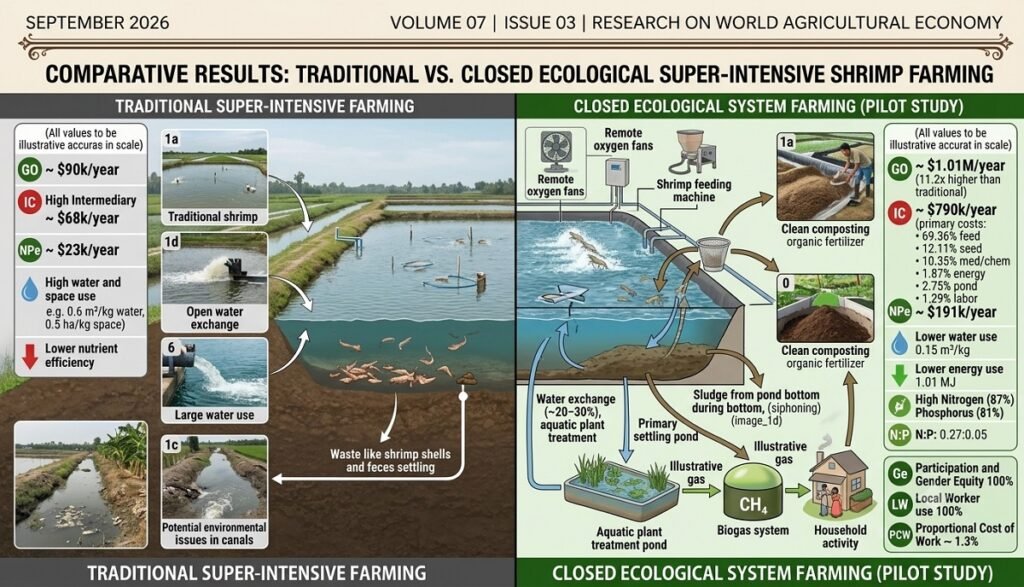
- A fully integrated closed-loop recycling circuit: Accumulated sludge is transferred to a biodigester to produce domestic biogas, solid waste and molted shells are converted into organic compost to replace chemical fertilizers, and the water resource is treated for complete recirculation.
- A dramatic boost in productivity: The gross production value of the closed-loop system exceeded that of conventional super-intensive farming by nearly 11 times, primarily due to its capacity to significantly increase stocking density per square meter.
- Greater resource efficiency per kilogram produced: Water consumption was reduced from 0.60 to 0.15 m³/kg, energy demand dropped from 4.86 to 1.01 MJ, and land use declined from 0.50 to 0.09 ha/kg; additionally, nitrogen and phosphorus utilization efficiency rose to 87% and 81%, respectively.
- Essential planning for rising operational costs: Higher stocking densities increase intermediate costs—with feed accounting for roughly 70% of total expenses—making strict water management and effective waste valorization essential to ensure profitability.
Every morning, before the sun intensifies over the shrimp ponds in Vietnam’s Bến Tre province, the farmer turns on the siphon pump to extract a dense, dark slurry from the bottom: molted shells, feces, and uneaten feed. Thousands of liters of turbid water end up discharged directly into the drainage canal across most farms in the Mekong Delta—a problem seemingly resolved, yet one that is only beginning to take its toll on the harvest’s financial bottom line.
Dissolved within that discarded effluent is a significant portion of the nitrogen and phosphorus previously purchased in commercial feed. Furthermore, it wastes a volume of water that will require replacement, treatment, and disinfection, heightening the risk that the contaminated canal will reintroduce pathogens during the next stocking cycle. While siphoning the pond bottom is the most elementary routine in super-intensive farming, a closer look reveals it as one of the most costly, imperceptible capital drains in the business.
Addressing this issue, a research team from the Institute for Environment and Resources at Vietnam National University, Ho Chi Minh City, intervened directly at the waste source. Rather than treating waste as an inevitable loss, they designed and implemented an eco-friendly closed-loop system on a commercial shrimp farm—a circuit where water, sludge, molted shells, and even gases are systematically reused within the facility. The researchers’ findings are compelling for the aquaculture sector: a gross production value roughly 11 times higher than traditional super-intensive systems, alongside lower water and energy consumption per kilogram and an effective utilization of nearly all input nitrogen.
An Expanding Sector Facing an Unresolved Environmental Challenge
Shrimp farming stands as one of the primary economic engines of the Mekong Delta. By late 2024, Vietnam reported nearly 749,777 hectares dedicated to this activity, yielding an estimated output exceeding one million metric tons. This region alone concentrated over 90% of the total surface area and 95% of national brackish-water shrimp production, providing a direct livelihood for thousands of families.
However, the super-intensive model—the yield leader—also imposes a heavy burden on ecosystems and farm financial viability. Daily operations require massive volumes of feed and water exchanges. Yet, shrimp assimilate only a fraction of the provided protein; each pond is estimated to emit roughly 50 grams of total ammonia nitrogen per kilogram of feed applied. Unabsorbed remnants settle to the bottom, mixing with metabolic waste to form a high-nutrient load that accelerates basin-wide eutrophication when discharged into effluent canals.

For years, the industry’s default response relied on treating symptoms through palliatives: increasing chemical and biological inputs alongside rapid water exchange rates. Sector data indicates intensive and semi-intensive operations utilize several metric tons of chemical and biological products per season. Despite these measures, receiving water quality continues to degrade, and health pressures remain relentless—with 6 out of 10 surveyed farms admitting to antibiotic use for disease prevention—while producers continue to treat waste as a liability to be swiftly discarded.
Here, the study proposes a radical paradigm shift. Since residual sludge concentrates valuable nutrients already paid for by the farmer, the fundamental question is not how to discard it at minimal cost, but how to recover and reintegrate that value directly back into the operation.
How the closed-loop system works, step by step
The operational logic is straightforward, though it demands execution rigor. Water drawn from the intake canal passes first through a sedimentation pond before entering the culture pond. During routine water exchanges—typically ranging from 20% to 30% of total volume—effluent is not discharged externally, but channeled to an onsite wastewater retention tank.
Sludge siphoned from the bottom is pumped into a biogas system, where anaerobic bacteria digest organic matter and convert harmful compounds into stable chemical forms. This breakdown releases usable biogas for household energy consumption on the farm, significantly reducing energy expenses.
Mantente siempre informado
Stay Informed
Únete a nuestras comunidades para recibir al instante las noticias, informes y análisis más importantes del sector acuícola.
Join our communities to get instant access to the most important news, reports, and analysis from the aquaculture industry.
Concurrently, a fine filter mesh (under 0.5 cm) retains residual biomass and molted shells before decomposition occurs. These solid wastes, along with post-digestion sediment, are moved to a bio-assisted composting area. The resulting compost replaces chemical fertilizers in local crop fields and enhances soil structure, ensuring complete waste valorization.
Finally, biodigestion effluent undergoes four-stage treatment (initial sedimentation, catalytic filtration, microbial treatment, and final clarification) before entering a phytoremediation pond with aquatic plants. These species act as a natural filter, absorbing remain
Economic Performance and Key Indicators at Harvest Conclusion
This aspect is decisive for aquaculture investors. By closing the water loop and significantly raising stocking density, the closed-loop system’s gross production value exceeded that of traditional super-intensive farming by roughly 11 times. Biological density is a critical factor: while a conventional super-intensive pond manages 80 to 150 shrimp per square meter, this model—sustained by material and energy circulation—achieves 200 to 500 individuals, and up to 1,000 per square meter in optimized scenarios.
Increasing stocking density inherently elevates the operational cost structure, a detail the study presents transparently. Feed accounted for nearly 70% of total expenses, followed by post-larvae or seed stock procurement (~12%) and health, chemical, and biological inputs (slightly over 10%). Consequently, the model is not designed to lower absolute costs, but rather to maximize productivity per unit of invested resource, provided it is paired with rigorous water management.
Regarding resource efficiency, the difference is substantial. Per kilogram of shrimp produced, water consumption dropped from 0.60 to 0.15 m³, energy demand declined from 4.86 to 1.01 MJ, and land footprint shrank from 0.50 to 0.09 hectares. Concurrently, feed nitrogen utilization efficiency increased from 70% to 87%, while phosphorus utilization rose from 70% to 81%, translating into lower environmental impact from nutrient leaching and a higher financial return on applied inputs.
The research team approaches its findings with prudence, reinforcing the study’s rigor. Evaluated across 36 family farms in Bến Tre’s Thạnh Phú district, the authors emphasize that biophysical and socioeconomic variations require further research before scaling statewide. Technical challenges remain—most notably, how salinity influences effluent nutrient recovery rates—and broad adoption will require public incentives and accessible financing to accelerate adoption beyond current technical viability.
On the social front, the model generated 100% local, gender-equitable employment. Integrating automated feeders and remote-monitored aerators reduced field labor to under 17 hours weekly per operator.
Returning to the dawn siphoning scene: that dark slurry no longer flows into the discharge canal, but into a biodigester to yield domestic biogas, compost, and phytoremediated water. Siphoning transforms from an imperceptible capital drain into a profitable resource recovery opportunity—the study’s most valuable contribution to sustainable aquaculture.
Contact
Tran Trung Kien
Institute for Environment and Resources, National University of Ho Chi Minh City
Ho Chi Minh 740500, Vietnam
Email: trungkienmt95@gmail.com
Reference (open access)
Linh, D.M., Kien, T.T., Thao, N.T.P., et al., 2026. Enhancing Sustainability in Super‑Intensive Shrimp Farming by Implementing a Closed Ecological System. Research on World Agricultural Economy. 7(3): 254–273. DOI: https://doi.org/10.36956/rwae.v7i3.2960

Editor at the digital magazine AquaHoy. He holds a degree in Aquaculture Biology from the National University of Santa (UNS) and a Master’s degree in Science and Innovation Management from the Polytechnic University of Valencia, with postgraduate diplomas in Business Innovation and Innovation Management. He possesses extensive experience in the aquaculture and fisheries sector, having led the Fisheries Innovation Unit of the National Program for Innovation in Fisheries and Aquaculture (PNIPA). He has served as a senior consultant in technology watch, an innovation project formulator and advisor, and a lecturer at UNS. He is a member of the Peruvian College of Biologists and was recognized by the World Aquaculture Society (WAS) in 2016 for his contribution to aquaculture.