Key Takeaways
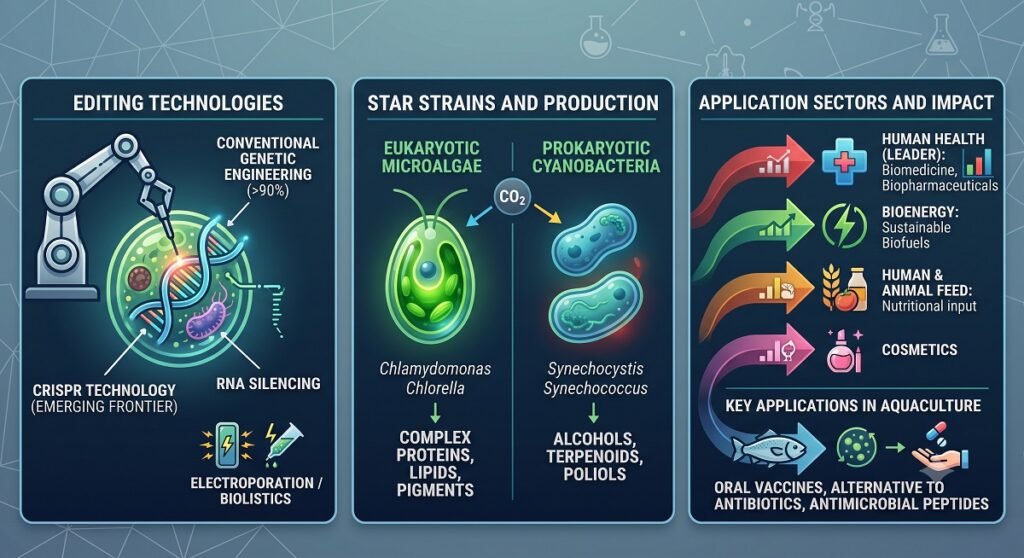
- Dominance of Gene Transfer: Over 90% of applied studies rely on conventional genetic engineering methods (heterologous DNA), while precision tools like CRISPR represent an emerging yet rapidly expanding frontier.
- Functional Cellular Duality: Engineered eukaryotic microalgae excel at synthesizing complex proteins, lipids, and pigments; conversely, prokaryotic cyanobacteria are predominantly leveraged for producing alcohols, polyols, and terpenoids.
- Model Strain Dominance: Three genera account for the vast majority of successful developments: the green eukaryotic alga Chlamydomonas and the prokaryotic cyanobacteria Synechocystis and Synechococcus.
- Impact on Health and Aquaculture: The biopharmaceutical sector leads potential applications, closely followed by bioenergy, human nutrition, and animal feed, where these organisms serve as platforms for producing antimicrobial peptides and oral vaccines.
The growing global demand for sustainable solutions has positioned microalgae at the center of the circular bioeconomy. These photosynthetic microorganisms possess the natural ability to capture atmospheric CO₂ and convert sunlight into high-value biocompounds. However, to achieve industrial-scale yields, research has increasingly focused on genetic engineering and new genomic techniques (NGTs).
In this context, a systematic review conducted by Agroscope researchers and published in Reviews in Aquaculture examines nearly four decades of advances in the genetic manipulation of microalgae and cyanobacteria, detailing key strains, optimized traits, and commercial projections for today’s market.
Evolution of Genomic Tools and Gene Transfer Methods
A recent bibliometric analysis reveals that genetic improvement in industrial microalgae began in the late 1980s and experienced exponential growth starting in 2009. Although direct DNA transfer has been the dominant strategy, RNA silencing techniques emerged in 2013 with modest impact; meanwhile, CRISPR-Cas gene editing broke ground in 2016 and has now reached its peak adoption rate due to its design simplicity, low cost, and multiplex editing capabilities.
Regarding the introduction of genetic material into the cell, physical methods substantially outperform biological ones:
- Electroporation and Biolistics (Particle Bombardment): These are the most widely used techniques due to their high efficiency in penetrating rigid cell walls without requiring protoplasts.
- Glass Bead Agitation: Highly popular in laboratory settings for its low cost, though it remains limited in thick-walled strains unless specific wall-deficient mutants are used.
- Conjugation and Natural Transformation: Biological pathways applied primarily to prokaryotic cyanobacteria.
In terms of distribution, 71.8% of the evaluated studies introduced heterologous genes (from other species), 22.1% modified endogenous genes, and 6% combined both approaches to optimize complex metabolic pathways.
Star Strains: Eukaryotes vs. Prokaryotes

The systematic mapping identified over 60 engineered strains belonging to 10 major genera, with eukaryotic microalgae accounting for 54.6% and prokaryotic cyanobacteria making up 45.4%.
Eukaryotic Microalgae
The green alga Chlamydomonas reinhardtii decisively leads eukaryotic research, representing 26.6% of all studies. Its fully sequenced genome and chloroplast (plastome) molecular tools make it an ideal photosynthetic chassis for expressing recombinant proteins and therapeutic peptides, followed in commercial relevance by oleaginous and industrial genera such as Chlorella (5.8%), the diatom Phaeodactylum (5.5%), Schizochytrium (4.1%), Nannochloropsis (3.4%), and Dunaliella (2.4%).
Prokaryotic Cyanobacteria
In the prokaryotic realm, the genera Synechocystis (20.7%) and Synechococcus (18.5%) drive the vast majority of research, alongside Anabaena (4.5%). Their flexible metabolism allows fixed carbon to be channeled directly into the production of volatile compounds and chemical precursors.
Enhanced Traits and Industrial Application Sectors
Researchers cataloged 581 instances of optimized metabolic traits, led by protein expression (25.1%), lipid accumulation (19.1%), and pigment production (10.8%), followed by alcohols and polyols (8.8%), terpenoids and waxes (8.4%), and esters and acids (6.5%). In terms of downstream economic sectors, human health and biomedicine rank highest (23.6%), followed by bioenergy (20.3%), food and beverages (15.5%), agriculture and animal nutrition (10.7%), and cosmetics (8.3%).
Mantente siempre informado
Stay Informed
Únete a nuestras comunidades para recibir al instante las noticias, informes y análisis más importantes del sector acuícola.
Join our communities to get instant access to the most important news, reports, and analysis from the aquaculture industry.
Strategic Opportunities for Aquaculture
In animal production and aquaculture, engineered microalgae are projected not merely as basic protein inputs, but as targeted delivery systems and high-value functional additives:
- Oral Vaccines and Biocontrol: Genetic transformation of microalgae such as Chlamydomonas, Schizochytrium, or Dunaliella to express viral antigens (e.g., VP28 against white spot syndrome virus in shrimp or viral hemorrhagic septicemia virus glycoproteins in fish).
- Antibiotic Alternatives: Production of antimicrobial peptides (e.g., mytilin A, lactoferricin) that combat pathogenic bacteria such as Vibrio or Aeromonas within the digestive tract of fish and mollusks, mitigating antimicrobial resistance.
- Digestive Enzymes: Heterologous expression of phytases to optimize phosphorus solubilization and absorption in monogastric species.
- Pigmentation and Nutrition: Optimized biosynthesis of high-value carotenoids—such as astaxanthin, canthaxanthin, and zeaxanthin—alongside continuous secretion of omega-3 polyunsaturated fatty acids (EPA and DHA).
Conclusion
Genomic manipulation of microalgae has evolved from plant physiology proof-of-concept studies into a mature platform for biomanufacturing high-value molecules. Although large-scale industrial adoption faces regulatory hurdles and high photobioreactor scaling costs, the consolidation of precision tools like CRISPR and chloroplast synthetic biology will accelerate the availability of optimized strains. In aquaculture, these advanced microalgae offer a sustainable path to replace chemical medications, enhance the immune systems of farmed species, and ensure global food security.
The research was funded by the European Union’s Horizon Europe research and innovation program (Grant Agreement No. 101061015) under the GeneBEcon project.
Contact
Irene Gallego
Research Division Agroecology and Environment, Agroscope
Zurich, Switzerland
Email: irene.gallego@agroscope.admin.ch
Reference (open access)
Gallego I., M. Meissle, and J. Romeis, “Genome Manipulation in Microalgae: A Systematic Map on Improved Traits, Strains, and Their Commercial Applications,” Reviews in Aquaculture 18, no. 4 (2026): e70178, https://doi.org/10.1111/raq.70178.

Editor at the digital magazine AquaHoy. He holds a degree in Aquaculture Biology from the National University of Santa (UNS) and a Master’s degree in Science and Innovation Management from the Polytechnic University of Valencia, with postgraduate diplomas in Business Innovation and Innovation Management. He possesses extensive experience in the aquaculture and fisheries sector, having led the Fisheries Innovation Unit of the National Program for Innovation in Fisheries and Aquaculture (PNIPA). He has served as a senior consultant in technology watch, an innovation project formulator and advisor, and a lecturer at UNS. He is a member of the Peruvian College of Biologists and was recognized by the World Aquaculture Society (WAS) in 2016 for his contribution to aquaculture.