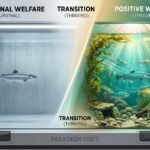
Aquaculture stands as the world’s fastest-growing food production sector. However, as production intensifies, fish welfare has evolved from a peripheral concern into an essential pillar of industrial sustainability. Cultivation environments are often monotonous and differ drastically from natural habitats, which can induce chronic stress and abnormal behaviors. Environmental enrichment emerges as a strategic solution to bridge this gap, promoting natural behaviors and enhancing the physical health of the fish.
Researchers from Macquarie University, in collaboration with institutions from Australia, Belgium, and the USA, have published a critical roadmap in Reviews in Aquaculture for integrating environmental enrichment into commercial production systems. The objective is ambitious: to demonstrate that a stimulated fish is not only healthier but also more profitable.
Key Conclusions for the Sector
- Paradigm Shift: Animal welfare is no longer an ethical ‘add-on,’ but a cornerstone of economic sustainability that mitigates chronic stress and enhances disease resistance.
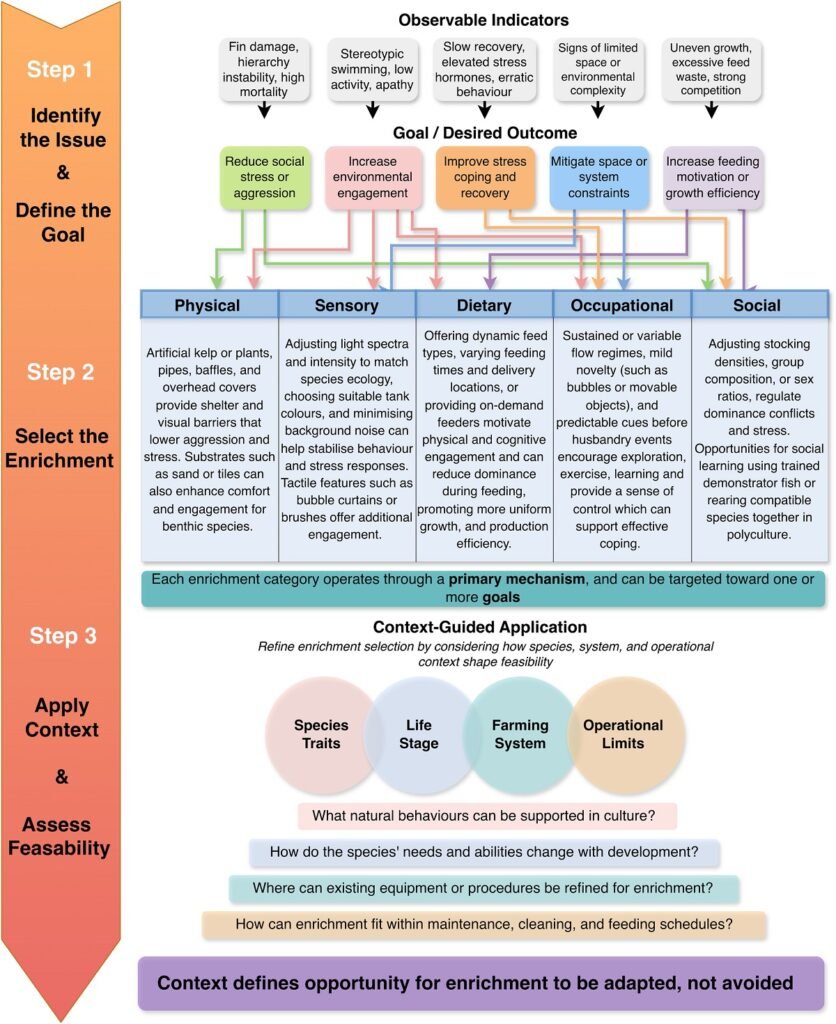
- Five Dimensions of Success: Strategies are categorized into physical, sensory, dietary, occupational, and social frameworks, allowing for species-specific tailored interventions.
- Production Benefits: Implementing physical structures and exercise regimens (occupational enrichment) yields superior growth rates and improved feed conversion ratios.
- Implementation Framework: A three-step model is proposed to align welfare objectives with the operational viability of production facilities.
What is environmental enrichment, and why is it vital?
Environmental enrichment consists of providing biologically relevant stimuli that satisfy the physical, psychological, and behavioral needs of animals. While it is an established practice in terrestrial livestock farming, its development in aquaculture has been slower due to the vast diversity of cultured species (over 300) and a lack of fundamental behavioral data.
The primary objective is to mitigate the mismatch between the captive environment and the complexity of nature, enabling fish to have positive experiences and ‘agency’ over their surroundings.
The Five Dimensions of On-Farm Enrichment
Physical Enrichment: Complexity and Shelter
This is the most common form and involves adding structures such as artificial plants, PVC pipes, substrates (sand or rocks), or suspended elements.
- Benefits: Shelters reduce aggression in territorial species, such as Atlantic salmon or rainbow trout, by allowing subordinate individuals to avoid dominant encounters.
- Practical Results: The use of smooth pebble substrates has been shown to reduce fin damage in trout by redirecting fish activity toward the bottom rather than toward conspecifics.
Sensory Enrichment: Light, Sound, and Touch

Modifies visual, auditory, or olfactory stimuli to prevent monotony.
- Vision: Tank color directly influences stress. While blue tanks may stress certain flatfish species, they improve growth in European catfish (Silurus glanis).
- Hearing: Machinery noise in recirculating aquaculture systems (RAS) can be stressful. However, controlled exposure to music (such as Mozart) has been linked to elevated cerebral serotonin levels and a calming effect in trout.
- Touch: The use of ‘bubble curtains’ provides tactile and cognitive stimulation, reducing abnormal behaviors and encouraging exploration.
Dietary Enrichment: More Than Nutrition
Focuses on how food is delivered to encourage natural foraging.
- Demand Feeders: These allow the fish to initiate feeding, granting them control over their intake.
- Mixed Strategies: In tilapia farming, combining floating and sinking pellets reduces competition and improves survival by distributing fish across different feeding zones.
Occupational Enrichment: Challenges and Exercise
Involves challenges that stimulate physical effort or problem-solving.
- Induced Exercise: Manipulating water flow to induce sustained swimming improves growth performance, fillet texture, and disease resistance.
- Predictability: Training fish to associate a signal (light or sound) with feeding helps them prepare physiologically, reducing anticipatory anxiety.
Refers to managing interactions between individuals of the same or different species.
Mantente siempre informado
Stay Informed
Únete a nuestras comunidades para recibir al instante las noticias, informes y análisis más importantes del sector acuícola.
Join our communities to get instant access to the most important news, reports, and analysis from the aquaculture industry.
- Optimal Density: ‘Less’ is not always ‘better.’ In some species, very low densities increase territoriality and aggression, whereas adequate density stabilizes the social hierarchy.
- Polyculture: Rearing complementary species can increase social complexity and improve system efficiency, as seen in carp systems or the co-culture of European sea bass and gilthead seabream.
A Practical Approach to Implementation
To prevent enrichment from being perceived as an operational burden, Spiliopoulos and his team propose a three-step process:
- Identify the Problem and Define the Goal: Is there fin damage? Uneven growth? The objective is defined (e.g., ‘Reducing aggression’).
- Select the Mechanism: Choose the enrichment category among the five that best addresses the issue.
- Apply the Context Filter: Evaluate if the strategy is viable based on the species, its life stage, the farming system (tanks vs. cages), and operational constraints (cleaning, costs).
General Conclusion
Environmental enrichment has demonstrated considerable potential to enhance the welfare of farmed fish by mitigating common challenges and expanding opportunities for positive experiences. When appropriately designed, these strategies offer complementary production benefits, transforming welfare management from reactive problem-solving into proactive system design for the future.
The research was commissioned by Eurogroup for Animals (Brussels, Belgium) and supported by the Australian Government Research Training Program Scholarship.
Reference (open access)
Spiliopoulos, O., Kadri, S., Sinclair, M., Vanderzwalmen, M., & Brown, C. (2026). Environmental Enrichment in Aquaculture: Linking Welfare Goals to Practical Applications. Reviews in Aquaculture, 18(2), e70142. https://doi.org/10.1111/raq.70142

Editor at the digital magazine AquaHoy. He holds a degree in Aquaculture Biology from the National University of Santa (UNS) and a Master’s degree in Science and Innovation Management from the Polytechnic University of Valencia, with postgraduate diplomas in Business Innovation and Innovation Management. He possesses extensive experience in the aquaculture and fisheries sector, having led the Fisheries Innovation Unit of the National Program for Innovation in Fisheries and Aquaculture (PNIPA). He has served as a senior consultant in technology watch, an innovation project formulator and advisor, and a lecturer at UNS. He is a member of the Peruvian College of Biologists and was recognized by the World Aquaculture Society (WAS) in 2016 for his contribution to aquaculture.