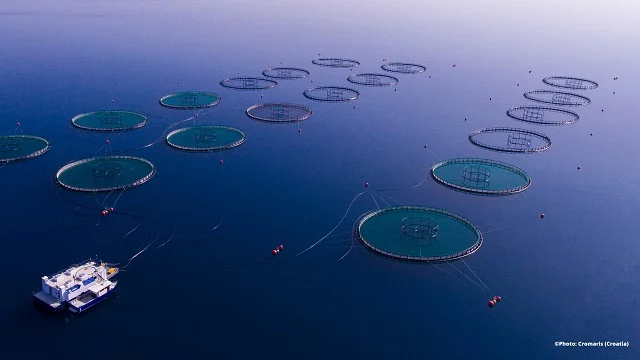
Aquaculture already accounts for over 57% of aquatic animal products for human consumption. Nevertheless, this success comes at a price: rapid intensification has increased stocking densities on farms, making infectious diseases the primary cause of economic loss within the sector.
In many regions, the routine response has been the use of antibiotics, which drives Antimicrobial Resistance (AMR). This phenomenon is not merely a veterinary issue; it is a ‘One Health‘ threat, as resistant bacteria can circulate between aquatic ecosystems and the human food chain.
The research was conducted by experts from leading institutions such as WorldFish (Malaysia), the French Agency for Food, Environmental and Occupational Health & Safety (ANSES) (France), and the Animal and Veterinary Service, National Parks Board (Singapore). The article was published in the scientific journal Scientific and Technical Review of the World Organisation for Animal Health (WOAH).
Key Highlights
- Growth and Risk: Aquaculture is the fastest-growing food production sector; however, intensification escalates disease outbreaks and the reliance on antibiotics.
- Environmental Reservoir: The aquatic environment acts as both a vector and a reservoir for resistance genes, facilitating their transfer between animals, humans, and the surroundings.
- Success of Vaccination: In intensive systems, such as Atlantic salmon farming, vaccination has reduced antibiotic usage by over 99% since its historical peak.
- Climatic Impact: Rising water temperatures not only stress species but also accelerate bacterial proliferation and the horizontal transfer of resistance genes.
The Aquatic Ecosystem as a Global AMR Reservoir
Unlike terrestrial livestock production, aquaculture occurs in an open and highly interconnected medium: water. This environment functions simultaneously as a “sink” and a “vector” for resistant bacteria and their genes.
- Environmental Vulnerability: Antibiotic residues and pollutants from agriculture and wastewater enrich the aquatic “resistome.”
- Transmission Routes: AMR spreads not only through food consumption but also via water exposure during recreational and occupational activities, as well as contact with wildlife.
- Interconnection: Metagenomic studies have revealed an exchange of resistance genes between aquaculture bacteria and human clinical isolates, suggesting active cross-sectoral transmission.
The Challenge of Mobile Genetic Elements
Resistance in water spreads like a wildfire due to Horizontal Gene Transfer (HGT). Conjugative plasmids, such as the IncA/C found in Aeromonas salmonicida, are capable of encoding multi-drug resistance to florfenicol, tetracyclines, and beta-lactams. These genetic elements are identical in bacteria affecting humans, terrestrial animals, and aquatic pathogens, evidencing a constant flow of genetic resistance information.
The Surveillance Challenge: Methodologies and Data
One of the greatest obstacles to combating AMR is the lack of consistent and comparable data. Although global antimicrobial consumption in aquaculture was estimated at 10,259 tons in 2017, real figures remain uncertain due to the scarcity of primary data in key regions such as Asia and Africa.
Advances in Diagnosis and Monitoring
The study emphasizes the need to harmonize surveillance protocols following guidelines from WOAH, FAO, and CLSI (Clinical and Laboratory Standards Institute).
- AST (Susceptibility Testing): The use of standardized methods, such as broth microdilution, to determine the Minimum Inhibitory Concentration (MIC), is recommended.
- Genomics: Whole Genome Sequencing (WGS) allows for tracking transmission patterns and mobile genetic elements with high resolution.
- Data Platforms: Tools like the FAO’s InFARM system and the WHO’s GLASS are facilitating the integration of AMR data across countries to generate multisectoral analyses.
Mitigation Strategies: The Success of Vaccination
Reducing antibiotic use is not a utopia; the case of Atlantic salmon in Norway serves as the gold standard.
- 99% Reduction: Through the mass adoption of injectable vaccines, Norway reduced antibacterial use from 48 tons in 1987 to less than 1 ton annually in 2022, despite salmon production increasing from 200,000 to 1.5 million tons in the same period.
- Global South Barriers: In low- and middle-income countries, vaccine adoption is limited by a lack of cold chain infrastructure, high costs, and the absence of products tailored to local species.
Alternatives for Crustaceans and Mollusks
Since crustaceans lack an adaptive immune system for traditional vaccination, other approaches are required:
Mantente siempre informado
Stay Informed
Únete a nuestras comunidades para recibir al instante las noticias, informes y análisis más importantes del sector acuícola.
Join our communities to get instant access to the most important news, reports, and analysis from the aquaculture industry.
- Probiotics: Non-pathogenic microorganisms that maintain intestinal microbial balance and exclude pathogens through competition.
- Phage Therapy: The use of bacteriophages that specifically target bacterial pathogens.
- Phytochemicals: Plant extracts with immunostimulant and antimicrobial properties.
Climate Change: A Risk Multiplier
Global warming is drastically altering disease dynamics in aquaculture.
- Bacterial Proliferation: Warmer waters favor the multiplication of pathogens such as Vibrio, Aeromonas, and Lactococcus.
- Host Stress: Reduced dissolved oxygen levels due to heat stress fish, weakening their immune systems and necessitating more frequent antibiotic use.
- Gene Transfer: Elevated temperatures have been observed to facilitate the transfer of resistance genes, increasing the prevalence of multi-drug resistant strains of Vibrio parahaemolyticus in shrimp farms.
The Path Toward “One Health”
To secure the future of aquaculture, the article concludes that adopting a One Health approach is imperative, recognizing the interdependence between human, animal, and environmental health.
- Biosecurity: This is the first line of defense. Measures such as using certified disease-free seeds and area-based management systems are fundamental.
- Governance: National Action Plans on AMR must explicitly include aquaculture, an element currently omitted by 37% of countries.
- Transparency: Only 39 out of 152 countries reporting data to WOAH provide public quantitative information on antimicrobial use.
Aquaculture has the potential to feed the world sustainably, but only if it succeeds in decoupling its growth from antimicrobial dependence.
Contact
D.W. Verner-Jeffreys
WorldFish,
Jalan Batu Maung, Batu Maung, 11960 Bayan Lepas
Penang, Malaysia
Email:
Reference (open access)
Verner-Jeffreys DW, Baron S, Ching B, Chang SF. Aquaculture: sector-specific challenges and advances. Rev. Sci. Tech. 2025;44:3686. https://doi.org/10.20506/rst.44.3686

Editor at the digital magazine AquaHoy. He holds a degree in Aquaculture Biology from the National University of Santa (UNS) and a Master’s degree in Science and Innovation Management from the Polytechnic University of Valencia, with postgraduate diplomas in Business Innovation and Innovation Management. He possesses extensive experience in the aquaculture and fisheries sector, having led the Fisheries Innovation Unit of the National Program for Innovation in Fisheries and Aquaculture (PNIPA). He has served as a senior consultant in technology watch, an innovation project formulator and advisor, and a lecturer at UNS. He is a member of the Peruvian College of Biologists and was recognized by the World Aquaculture Society (WAS) in 2016 for his contribution to aquaculture.