The shrimp industry is a fundamental pillar for global food security and the livelihoods of coastal communities. However, its accelerated growth has brought a shadow of concern regarding the degradation of aquatic ecosystems and social well-being. Until now, most studies have been limited to analyzing a single factor: either economic profitability or ecological impact.
A new study published in Scientific Reports by researchers from the Ocean University of China and other leading institutions has broken this paradigm. Through a systematic meta-analysis of 136 studies published between 2002 and 2024, the team led by Yuzhen Wang has succeeded in quantifying, for the first time, the real differences in economic, ecological, and social benefits among the primary farming models.
Key Points
- Sustainability Leader: The PIMTA (Pond Integrated Multi-Trophic Aquaculture) model offers the best comprehensive benefits by combining compatible species.
- Industrial Performance: In-pond integrated systems with recirculation (ISIC_Recirculation) excel in ecology but face high energy costs.
- The Risk of Monoculture: The traditional pond monoculture (PMC) model is the least efficient and provides the lowest comprehensive long-term benefits.
- Critical Variables: The survival rate (SR) of shrimp is the determining factor; above 68.37%, technical differences between models become less critical.
Models Under the Microscope: From Traditional Ponds to Super-Intensity
To understand the findings, it is vital to differentiate between the evaluated technologies:
PIMTA: The Circular Ecosystem
The Pond Integrated Multi-Trophic Aquaculture (PIMTA) model is based on biological hierarchy. Here, shrimp coexist with crabs, fish, mollusks, and algae. Waste from one species becomes nutrients for another, creating a nearly closed system that minimizes environmental impact and diversifies producer income.
ISIC: The High-Density Factory
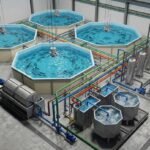
The Indoor Super Intensive Culture (ISIC) model represents the technological vanguard, with densities of up to 1,200 shrimp per square meter. It is subdivided into three main types:
- Exchange: The traditional industrial system that relies on renewing large volumes of water.
- Recirculation (ISIRC): Constantly purifies and recycles water, drastically reducing pollutant discharge.
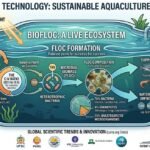
- Biofloc (ISIBC): Utilizes microbial communities to process nitrogenous waste and convert it into protein usable by the shrimp itself.
PMC: Traditional Monoculture
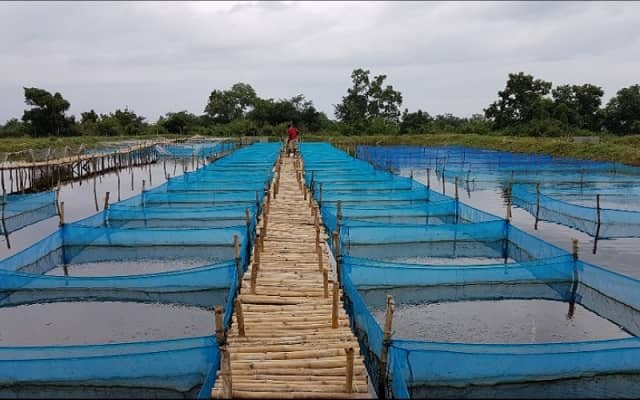
Pond Monoculture (PMC) is the most common system, especially in China, due to its low initial costs; however, it is highly vulnerable to environmental changes and has a very limited population density.
Who Wins the Sustainability Race?
The Triumph of the PIMTA Model
The research concludes decisively: the PIMTA model exhibits the best comprehensive benefits. Its carbon sequestration capacity (especially through bivalve and algae cultivation) and its resilience to economic risks position it as the most robust option for the industry’s green development. In economic terms, while it does not produce the massive densities of ISIC, its low operating cost balances the scales.
The Recirculation System Balance
The recirculation model (ISIC_Recirculation) ranked second. It is the ‘ecological champion’ regarding water quality, achieving significant reductions in nitrite emissions and suspended solids. However, its Achilles’ heel is high electricity consumption, which raises its carbon footprint and reduces its overall benefit compared to PIMTA.
Challenges for Biofloc and Water Exchange
Despite its reputation, Biofloc technology showed relatively low comprehensive benefits due to operational complexity, high energy demand, and pollutant accumulation from constant carbon source addition. Meanwhile, the Water Exchange model (ISIC_Exchange), though excelling in social benefits through high production capacity and job creation, fails in the ecological dimension due to the high volumes of effluents discharged into the environment.
Stay Always Informed
Join our communities to instantly receive the most important news, reports, and analysis from the aquaculture industry.
The Science Behind the Data
The research team utilized a mixed-effects meta-analysis model to integrate qualitative and quantitative indicators. Critical variables analyzed included:
- Ecological: Ammoniacal nitrogen, microplastics (MPs), Shannon index (microbial diversity), and $CO_2$ emissions.
- Economic: Land rent, feed costs (bait), electricity, and profit margins.
- Social: Protein supply, job creation, and living conditions.
A key methodological finding was the relationship with the Survival Rate (SR). Through simulations, scientists determined that when the SR exceeds 68.37%, the choice of a specific technology becomes less relevant to business success. This suggests that for producers, improving health management is the first step toward sustainability, regardless of the model chosen.
Global Impact and Future of the Industry
This study provides a vital scientific foundation for policymakers and producers seeking to optimize the aquaculture industry. The transition toward PIMTA systems not only responds to an ethical need but is also a smart financial decision given its risk resistance and lower costs.
For industrial systems (ISIC), the path is clear: they must integrate renewable energy technologies to mitigate their carbon footprint and adopt advanced filtration systems to close the nutrient cycle. The presence of microplastics in culture systems also emerged as a critical factor affecting both shrimp health and final product quality for the consumer.
Limitations to Consider
The authors warn that due to high data heterogeneity (from various regions and climates), results should be interpreted as general trends rather than universal rules applicable to every individual farm. Further regional research is required to adapt these conclusions to specific local contexts.
Reference (open access)
Wang, Y., Chen, Z., Wang, J. et al. Analysis of sustainability differences among various shrimp farming models: a systematic review and meta analysis. Sci Rep 16, 4061 (2026). https://doi.org/10.1038/s41598-025-34072-6

Editor at the digital magazine AquaHoy. He holds a degree in Aquaculture Biology from the National University of Santa (UNS) and a Master’s degree in Science and Innovation Management from the Polytechnic University of Valencia, with postgraduate diplomas in Business Innovation and Innovation Management. He possesses extensive experience in the aquaculture and fisheries sector, having led the Fisheries Innovation Unit of the National Program for Innovation in Fisheries and Aquaculture (PNIPA). He has served as a senior consultant in technology watch, an innovation project formulator and advisor, and a lecturer at UNS. He is a member of the Peruvian College of Biologists and was recognized by the World Aquaculture Society (WAS) in 2016 for his contribution to aquaculture.