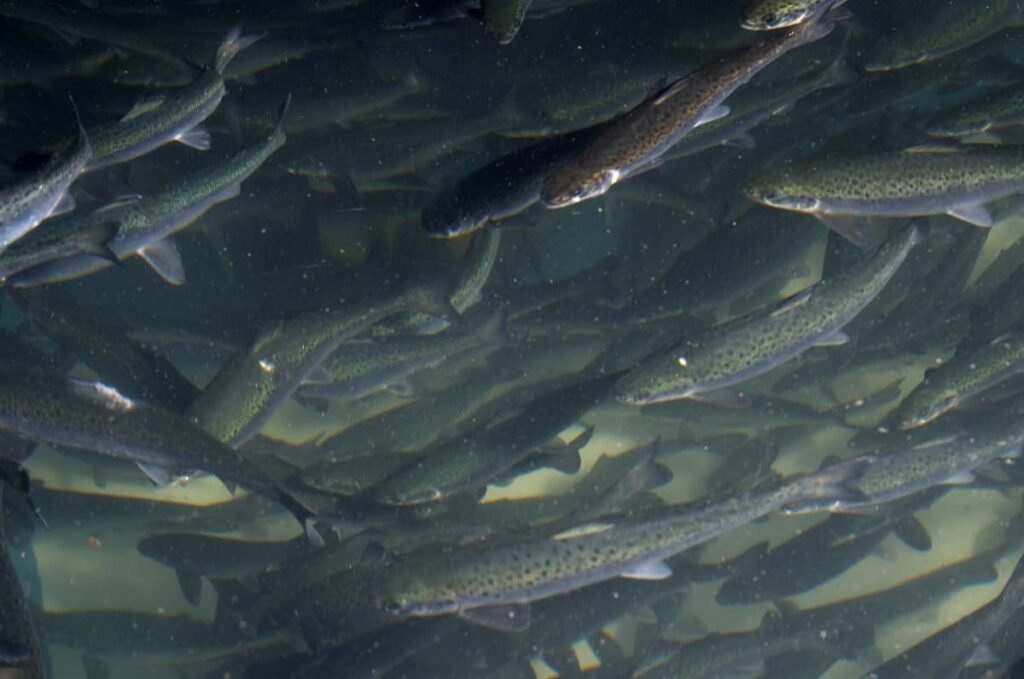
‘Crowding’ (or trenging) is one of the most critical moments in salmon aquaculture. It is a necessary operation for procedures such as transfer, vaccination, sea lice counting, or harvesting, yet it is inherently stressful for the fish. Poor management of this process can compromise animal welfare, increase mortality, and reduce final product quality. The challenge has always been how to measure and manage this risk objectively and in a standardized manner.
To address this need, the CrowdMonitor project, funded by the Norwegian Seafood Research Fund (FHF), has published two innovative manuals. These documents, developed by renowned institutions such as Nofima and the Institute of Marine Research (IMR) in collaboration with commercial partners like Cermaq and Grieg Seafood ASA, offer an updated “toolbox” for measuring and monitoring Atlantic salmon welfare during crowding in net pens and tanks.
Key conclusions
- The FHF-funded CrowdMonitor project has created two manuals (for net pens and tanks) featuring updated tools to measure salmon welfare during crowding.
- It introduces a three-stage framework (before, during, after) for applying Operational Welfare Indicators (OWIs) and Laboratory-Based Welfare Indicators (LABWIs).
- It proposes new 5-level crowding intensity scales, ranging from “minimal risk” (Level 1) to “high/unacceptable risk” (Level 5), where immediate action is required.
- For net pens, it offers an ROV (Remotely Operated Vehicle) based scale in addition to surface observation, recognizing that surface activity may not reflect underwater risk.
- The manuals emphasize the importance of a prior risk assessment, considering gill, heart, and skin health, as well as water quality.
A unified framework: Before, during, and after
A common mistake is to think about welfare only during the crowding event. The CrowdMonitor manuals propose a holistic approach, dividing the assessment into three critical phases: before, during, and after the operation.
For each phase, Operational Welfare Indicators (OWIs)—which are farm-staff friendly and can be measured in real-time (e.g., behavior, water quality)—are identified, along with Laboratory-Based Welfare Indicators (LABWIs), which are more complex and require subsequent analysis (e.g., cortisol, histology).
This three-stage framework allows staff to:
- Assess risk (Before): Are the fish healthy enough to withstand the stress?
- Monitor and react (During): Are we reaching unacceptable risk levels?
- Learn and audit (After): What impact did the operation have, and how can we improve?
The new 5-level scale for crowding intensity
The manuals’ most significant advancement is an updated crowding intensity risk scale. Unlike previous scales, this new version is designed for integration into Standard Operating Procedures (SOPs) and is based on clear observational metrics.
The scale classifies the operation into five risk levels:
- Level 1 (Minimal Risk): Acclimatization period. Crowding may proceed as planned.
- Level 2 (Low Risk): Crowding may proceed as planned.
- Level 3 (Increasing Risk): May proceed, but with heightened diligence. Staff must be ready to apply corrective actions if necessary.
- Level 4 (High Risk): Staff must consider intervening, pausing, or releasing the crowd.
- Level 5 (Unacceptable Risk): Clearly unacceptable. A corrective action must be implemented immediately, or the crowd must be released.
Crucially, observing just one negative metric is sufficient to define the crowd’s intensity level.
Stay Always Informed
Join our communities to instantly receive the most important news, reports, and analysis from the aquaculture industry.
Application in net pens: Beyond the surface
The manual for net pens (Report 30/2025) addresses the specific risks of the open marine environment, such as bad weather, waves, strong currents, biofouling on the nets, and the formation of “pockets” or folds in the net where fish can become trapped.
The surface observation scale
For monitoring from the surface, staff must watch for key indicators that define the 5 risk levels. Metrics such as “Burrowing” (fish attempting to dive down), “Gasping” (fish gasping at the surface), “Lethargy,” or the appearance of “White sides” are warning signs. A Level 5, for example, is defined by “Extensive burrowing observed” or “Frequent instances of fish gasping.”
The new ROV scale
One of the major limitations of monitoring in net pens is that surface activity does not always reflect what is happening at the bottom of the crowd. Fish may avoid the surface due to weather or light, and the greatest risks may be underwater. Therefore, the CrowdMonitor project introduces a preliminary risk scale for ROV (Remotely Operated Vehicle) operators (Table 7 of the report). This tool, developed with industry personnel, allows for the assessment of underwater risk by observing metrics such as:
- Net Proximity: Are the fish pressed against the net?
- Collisions: Are they frequently colliding with each other?
- Queueing: Are the fish “stalled” and unable to advance?
- Mobility: Do they have room to maneuver?
- Occlusion: Is it impossible to see the surface through the school?
A Level 5 underwater is defined, for example, when fish are pressed against the net with no opportunity to move, or are trapped in net folds.
Application in tanks: A controlled environment with its own risks
The manual for tanks (Report 31/2025) focuses on the transfer of smolts or post-smolts from hatchery facilities. Although this is a controlled environment, the risks are different. The crowding method here usually involves draining the water to reduce the volume.
Specific risks in tanks include:
- Tank Hazards: Sharp edges or infrastructure where fish can become trapped.
- Water Quality: Greater vulnerability to gas supersaturation (e.g., from emergency oxygenation) or pH changes.
- Management: The water level may drop too quickly, or there may be a lack of synchronization between draining and fish pumping.
The observation scale for tanks is similar to the surface scale for net pens but adapts the metrics to the environment. For example, instead of “net contact,” the metric is “Contact with tank and equipment.” A Level 5 is defined if “Fish are pressed against the tank… with no opportunity to move.”
Key recommendations for improved management
Both manuals conclude with practical recommendations (Box 6 in the reports). Effective crowding management requires diligent planning and careful execution:
- Assess prior risk: It is essential to review fish health before starting. Poor gill, heart, or skin health dramatically increases the operation’s risk.
- Monitor water quality: Especially dissolved oxygen (DO) levels. The manual suggests maintaining high DO (some authors suggest 80-100%) and using supplementary oxygenation if necessary.
- Monitor behavior: Use the observation scales (both at the surface and underwater with an ROV if possible) to detect early signs of stress.
- Avoid rapid actions: Conduct the crowding methodically and incrementally. Rapid actions can trigger panic, “burrowing,” or “piling,” which increases oxygen demand and the risk of injury.
- Balance duration and intensity: Although a crowding event should be as short as possible, rushing should not compromise the calm and control of the operation. Sometimes, relaxing the crowd momentarily to allow the fish to rest is the best option if there are delays.
In summary, the CrowdMonitor manuals are not a guarantee of results but rather a fundamental support tool for personnel. They provide, for the first time, a standardized framework based on the latest science to make informed decisions, helping the industry balance operational efficiency with animal welfare responsibility.
Contact
Chris Noble
Nofima
References (open access)
Noble, C., Stien, L. H., Alsos, V. C., Alvestad, R., Espmark, A. M., Izquierdo Gomez, D., Johannessen, S. N., Johansson, G. S., Johny, A., Kolarevic, J., Lazado, C. C., Madaro, A., Nilsson, J., Ottem, K. F., Seljestokken, B., Slettjord, T., Timmerhaus, G., Tschirren, L., Ytteborg, E., Zena, L., & Asli, M. (2025). The CrowdMonitor handbook for commercial net pens v0.1: an updated welfare indicator toolbox and crowding intensity scales for measuring and monitoring Atlantic salmon welfare during crowding operations (Report 30/2025). Nofima.
Noble, C., Stien, L. H., Alsos, V. C., Alvestad, R., Espmark, A. M., Izquierdo Gomez, D., Johannessen, S. N., Johansson, G. S., Johny, A., Kolarevic, J., Lazado, C. C., Madaro, A., Nilsson, J., Ottem, K. F., Seljestokken, B., Slettjord, T., Timmerhaus, G., Tschirren, L., Ytteborg, E., Zena, L., & Asli, M. (2025). The CrowdMonitor handbook for commercial tanks v0.1: an updated welfare indicator toolbox and crowding intensity scale for measuring and monitoring Atlantic salmon welfare during crowding operations (Report 31/2025). Nofima.

Editor at the digital magazine AquaHoy. He holds a degree in Aquaculture Biology from the National University of Santa (UNS) and a Master’s degree in Science and Innovation Management from the Polytechnic University of Valencia, with postgraduate diplomas in Business Innovation and Innovation Management. He possesses extensive experience in the aquaculture and fisheries sector, having led the Fisheries Innovation Unit of the National Program for Innovation in Fisheries and Aquaculture (PNIPA). He has served as a senior consultant in technology watch, an innovation project formulator and advisor, and a lecturer at UNS. He is a member of the Peruvian College of Biologists and was recognized by the World Aquaculture Society (WAS) in 2016 for his contribution to aquaculture.