As aquaculture intensifies to meet the surging global demand for protein, producers face rising biological variability, complex feeding environments, and mounting pressure to deliver consistent performance.
Simultaneously, AI-enabled feeding systems, advanced imaging tools, and precision nutrition platforms are maturing rapidly. These innovations are reshaping how farms monitor livestock and approach daily decision-making. Consequently, the sector is steadily transitioning from manual observation and intuition toward structured, predictive, and biologically informed farming methodologies.
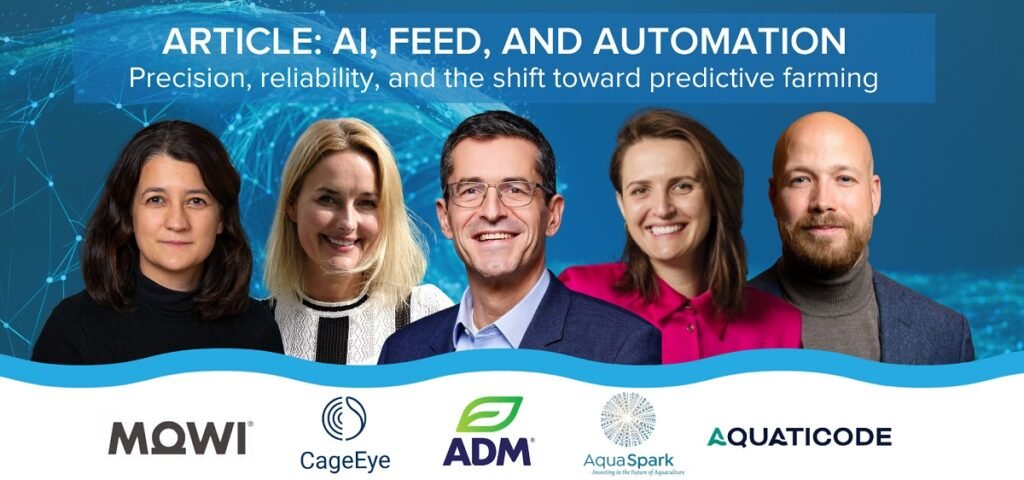
Ahead of the Blue Food Innovation Summit 2026 this May, industry leaders from Aquaticode, CageEye, Aqua-Spark, ADM, and Mowi shared insights highlighting AI’s immense potential—while addressing the operational realities required for these technologies to scale successfully.
Where AI and Precision Tools Drive Impact Today
A clear pattern has emerged among industry experts: AI is already empowering producers to make earlier, more accurate biological decisions, particularly regarding feeding and early-stage cohort optimization.
Stian Rognlid, CEO and Co-Founder at Aquaticode, notes that AI is unlocking unprecedented insights:
“AI phenotyping is emerging as a new category… When early biological information becomes actionable, producers can build more predictable cohorts and improve downstream performance.”
Rognlid explains that while aquaculture has historically optimized equipment and environment, it lacked visibility into early biological variation. AI-driven phenotyping now allows producers to identify traits linked to survival and growth much sooner, stabilizing production.
Feeding automation is also seeing rapid adoption. Ragnhild Dragøy, CEO at CageEye, observes that operators often juggle complex variables—behavior, pellet visibility, and oxygen levels—through a single camera.
“Near-term opportunities for AI lie in structuring and analyzing all available data sources to give a clear, objective picture of what’s happening in the pen,” says Dragøy.
The next frontier will involve feeding aligned with fish behavior rather than human visibility, utilizing acoustics and behavioral inference.
Maria Velkova, Chief Portfolio Officer of Aqua-Spark, emphasizes that these systems are becoming essential assets:
Stay Always Informed
Join our communities to instantly receive the most important news, reports, and analysis from the aquaculture industry.
“AI-enabled camera systems and automated feeding platforms are increasingly becoming core farm infrastructure.”
Even marginal improvements in the Feed Conversion Ratio (FCR) drive significant economic and environmental benefits. Meanwhile, Pierre-Joseph Paoli, President of Growth & Commercial Excellence at ADM, highlights the evolution of precision nutrition:
“By delivering advanced insights and consistent value, we are strengthening customer trust and securing long-term business growth.”
Breaking Barriers to Global Scaling
Despite the enthusiasm, adoption is tempered by the need for reliability in high-stakes environments. Stian Rognlid stresses that the challenge is operational fit rather than lack of interest:
“The main barrier is not interest; it is integration. Solutions must work reliably at commercial speed and fit into trusted workflows.”
Maria Velkova points to biological unpredictability, noting that technology must perform across fluctuating densities and water qualities. Similarly, Ragnhild Dragøy emphasizes that downtime is unacceptable in feeding:
“Feeding has to happen every day… Hardening and reliability are the primary focus.”
Technology should augment, not replace, the farmer’s judgment. Pierre-Joseph Paoli adds that the key is converting raw data into “meaningful guidance,” as clarity drives adoption more than complexity.
Lessons from Early Adopters: Culture and Co-Development
Scaling AI is as much about people as it is about software. Dragøy underscores the need for “change management,” ensuring tradition and technology go hand-in-hand. Velkova adds that farmers don’t need more dashboards; they need tools that simplify daily routines.
Catarina Martins, Chief Technology and Sustainability Officer at Mowi, offers a structured framework:
“Start with the problem, not the device… Technologies succeed when anchored to a clear bottleneck such as feed efficiency or labor shortages.”
AI thrives only when digital and biological systems operate as a unified model.
Partnerships: Moving from Pilot to Reality
The consensus is clear: scaling AI is a partnership challenge. Ragnhild Dragøy advocates for farmer-led co-development as the most efficient route to commercial scale. By integrating acoustics, sensors, and analytics, providers reduce complexity for the end-user. Paoli concludes that successful collaborations require transparency regarding value-sharing and role clarity across the supply chain.
Looking Ahead
AI and predictive management are fundamentally reshaping aquaculture. However, the transition to scalable solutions is still unfolding at the intersection of biology and technology. These themes will be explored in depth at the Blue Food Innovation Summit in London, May 27-28, 2026.

Editor at the digital magazine AquaHoy. He holds a degree in Aquaculture Biology from the National University of Santa (UNS) and a Master’s degree in Science and Innovation Management from the Polytechnic University of Valencia, with postgraduate diplomas in Business Innovation and Innovation Management. He possesses extensive experience in the aquaculture and fisheries sector, having led the Fisheries Innovation Unit of the National Program for Innovation in Fisheries and Aquaculture (PNIPA). He has served as a senior consultant in technology watch, an innovation project formulator and advisor, and a lecturer at UNS. He is a member of the Peruvian College of Biologists and was recognized by the World Aquaculture Society (WAS) in 2016 for his contribution to aquaculture.