When a European citizen sits down to a meal, there is an overwhelming probability that the seafood on their plate has traveled thousands of kilometers before reaching their table. Despite being one of the world’s leading economic powers, the European Union (EU) faces a food paradox: although its waters are productive, its reliance on third-country imports has steadily increased, reaching levels that compromise its self-sufficiency and food security.
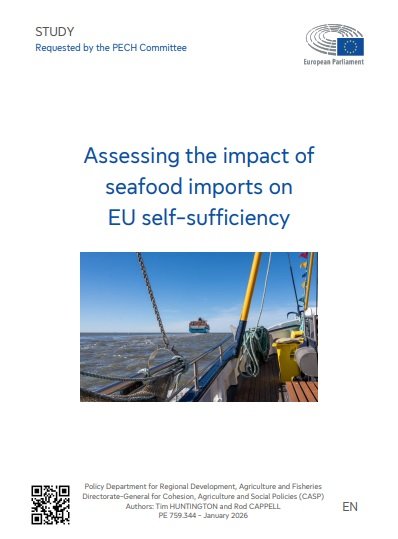
A recent study commissioned by the European Parliament’s Committee on Fisheries (PECH), published in January 2026, dissects this ‘competitiveness gap.’ The report, authored by Tim Huntington and Rod Cappell, reveals that factors such as inflation, Brexit, and disruptions from the war in Ukraine have driven consumers toward cheaper imported fish, eroding the market share of local producers.
- 1 Key Points
- 2 The Harsh Reality of the Figures: The Production Mirage
- 3 Challenges in Capture Fisheries: Wages, Fuel, and Productivity
- 4 Aquaculture: A Sleeping Giant Amidst Regulations
- 5 Technological Innovation: The Path to Resilience
- 6 Toward a New Policy: Recommendations for 2040
- 7 Entradas relacionadas:
Key Points
- Critical Dependency: Excluding exports, the EU’s domestic production covers only 14.2% of total consumption of Fishery and Aquaculture Products (FAPs).
- Competitiveness Gap: High labor costs (33% of fishing revenue) and energy expenses place the European fleet at a disadvantage compared to countries like Morocco or Turkey.
- Stagnant Aquaculture: EU production remains flat at approximately one million tonnes, limited by complex licensing and restricted access to marine space.
- Innovation as a Lifeline: The deployment of Recirculating Aquaculture Systems (RAS) and offshore farming is vital for restoring the sector’s resilience.
The Harsh Reality of the Figures: The Production Mirage
At first glance, statistics can be misleading. In 2022, the official self-sufficiency rate stood at 37.5%. However, this figure ‘hides’ a much deeper dependency. The EU harvests large quantities of pelagic species (such as herring and mackerel) that are mostly exported, while importing the species Europeans actually prefer to consume: tuna, salmon, cod, and shrimp.
If exports are removed from the equation, European domestic production satisfies only 14.2% of internal demand. In key categories such as crustaceans (shrimp), self-sufficiency is barely 12%, while nearly all salmon consumed originates from Norway, Chile, or the United Kingdom.
Challenges in Capture Fisheries: Wages, Fuel, and Productivity
The competitiveness of the European fleet is under siege due to a rigid and high-cost structure. The determining factors are:
- Labor: Wages represent 33% of the fleet’s gross revenue. Supplier countries such as Morocco, India, Ecuador, and China operate with drastically lower labor costs.
- Energy: Fuel accounts for 21% of revenue. Despite tax exemptions, prices in the EU remain higher than those of direct competitors like Morocco.
- Fleet Aging: Unlike Iceland or Norway, which have invested in modern, ultra-efficient vessels, the EU fleet is aging, thereby reducing its Catch Per Unit Effort (CPUE).
Case Study 1: The Moroccan Sardine
Morocco is the EU’s largest supplier of wild seafood. Its advantage is clear: the price of diesel in Morocco (as of October 2025) was EUR 1.2 per liter, compared to EUR 1.6–1.9 in major EU producers. This, coupled with lower electricity and wage costs, allows its preserves to dominate the French and Spanish markets, often at the expense of stock sustainability in Saharan waters.
Aquaculture: A Sleeping Giant Amidst Regulations
While global aquaculture has exploded in recent decades, European production has stagnated at 1.05 million tonnes. EU producers face a “wall of administrative complexity.”
“One of the primary obstacles is the slow and intricate nature of legal procedures for establishing or expanding farms, which discourages private investment and incentivizes imports.”
Cost Comparison: The Dominance of Turkey and Chile
- Sea Bass and Sea Bream (Turkey vs. Greece): Turkey produces four times more than Greece. Its cost base is significantly lower: electricity in Greece costs EUR 0.19 per kWh, compared to EUR 0.04 per kWh in Turkey.
- Mussels (Chile vs. Spain): Chile has increased its production by 1,683% since 2000. The average production cost in Galicia is EUR 1.18 per kg (using traditional rafts), while in Chile, it drops to EUR 0.69 per kg due to extreme automation and economies of scale.
Technological Innovation: The Path to Resilience
To reverse this trend, the study identifies two critical technological frontiers supported by funds such as Horizon Europe and the EMFAF:
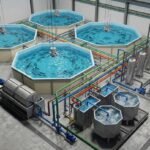
Recirculating Aquaculture Systems (RAS)
The RAS allows for fish farming in controlled environments, reducing freshwater usage by 95%. This technology is key to:
Stay Always Informed
Join our communities to instantly receive the most important news, reports, and analysis from the aquaculture industry.
- Cultivating non-native species (such as tropical prawns or tilapia) near European markets, and reducing the carbon footprint of transport.
- Protecting production from marine heatwaves and external diseases.
Offshore Shellfish Aquaculture
Moving mussel and oyster farms from the coast to deeper, cleaner waters. Although operational costs are higher, product quality improves and space conflicts in saturated coastal areas are avoided.
Toward a New Policy: Recommendations for 2040
The report concludes with a call for legislative action to ensure EU producers do not compete on an uneven playing field:
- Level Playing Field: Ensure that imports comply with the same environmental and social standards as European products.
- Sustainability Labeling: Expand marketing standards so consumers know if imported fish respects labor rights and ocean health.
- Decarbonization Incentives: Support the fleet’s transition toward green fuels and digital tools (AI and automation) to gain efficiency.
- Mission-Oriented Investment: Align public and private capital to scale solutions such as seaweed and regenerative aquaculture within the European Green Deal.
Reference (open access)
Huntington, T., y Cappell, R. (2026). Assessing the impact of seafood imports on EU self-sufficiency (PE 759.344). European Parliament, Policy Department for Regional Development, Agriculture and Fisheries . https://doi.org/10.2861/9988787

Editor at the digital magazine AquaHoy. He holds a degree in Aquaculture Biology from the National University of Santa (UNS) and a Master’s degree in Science and Innovation Management from the Polytechnic University of Valencia, with postgraduate diplomas in Business Innovation and Innovation Management. He possesses extensive experience in the aquaculture and fisheries sector, having led the Fisheries Innovation Unit of the National Program for Innovation in Fisheries and Aquaculture (PNIPA). He has served as a senior consultant in technology watch, an innovation project formulator and advisor, and a lecturer at UNS. He is a member of the Peruvian College of Biologists and was recognized by the World Aquaculture Society (WAS) in 2016 for his contribution to aquaculture.