The Nile tilapia (Oreochromis niloticus) has established itself as a cornerstone of global food security due to its production efficiency. In Brazil, the world’s fourth-largest producer, this species accounts for nearly 70% of the national fish-farming sector, generating an annual economic impact exceeding 6 billion reais.
However, commercial success hinges on a critical and highly stressful link: pre-slaughter transport. During this phase, fish experience capture, handling, and stocking-density fluctuations that not only pose ethical dilemmas but can also compromise the quality of the final product through biochemical changes in the muscle. A recent study published in Frontiers in Veterinary Science by researchers from the State University of Londrina examines whether current density regulations are sufficient under the extreme climatic fluctuations of southern Brazil.
Key Insights
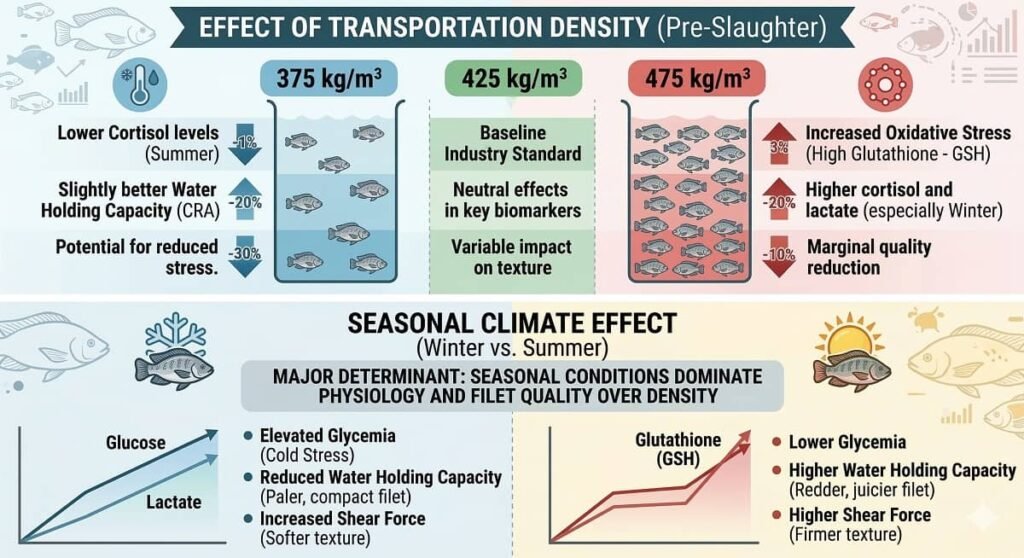
- Climate Dominance: Seasonal conditions (summer vs. winter) are the primary determinants of physiological stress and post-mortem fillet quality, outweighing stocking density.
- Invisible Stress: Standard commercial densities (375 to 475 kg/m³) exceed welfare thresholds, triggering blood lactate levels of up to 15 mmol/L—triple the normal rate.
- Metabolic Cold: Winter significantly increases plasma glucose (172 mg/dL) due to the activation of the hormonal axis to compensate for cold-induced energy expenditure.
- Operational Priority: In short journeys (~1.5 h), water thermal control and oxygenation are more critical for the industry than fine-tuning the number of fish per tank.
Simulating Industrial Reality
To ensure findings applied to the industry, the team led by Daniela Kaizer Terto employed a factorial experimental design. Scientists evaluated three realistic transport densities:
- 375 kg/m³ (Low)
- 425 kg/m³ (Medium/Industry Average)
- 475 kg/m³ (High)
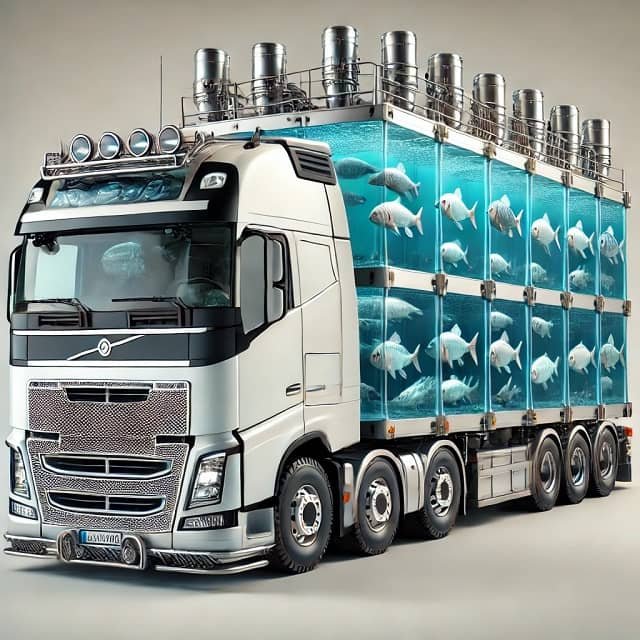
These densities were tested during summer (March) and winter (August) in the Londrina region, Paraná. Researchers transported a total of 7,650 fish in trucks equipped with fiberglass tanks and oxygen diffusers, covering 100 km over 1.5 hours at an average speed of 68 km/h. The study monitored stress biomarkers (glucose, lactate), oxidative indicators, and fillet quality parameters such as pH, Water Holding Capacity (WHC), color, and texture.
The Impact of Temperature
The Fish’s “Emergency Battery”
The study revealed that winter acts as a severe thermal stressor. Plasma glucose levels were significantly higher in winter (172.00 mg/dL) than in summer (126.89 mg/dL). This phenomenon stems from the activation of the hypothalamic-pituitary-interrenal (HPI) axis, which releases cortisol to stimulate gluconeogenesis, thereby providing rapid energy to survive the cold. Interestingly, stocking density did not affect glucose levels, suggesting that thermal stress masked any effects of overcrowding.
Lactate as a Welfare “Whistleblower”
Unlike glucose, lactate showed a complex interaction between density and season. In summer, the lowest density (375 kg/m³) recorded the lowest lactate level (4.0 mmol/L). However, under that same density in winter, lactate spiked to 15.0 mmol/L. This indicates that in cold waters, lower densities might increase the thermal vulnerability and metabolic imbalance of tilapia.
Fillet Quality: From Biochemistry to the Table
The industry seeks firm fillets with good color that retain moisture. Findings show that the season dictated these parameters:
- Water Holding Capacity (WHC): In summer, fillets showed superior WHC, especially at 375 kg/m³. In winter, WHC dropped significantly at 425 kg/m³ (~66%), resulting in drier meat after processing.
- Coloration: Summer fillets were darker, redder, and yellower (higher saturation or chroma). Winter produced paler and lighter fillets, likely due to dehydration and fiber compaction under cold stress.
- Texture and Hardness: Fillet hardness was higher in summer. Heat accelerates glycogen degradation and lactate production, inducing early rigor mortis that toughens the tissue. Conversely, winter cold slows ATP degradation, resulting in more tender fillets.
Oxidative Stress: The Internal Defense
The study also evaluated reduced glutathione (GSH), the primary cellular antioxidant. Fish transported at the highest density (475 kg/m³) showed the highest GSH levels. Rather than a positive trait, this indicates an “adaptive cost”: the fish is depleting its energy reserves to synthesize antioxidants and neutralize reactive oxygen species (ROS) caused by overcrowding.
Rethinking Animal Welfare
A critical point highlighted by the authors is that all tested densities (375–475 kg/m³) are well above the welfare threshold suggested by previous studies, which set the limit at 300 kg/m³. Although Brazilian official guidelines allow up to 550 kg/m³, this work demonstrates that such levels impose a severe physiological cost. The lack of significant differences between the evaluated densities suggests the fish were already in a “uniform high-stress range” where minor load variations fail to alleviate animal suffering.
Stay Always Informed
Join our communities to instantly receive the most important news, reports, and analysis from the aquaculture industry.
Conclusion: Industry Implications
The study concludes that for short journeys (~1.5 hours), producers should prioritize seasonal thermal management and water quality control (oxygen and ammonia) over minor adjustments in stocking density. While density influences specific texture parameters, climate is the true “conductor” of meat quality. Nevertheless, the study leaves a clear warning: to achieve optimal rather than merely “acceptable” welfare standards, the industry should consider lowering densities below 300 kg/m³, balancing ethics with economic efficiency.
Reference (open access)
Terto DK, Bridi AM, Carvalho RH, Rocha JDS, Flaiban KKMC, Ferreira GA, Barro AG, Ogawa NN, Bezerra V and Ferreira NA (2026) Pre-slaughter transport density and seasonal effects on Nile tilapia (Oreochromis niloticus): welfare and filet quality outcomes. Front. Vet. Sci. 13:1743555. doi: 10.3389/fvets.2026.1743555

Editor at the digital magazine AquaHoy. He holds a degree in Aquaculture Biology from the National University of Santa (UNS) and a Master’s degree in Science and Innovation Management from the Polytechnic University of Valencia, with postgraduate diplomas in Business Innovation and Innovation Management. He possesses extensive experience in the aquaculture and fisheries sector, having led the Fisheries Innovation Unit of the National Program for Innovation in Fisheries and Aquaculture (PNIPA). He has served as a senior consultant in technology watch, an innovation project formulator and advisor, and a lecturer at UNS. He is a member of the Peruvian College of Biologists and was recognized by the World Aquaculture Society (WAS) in 2016 for his contribution to aquaculture.