The accelerated growth of the global population has surged the demand for aquatic proteins, forcing the industry to transition toward intensive, large-scale aquaculture systems. However, this model introduces significant risks to animal health. To mitigate these challenges, a research team led by China Agricultural University has published a comprehensive review in Computer Science Review on how Deep Learning (DL) is transforming aquaculture farm management.
The capability of DL to extract complex features from imagery enables management systems to be adaptive and responsive in real-time, laying the groundwork for sustainable and efficient production.
Key Insights
- Non-Invasive Monitoring: Computer Vision (CV) outperforms acoustic and physical sensors by being cost-effective, repeatable, and non-intrusive to the animals.
- Five Pillars of Behavior: AI already enables the successful identification of feeding, stress, disease, reproduction, and cannibalistic behaviors.
- Cost Efficiency: Since feed accounts for up to 86% of production costs, AI optimizes rations by detecting actual appetite and preventing waste.
- Environmental Challenges: Water turbidity, fish occlusions, and lighting fluctuations remain the primary hurdles for current algorithms.
The 5 Critical Behaviors Under the AI Lens
The research categorizes advancements in behavior pattern recognition using Artificial Intelligence (AI) into five fundamental categories, assessing their current level of success:
Feeding Behavior: The Engine of Profitability
Feeding is the most critical process in intensive aquaculture. AI aims not only to “see” if the fish are eating but to quantify appetite intensity.
- Visual Indicators: Models analyze changes in swimming speed and the formation of dense clusters near the surface or dispensers.
- Pellet Detection: Segmentation algorithms identify individual feed grains in the water. If the model detects that pellets are floating or sinking unconsumed, it triggers an automatic stop signal.
- Impact: This prevents eutrophication (excess nutrients depleting oxygen) and reduces the waste of the farm’s most expensive input.
Stress Behavior: The Early Warning System
Fish manifest stress long before mortality occurs; AI acts as a welfare thermometer.
- Trajectory Changes: Stressed fish often exhibit erratic swimming, sudden escape maneuvers, or unusual defensive shoaling.
- Response to External Factors: The study highlights how DL models identify stress caused by poor water quality (hypoxia or high ammonia levels).
- Technology: Recurrent Neural Networks (RNN) and LSTM are employed to analyze temporal sequences of movement, distinguishing normal swimming from stress-induced patterns.
Disease Behavior: Phenotypic Diagnosis
Identifying a sick fish in a tank with thousands of individuals is nearly impossible for the human eye, but not for computer vision.
- Morphological Anomalies: AI detects skin texture changes, abnormal coloration, external hemorrhaging, or scale loss.
- Lethargic Behavior: Tracking algorithms identify individuals that separate from the group or float with minimal movement.
- Precision: The paper mentions that architectures like YOLO-FD filter out “noise” from turbid water to focus on the fish’s physical symptoms.
Reproductive Behavior: The Continuity Challenge
In breeding and genetic selection centers, monitoring spawning is vital to ensuring the next generation.
- Courtship Pattern Identification: AI recognizes specific interactions, such as rhythmic chasing or subtle physical contact.
- Spawning Monitoring: Systems can detect the exact moment of egg release to adjust water conditions or collect samples, which is particularly difficult in shaded or protected areas.
Cannibalism and Aggression: Mortality Control
In territorial species or those with significant size variations (such as grouper or juvenile salmon), aggression can decimate populations.
- Attack Detection: AI identifies lunging movements and stalking behaviors.
- Intervention: Upon detecting aggression spikes, the system can suggest grading (sorting by size) or adjusting light intensity to reduce territoriality.
- Complex Modeling: Spatial-Temporal Attention models are used to distinguish between accidental contact due to high density and intentional aggressive attacks.
Technological Evolution: From CNN to Transformers
The article highlights a fascinating transition in vision models applied to the sector:
Stay Always Informed
Join our communities to instantly receive the most important news, reports, and analysis from the aquaculture industry.
| Technology | Main Advantage | Primary Challenge |
| CNN (YOLO) | High speed for real-time processing | Sensitivity to occlusions and visual noise |
| Transformers | Better global context understanding | High computational demand and slow convergence |
The Bottlenecks: What is missing for the 100% autonomous farm?
Despite the progress, researchers identify three critical challenges:
- Data Quality: The aquatic environment is inherently difficult due to light refraction and motion blur.
- Annotation Cost: Training these models requires thousands of images manually labeled by experts, a slow and expensive process.
- Limited Hardware: Edge devices on farms often lack the memory and processing power to run such dense AI models.
The Future: Toward 3D Vision and Multimodal Models
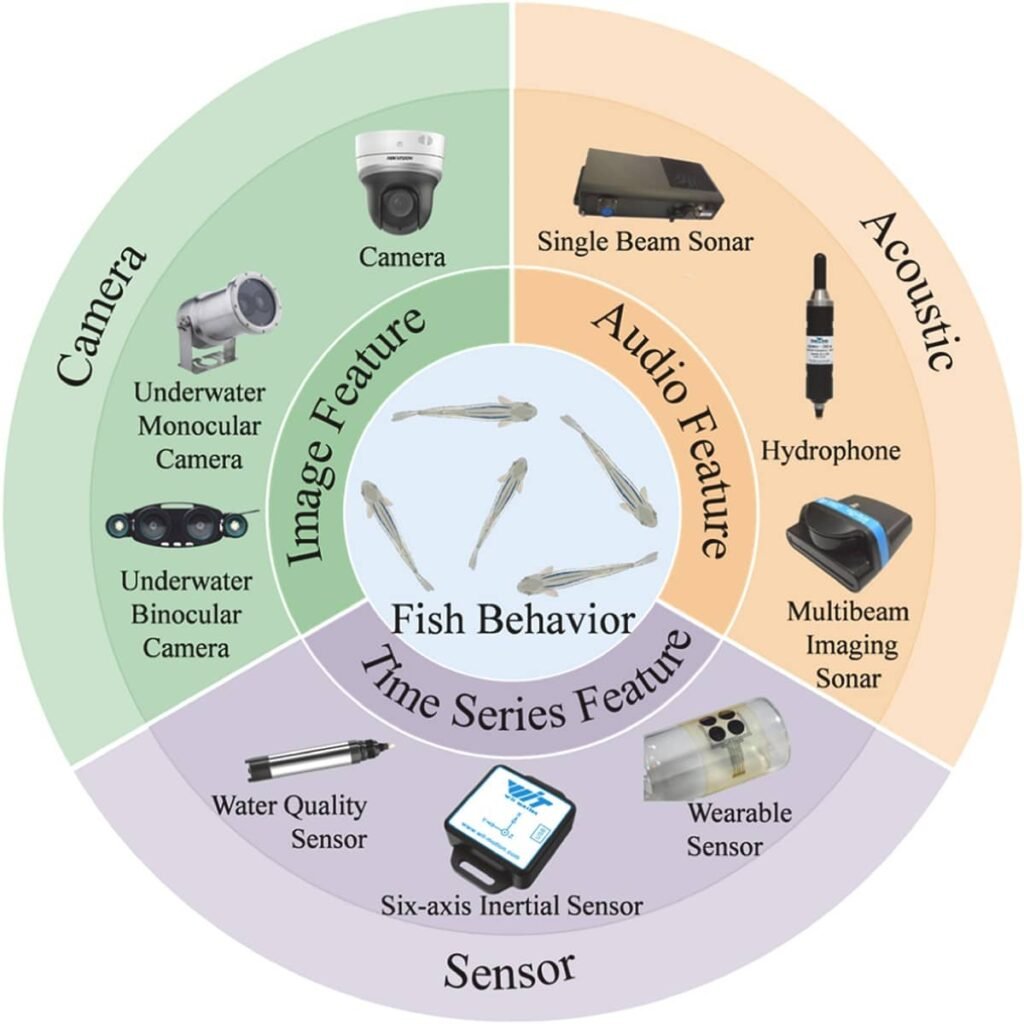
The horizon of digital aquaculture points toward stereo vision technologies to reconstruct 3D movement trajectories, overcoming the limitations of traditional 2D cameras. Furthermore, the integration of multimodal data (imagery, hydrophone audio, and chemical sensors) is expected to create holistic and sustainable management systems.
Contact
Yingyi Chen
China Agricultural University
17 Tsinghua East Road, Beijing 100083, China.
Email: chenyingyi@cau.edu.cn
Reference
He, Q., Yu, H., Qin, H., Mei, Y., Xu, L., Chai, Y., Li, C., Song, L., Li, D., & Chen, Y. (2026). Deep learning-based computer vision for fish behavior recognition in intensive aquaculture: A comprehensive review. Computer Science Review, 60, 100896. https://doi.org/10.1016/j.cosrev.2026.100896

Editor at the digital magazine AquaHoy. He holds a degree in Aquaculture Biology from the National University of Santa (UNS) and a Master’s degree in Science and Innovation Management from the Polytechnic University of Valencia, with postgraduate diplomas in Business Innovation and Innovation Management. He possesses extensive experience in the aquaculture and fisheries sector, having led the Fisheries Innovation Unit of the National Program for Innovation in Fisheries and Aquaculture (PNIPA). He has served as a senior consultant in technology watch, an innovation project formulator and advisor, and a lecturer at UNS. He is a member of the Peruvian College of Biologists and was recognized by the World Aquaculture Society (WAS) in 2016 for his contribution to aquaculture.