- 1 Key Study Findings
- 2 The Pond-Level Dilemma: Why National Sales Statistics Fail to Reflect Your Reality
- 3 What Happens Underwater When Medicated Feed Is Administered
- 4 Lessons from Major Producers: How Chile, Norway, and Canada Track Antibiotic Use
- 5 On-the-Ground Bottlenecks: From Regulatory Fear to Connectivity Divides
- 6 Practical Solutions: Accessible Technology and Non-Punitive Collaboration
- 7 The Passport to Tomorrow’s Markets
- 8 Entradas relacionadas:
Key Study Findings
- Official registries quantify antibiotic imports and sales yet overlook critical data: the treated species, actual dosage, and specific pathology prompting administration.
- A substantial portion of medicated feed is neither ingested nor assimilated by fish and shrimp, accumulating in water and sediment where it exerts selective pressure on native bacterial populations.
- Maintaining rigorous pond-level recordkeeping validates posology, ensures adherence to withdrawal periods, and certifies product safety for the most demanding international markets.
- Chile, Norway, and Canada spearhead regulatory frameworks by integrating electronic veterinary prescriptions with feed mill dispatches—a binding standard the European Union will enforce beginning in 2027.
- Utilizing lightweight, open-access mobile applications enables small- and medium-scale farms to maintain precise health logs without unnecessary bureaucratic burdens.
It is five-thirty in the morning, and mist still blankets the ponds. From the bank, the production manager spots an alarming signal: feed intake has plummeted abruptly, while several fish surface with erratic swimming behavior and uncharacteristically dark pigmentation—a clear field indication that a bacterial outbreak may be taking hold.
At this critical juncture, financial pressures mount; awaiting laboratory confirmation demands time the standing biomass cannot afford, whereas administering preventative medication entails steep costs and the latent risk of driving antimicrobial resistance across the aquatic ecosystem. The farm technician’s field notebook becomes the sole repository for kilograms applied, treatment duration, and the underlying clinical rationale, yet across most aquaculture regions globally, these vital metrics never make it beyond the farm gate.
This longstanding disparity between operational realities at the pond level and official regulatory statistics represents a profound vulnerability for the industry’s sustainable growth. A comprehensive study published in the journal Aquaculture Reports by experts affiliated with institutions such as the European Marine Biological Resource Centre (EMBRC-ERIC), the World Organisation for Animal Health (WOAH), the FAO Reference Centre for Antimicrobial Resistance and Aquaculture Biosecurity at Nitte University, the Public Health Agency of Canada, and the Center for Antimicrobial Stewardship in Aquaculture in Chile, warns that the sector cannot continue managing aquatic animal health blindly: implementing on-farm antimicrobial surveillance is paramount to protecting public health, averting costly trade rejections, and safeguarding the industry’s global standing.
The Pond-Level Dilemma: Why National Sales Statistics Fail to Reflect Your Reality
For decades, global aquaculture health has been assessed through customs manifests and sales reports issued by the pharmaceutical sector. Under this framework, regulatory agencies tally annual imported or commercialized tonnages, tacitly assuming that aggregate volume mirrors operational farm practices on the ground.
Such an approach is akin to calibrating a facility’s aeration systems based solely on regional average wind speeds: a broad metric that reveals nothing about dissolved oxygen concentrations at the culture unit’s critical threshold. Aggregated sales data cannot discern whether a shipment of oxytetracycline or florfenicol was administered to trout fry, cage-reared tilapia juveniles, or shrimp broodstock; nor can it capture exact posology per kilogram of biomass, the route of administration, or whether the intervention stemmed from a formal clinical diagnosis rather than urgent prophylaxis following stressful handling or biometrics.

When sector sustainability is benchmarked against international platforms like the World Organisation for Animal Health’s (WOAH) ANIMUSE database, the picture remains fragmented, as nearly 50% of producing nations fail to include aquatic species within their national veterinary pharmacovigilance schemes. In the absence of standardized, pond-side recordkeeping, aquaculture remains vulnerable to global scrutiny over drug stewardship, leaving producers who uphold rigorous best management practices without the empirical data needed to demonstrate compliance.
What Happens Underwater When Medicated Feed Is Administered
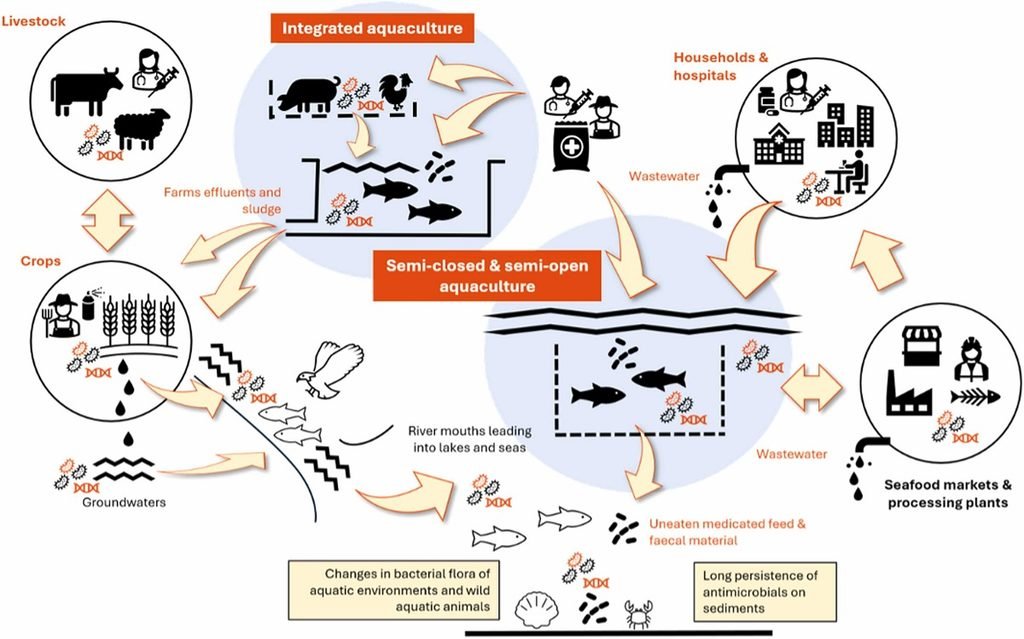
Administering therapeutics within aquatic environments entails unique dynamics that terrestrial livestock and poultry producers never face: in open or semi-open systems—such as floating net-pens in lakes and bays, or earthen ponds subject to continuous water exchange—water serves as a perpetual dispersal medium.
When bacterial disease depresses appetite, severely compromised individuals cease feeding altogether, causing a considerable fraction of medicated pellets to settle unconsumed onto the benthic substrate or to be excreted prior to effective systemic absorption.
These lingering residues expose native benthic communities to sustained sublethal concentrations, accelerating horizontal gene transfer of antimicrobial resistance across aquatic microbial taxa and traveling downstream to wild populations, recreational waters, and shellfish beds within a broader One Health framework.
Mantente siempre informado
Stay Informed
Únete a nuestras comunidades para recibir al instante las noticias, informes y análisis más importantes del sector acuícola.
Join our communities to get instant access to the most important news, reports, and analysis from the aquaculture industry.
Lessons from Major Producers: How Chile, Norway, and Canada Track Antibiotic Use
Confronting this challenge, leading global aquaculture nations demonstrate that systematic, pond-side data collection is not only operationally feasible, but serves as a decisive competitive advantage across international markets.
In Chile, the National Fisheries and Aquaculture Service (Sernapesca) mandates monthly antimicrobial reporting from salmonid farms—detailing active pharmaceutical ingredients, exact posology, routes of administration, and the underlying clinical diagnoses—supported since 2018 by an obligatory electronic veterinary prescription system that traces every milligram from issuance to harvest.
Norway coordinates surveillance through its NORM-VET program, where feed mills and wholesalers automatically report deliveries while the state platform VetReg centralizes certified prescriptions to audit treatments by species and life stage down to cleaner fish; meanwhile, Canada’s Aquaculture Activities Regulations ensure field reports align with CIPARS wholesale figures, foreshadowing the binding on-farm reporting standards that European Union Delegated Regulation (EU) 2021/578 will enforce starting in 2027.
On-the-Ground Bottlenecks: From Regulatory Fear to Connectivity Divides
If the benefits of recordkeeping are so conclusive, why do most production facilities across Latin America, Asia, and Africa still operate without systematic health logs? The authors of the study published in Aquaculture Reports identify socioeconomic and operational barriers that extend far beyond simply filling out a technical form:
- Fear of Retaliation and Commercial Penalties: Many farmers and traders worry that transparently reporting health interventions could trigger regulatory sanctions, punitive audits, or the loss of buyers, turning documentation into a perceived liability rather than a management asset due to the absence of positive incentives.
- Educational Gaps and Language Barriers: Guidelines and protocols are often drafted in technical jargon detached from day-to-day farm routines; without extension agents to translate these concepts into actionable field language, producers either guess through forms or abandon monitoring altogether.
- Resource Asymmetries and Labor Shortages: Whereas corporate enterprises employ dedicated quality assurance teams and resident veterinarians, artisanal producers and cooperatives lack the budget to underwrite third-party audits or allocate staff solely to administrative tasks.
- Off-Label Use Driven by Therapeutic Scarcity: A chronic lack of registered aquatic formulations frequently compels off-label drug administration; lacking validated withdrawal periods or pharmacokinetics for tropical waters, farmers systematically avoid documenting these applications.
- Geographic Isolation and Connectivity Deficits: In inter-Andean valleys, remote shorelines, and Amazonian riverbanks, cellular coverage remains poor or nonexistent, rendering cloud platforms that require continuous real-time synchronization utterly impractical.
Practical Solutions: Accessible Technology and Non-Punitive Collaboration
For a monitoring scheme to succeed within the production environment, the fundamental prerequisite is operational simplicity. Demanding complex pharmacological calculations from the personnel responsible for daily feeding compromises the viability of the program from the outset.
Leading international organizations such as WorldFish have demonstrated the effectiveness of free, open-source digital tools, including KoboToolbox and EpiCollect. These platforms enable field personnel to record health variables using standard mobile devices, georeference each pond, operate without an internet connection in remote areas, and automatically synchronize data once network coverage is restored.
Furthermore, the research underscores the need to standardize evaluation parameters to ensure technical comparability. Rather than counting empty medicine containers, modern management must be grounded in scientifically validated metrics:
- Count-based indicators: proportion of ponds or production cycles that required therapeutic intervention during the year.
- Weight-based indicators: milligrams of active ingredient administered per kilogram of harvested biomass.
- Dose-based indicators: defined daily doses by species (nDDDvet), a metric that accurately quantifies treatment intensity and the pharmacological pressure applied to each batch.
Consolidating this transition requires defusing historical distrust among stakeholders across the supply chain. On-farm monitoring must not be structured as a punitive state mechanism, but rather as a strategic multi-sector alliance. While diagnostic laboratories and universities compile bacterial susceptibility profiles, aquaculture producers contribute hands-on field experience, the public sector establishes enabling frameworks, and academia analyzes health trends. When producers realize that documenting their therapies allows them to benchmark their health performance against regional standards and curtail economic losses, traceability ceases to be a burden and becomes established as a profitable, high-value practice.
The Passport to Tomorrow’s Markets
Let us return to the pond at five-thirty in the morning: the production manager is no longer forced to make blind decisions or hide the field logbook. Upon noticing the anomaly, he consults the batch’s health history on his mobile device, cross-references historical antibiograms validated by the reference laboratory, and administers the exact posology prescribed by the veterinarian—logging the application with merely three taps on the screen.
By the close of the production cycle, that data ceases to be an administrative burden relegated to a drawer; instead, it serves as irrefutable documentation that the farm honored withdrawal periods, safeguarded the aquatic ecosystem, and harvested safe produce free of pharmacological residues. In a global marketplace where retail supply chains and sustainability certification standards rigorously scrutinize the sanitary traceability of every cohort, pond-side antibiotic surveillance transcends compliance, establishing itself as the strategic passport toward profitability and competitive resilience in modern aquaculture.
Contact
Tosca Sala
European Marine Biological Resource Centre – European Research Infrastructure Consortium (EMBRC-ERIC), Paris, France.
Email: tosca.sala@embrc.eu
Reference (open access)
Sala, T., Mateo, D., Karunasagar, I., Uhland, F. C., Palić, D., Metwaly, S. A., Lara, M., Isyagi, N., & Yugueros-Marcos, J. (2026). Relevance and challenges associated with antimicrobial use (AMU) monitoring at the field level in aquaculture. Aquaculture Reports, 51, 103840. https://doi.org/10.1016/j.aqrep.2026.103840

Editor at the digital magazine AquaHoy. He holds a degree in Aquaculture Biology from the National University of Santa (UNS) and a Master’s degree in Science and Innovation Management from the Polytechnic University of Valencia, with postgraduate diplomas in Business Innovation and Innovation Management. He possesses extensive experience in the aquaculture and fisheries sector, having led the Fisheries Innovation Unit of the National Program for Innovation in Fisheries and Aquaculture (PNIPA). He has served as a senior consultant in technology watch, an innovation project formulator and advisor, and a lecturer at UNS. He is a member of the Peruvian College of Biologists and was recognized by the World Aquaculture Society (WAS) in 2016 for his contribution to aquaculture.