It is 5:00 a.m. at a shrimp processing plant. The truck carrying last night’s harvest has just arrived, the ice is still crackling in the crates, and the quality control manager walks among the trays following his usual routine: he picks up a shrimp, turns it over, and checks the junction between the head and the body. Right there, in that exact joint, is where it first appears. A dark spot, almost imperceptible at first, that within hours can spread across the entire cephalothorax. It does not matter how much ice was used or how quickly the product was chilled: if the shrimp died more than a day ago, the spot is already on its way.
For anyone working in the shrimp value chain—from the pond to the plant, and from the plant to the export container—this scene needs no explanation. Melanosis, that darkening that buyers instantly recognize and which triggers rejections, discounts, or returns, is one of the industry’s most constant headaches. And, contrary to what many producers assume, it is not a problem that can be solved simply by chilling faster or using more ice.
A group of researchers from Jimei University in China, along with colleagues from GeneBio Inc., published a scientific review in the journal Food Bioscience that compiles current knowledge on the causes of melanosis and how to address it. The value of this work lies not in a single spectacular finding, but in assembling years of scattered—and often contradictory—research across species into a clearer roadmap of causes and solutions. For a producer or a plant manager, understanding this map can mean the difference between losing an entire shipment and anticipating the problem before the first spot even appears.
Key Study Insights
- Melanosis (the black spots that appear on the shrimp’s head, joints, and shell after harvest) is the leading cause of buyer rejection, even ahead of tissue softening or microbial contamination.
- Ice and freezing do not stop it; they only pause it. As soon as the shrimp thaws, the responsible enzymes reactivate, and the spots appear within hours.
- An enzyme called polyphenol oxidase (PPO) is the primary culprit. It remains dormant inside the living shrimp and activates only after the animal’s death, triggered by a cascade of other enzymes (proteases) that sound a chain alarm.
- A team from Jimei University has just described in greater detail than ever how this enzyme assembles and activates, while also identifying a second suspect: hemocyanin, the protein that transports oxygen in the shrimp’s blood.
- The most promising strategies today combine multiple tools at once—modified atmosphere packaging, non-thermal treatments, and plant extracts—rather than relying on a single method.
Why Ice Falls Short
For a long time, industry logic was simple: if cold temperatures halt bacteria, they should also halt melanosis. While this is partly true—cold slows the process down—it does not stop it. Frozen shrimp develop dark spots very rapidly upon thawing because the enzymes responsible for melanosis become dormant during freezing but reactivate as soon as room temperature is restored. In other words, cold does not destroy the offending enzyme; it merely pauses it, like an armed alarm waiting for the right moment to trigger.
That culprit has a name: polyphenol oxidase, or PPO. It is a copper-containing protein that, while the shrimp is alive, serves a completely different function from the one that ruins its reputation post-mortem.
Shrimp lack an adaptive immune system like that of vertebrates, so they rely on their innate immune system for infection defense and wound healing, with PPO playing a central role. When a shrimp suffers an injury or infection, PPO helps seal the damaged area and neutralize bacteria, in a process similar to how human blood forms a scab.

The problem is that, upon the animal’s death, this same defense mechanism runs unchecked. For years, it was assumed that PPO simply “appeared” after harvest, but what actually happens resembles a military chain of command: PPO circulates continuously in the shrimp’s blood in an inactive form—a “dormant enzyme” called proPPO. It only activates when another enzyme, a protease, cleaves it at a precise structural point, akin to pulling the safety off a trigger.
What No One Had Managed to See in Such Detail
This is where the work of the Jimei University research team brings something new to the table. In previous studies by the same group, they successfully described with precision how active PPO in whiteleg shrimp (Litopenaeus vannamei) assembles: active PPO has a molecular weight of 210 kDa and likely forms as a four-piece complex, consisting of two chains called PPOα and two called PPOβ. Each of these components originates from an inactive precursor from which a specific protease—named PAP—cleaves an exact fragment, akin to popping the lid off a jar at just the right spot to reveal its contents.
Thinking of PPO as a factory with a safety switch helps explain why halting it is so difficult: lowering the temperature is not enough, as the switch remains intact, waiting to trigger as soon as conditions shift. In fact, there is a directly proportional relationship between the development of melanosis and the surge in activity of both PPO and its activating proteases during cold storage. The more protease is released—which happens naturally as shrimp cells break down post-mortem—the faster PPO activates and the quicker the spots appear.
The Second Suspect: The Shrimp’s Blue Blood
However, PPO does not act alone, which marks one of the most intriguing twists in this scientific review. Hemocyanin—the oxygen-transporting protein that imparts the characteristic bluish tint to shrimp blood, serving a role akin to hemoglobin in humans—turns out to also behave as an enzyme capable of generating melanin under certain conditions.
Mantente siempre informado
Stay Informed
Únete a nuestras comunidades para recibir al instante las noticias, informes y análisis más importantes del sector acuícola.
Join our communities to get instant access to the most important news, reports, and analysis from the aquaculture industry.
Recent investigations have revealed that hemocyanin exhibits phenoloxidase activity, the very same family of reactions that yields black spots, and also participates in antimicrobial defense.
The key distinction is that hemocyanin, unlike PPO, keeps its active site much more concealed within its own structure. It requires structural cleavage or deformation—induced by chemical treatments, proteases, or even specific solvents—for that site to become exposed and initiate dark pigment production. It is as though PPO leaves its door slightly ajar from the outset, whereas hemocyanin keeps it locked; yet, that lock is occasionally forced during post-harvest handling. The authors concede that the precise contribution of each protein to the overall issue, as well as their mutual interaction, remains an open question the industry has yet to answer.
From Theory to Tray: What Works Today
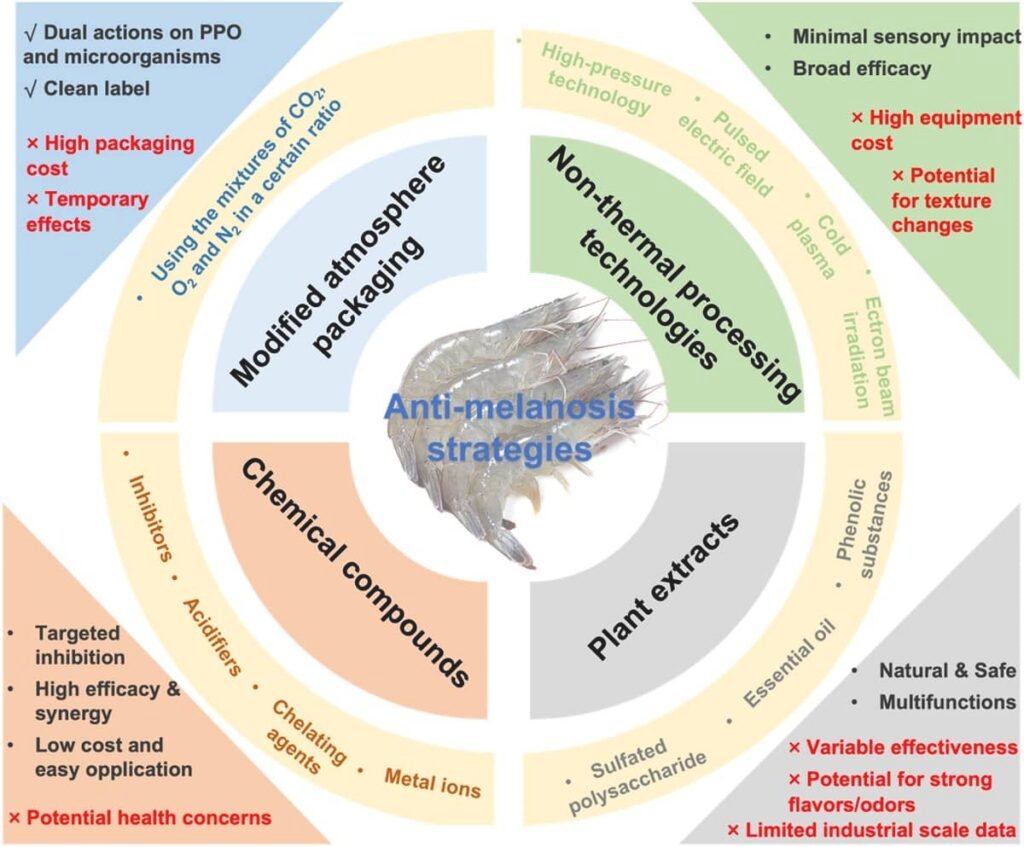
All this biochemistry only matters if it translates into practical decisions for those managing a plant or exporting shrimp. The review categorizes current strategies into four major families, and the general conclusion is uncomfortable yet honest: no single method solves the problem entirely.
Modified Atmosphere Packaging (MAP)
Modified atmosphere packaging—replacing the air inside the container with specific ratios of carbon dioxide, nitrogen, and oxygen—remains one of the most widely used options because it leaves no chemical residues and preserves original flavor. It was found that levels above 60%, combined with just 5% oxygen, effectively prevented melanosis in Pacific white shrimp for nearly two weeks of cold storage. The limitation: the effect is temporary and requires specialized packaging equipment.
Non-Thermal Technologies
Non-thermal technologies—high hydrostatic pressure, pressurized carbon dioxide, cold plasma, and pulsed electric fields—represent the most sophisticated approach. They work by physically deforming the structure of PPO without cooking the product, thereby preserving texture and flavor. The downside is clear: the initial investment in equipment is high, which limits adoption among small and medium producers.
Chemical Compounds
Chemical compounds—reducing agents, acids, and copper chelators—are the most economical and effective, but they also raise the most regulatory and health concerns. Sodium sulfite, for instance, was the industry standard for decades until it was confirmed to irritate respiratory tracts and trigger severe allergic reactions in asthmatic individuals, driving the search for safer alternatives.
Plant Extracts
This is where plant extracts come in, the category currently drawing the most interest from consumers and regulators alike. Phenolic-rich extracts—from cashew, oregano, tea, and guava leaves, among many others tested—successfully “chelate” or bind the copper that PPO requires to function, blocking it without leaving synthetic residues.
Studies have shown that a 1% cashew leaf extract provided a preventative effect against melanosis equivalent to 1.25% sodium metabisulfite, one of the most common synthetic additives. While costs are often higher and efficacy varies by extract and concentration, this route is rapidly gaining ground for markets demanding clean-label products.
No Silver Bullet, But a Clearer Roadmap
The researchers themselves are clear in their conclusion: there is no single solution. What is gaining traction in the industry is the combination of strategies—such as pairing a plant extract with modified atmosphere packaging, or a high-pressure treatment followed by a mild chelator—to tackle the problem from multiple fronts at once, thereby reducing individual dosages and minimizing side effects on flavor or cost.
For the quality control manager at that plant at 5:00 a.m., this roadmap does not alter tomorrow’s routine; he will continue inspecting each shrimp, looking for the first spot at the joint. However, it does change what he can demand from input suppliers and his own handling protocols: knowing that the battle is not won with ice alone, but by understanding which enzyme is waking up and which specific tool is best suited to put it back to sleep. The next time he picks up a shrimp and turns it over searching for that mark, he will know that what lies on the other side is not a mystery, but a biochemical cascade that science is only just beginning to map with precision.
Contact
Min-Jie Cao
College of Ocean Food and Biological Engineering, Jimei University
Xiamen, 361021, China
Email: mjcao@jmu.edu.cn
Reference
Lin, D., Hong, Q., Cao, K., Hong, S., Chen, Y., Sun, L., & Cao, M. (2026). Mechanisms and control strategies of shrimp melanosis during storage: A review. Food Bioscience, 79, 108867. https://doi.org/10.1016/j.fbio.2026.108867

Editor at the digital magazine AquaHoy. He holds a degree in Aquaculture Biology from the National University of Santa (UNS) and a Master’s degree in Science and Innovation Management from the Polytechnic University of Valencia, with postgraduate diplomas in Business Innovation and Innovation Management. He possesses extensive experience in the aquaculture and fisheries sector, having led the Fisheries Innovation Unit of the National Program for Innovation in Fisheries and Aquaculture (PNIPA). He has served as a senior consultant in technology watch, an innovation project formulator and advisor, and a lecturer at UNS. He is a member of the Peruvian College of Biologists and was recognized by the World Aquaculture Society (WAS) in 2016 for his contribution to aquaculture.