International trade and the production of bivalve mollusks (such as mussels, clams, and oysters) have experienced remarkable global growth, recording increases of 49% in production and 41% in trade between 2011 and 2023. However, this momentum constantly faces a critical ecological and sanitary challenge: harmful algal blooms (HABs) and the proliferation of toxic microalgae.
Certain species of microalgae—primarily dinoflagellates and some diatoms—produce highly potent metabolic compounds known as phytotoxins or marine biotoxins. As filter-feeding organisms, bivalves rapidly accumulate these toxins in their tissues (especially in the digestive gland or hepatopancreas), posing a severe risk of gastrointestinal or neurological poisoning for human consumers.
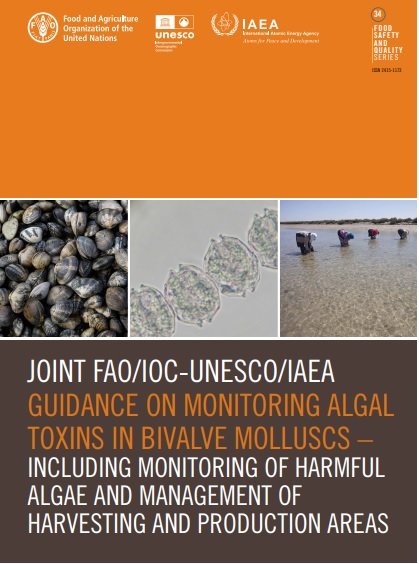
In response to the need to harmonize trade controls and protect public health, the Food and Agriculture Organization of the United Nations (FAO), the Intergovernmental Oceanographic Commission of UNESCO (IOC-UNESCO), and the International Atomic Energy Agency (IAEA) combined their technical expertise at an expert meeting in Rome. The result of this joint effort is the publication of the sector’s reference manual: Joint FAO/IOC-UNESCO/IAEA guidance on monitoring of algal toxins in bivalve molluscs.
Key Points of the Guide
- Dual Preventive Approach: Efficient health risk management requires both the periodic quantification of microalgae in water (as an early warning system) and the direct analysis of toxins in mollusk tissue.
- Validation of Chemical Methods: Modern instrumental techniques—such as liquid chromatography-tandem mass spectrometry ()—are confirmed as global reference standards to progressively replace animal bioassays.
- Establishment of Strict Limits: The maximum permitted limits set by the Codex Alimentarius are reaffirmed for the five main groups of biotoxins that cause poisoning syndromes in humans.
- Criteria for Opening and Closing Zones: A production area closed for exceeding legal limits should only be reopened after obtaining at least two consecutive negative analytical results from samplings separated by a minimum of 48 hours.
- Impact of Processing and Post-Harvest: Industrial processing and domestic cooking of bivalves do not destroy algal toxins; conversely, water loss during cooking can double the toxin concentration in the final product.
The Design of Monitoring Programs in Production Zones
For a production zone to be considered suitable and sustainable for mussel farming or bivalve harvesting, it must first undergo an environmental and sanitary risk assessment. Competent authorities and economic operators must geographically locate sampling stations using fixed GPS coordinates.
Water-Based Microalgae Monitoring
Phytoplankton surveillance serves as a predictive and early warning tool. The document highlights the importance of studying local hydrographic conditions and dominant currents; for instance, pelagic monitoring stations should be positioned “upstream” of currents entering aquaculture farms.

The water sampling frequency must be at least weekly before and during commercial harvest periods. For cell quantification, the recommended standard method is inverted microscopy analysis following sample sedimentation in a counting chamber. However, the guide highlights the incorporation of advanced molecular tools—such as quantitative PCR (qPCR and dPCR)—to discriminate between toxic and non-toxic strains within the same genus, as well as automated optical recognition systems driven by artificial intelligence (such as Flowcam or Imaging FlowCytobot).
A critical point identified in aquaculture management is that low cell counts do not always guarantee safety. Species of the genus Dinophysis can cause bivalves to exceed permitted toxicity limits even at densities below .
Biological Sampling and the Use of Sentinel Species
Because the rate of biotoxin accumulation varies among organisms, the guide promotes the use of indicator or sentinel species. Mussels (Mytilus spp.) are frequently classified as the best sentinels because they absorb and concentrate toxins much faster than clams or oysters. Installing cages with mussels in a clam farming area allows operators to anticipate toxicity events and optimize chemical analysis costs.
Risk Dynamics and the 5 Poisoning Syndromes
The globalization of markets implies that a localized toxic outbreak in a coastal production area can trigger health alerts and hospitalizations on another continent, due to the rapid speed of export chains. Climate change exacerbates this scenario by lengthening algal bloom seasons and altering marine currents. For example, Alexandrium catenella, historically confined to the Northern Hemisphere, has migrated to Australia and South Africa over the last two decades.
Mantente siempre informado
Stay Informed
Únete a nuestras comunidades para recibir al instante las noticias, informes y análisis más importantes del sector acuícola.
Join our communities to get instant access to the most important news, reports, and analysis from the aquaculture industry.
“Toxins affecting seafood safety are divided into different categories,” explained Esther Garrido Gamarro, FAO Fishery Officer. “Cooking and depuration do not appear to be effective against phycotoxins, which is why we must manage the risk before the product reaches the consumer.”
The guide classifies human poisoning caused by bivalves into five major regulated groups under the International Classification of Toxins and Maximum Permitted Limits (Codex Stan 292-2008):
| Toxin Group | Associated Syndrome | Maximum Limit in Meat (per kg) | Responsible Algal Genera | Main Mechanism of Action |
| AST (Amnesic Shellfish Toxins) | Amnesic Shellfish Poisoning | mg Domoic Acid (DA) | Pseudo-nitzschia, Nitzschia (Diatoms) | Neurotoxicity via activation of kainate receptors; short-term memory loss. |
| AZT (Azaspiracid Shellfish Toxins) | Azaspiracid Shellfish Poisoning | mg AZA-1 equivalents | Azadinium, Amphidoma | Combination of neurological and gastrointestinal symptoms (cellular mechanism under review). |
| DST (Diarrhetic Shellfish Toxins) | Diarrhetic Shellfish Poisoning | mg Okadaic Acid (OA) equivalents | Dinophysis, Phalacroma, Prorocentrum | Inhibits protein phosphatases; causes severe gastrointestinal symptoms. |
| NST (Neurotoxic Shellfish Toxins) | Neurotoxic Shellfish Poisoning | mouse units (0.8 mg BTX-2 eq.) | Karenia | Activates cellular sodium channels; can also be transmitted via marine aerosols. |
| PST (Paralytic Shellfish Toxins) | Paralytic Shellfish Poisoning | mg Saxitoxin (STX) equivalents | Alexandrium, Pyrodinium, Gymnodinium | Blocks voltage-gated sodium channels; causes respiratory paralysis. |
Exceptional Cases Under Current Regulations
The document addresses specific tolerances linked to the unique physiology of certain commercial species. A notable example is the king scallop (Pecten maximus); this bivalve absorbs domoic acid very slowly but can take months or even years to clear it from its tissues due to its low depuration rate. To prevent indefinite closures of offshore scallop fisheries, international regulations—such as those of the European Union—allow harvesting even when domoic acid levels in the whole animal range between 20 and 250 mg/kg. However, this tolerance is strictly conditional upon two regulatory requirements:
- Controlled Processing: It must take place exclusively in authorized establishments.
- Selective Removal: The complete extraction of the hepatopancreas (digestive gland) is mandatory. The remaining edible parts, such as the adductor muscle and gonads, must under no circumstances exceed the general limit of 20 mg/kg.
Conclusion
One of the guide’s most direct and disruptive contributions is demystifying the effectiveness of post-harvest processes. Depuration in controlled holding tanks—highly effective for removing bacterial microbiological contaminants—proves ineffective against phycotoxins due to the bivalves’ intrinsic, slow biological elimination rates.
Furthermore, industrial thermal processing introduces complex analytical paradoxes. Since these biotoxins are thermostable, cooked shellfish lose water during heat treatment, which increases the relative toxin concentration in the remaining tissue; in the case of oil-canned products, the migration of lipophilic toxins into the packing medium has been documented, a phenomenon that complicates the interpretation of standard legal limits originally based on fresh tissue weight.
“All regional and national authorities and institutions can use this publication as a roadmap to establish robust protocols and procedures that prevent phycotoxins from reaching consumers,” said Kristof Moeller, Associate Research Scientist for HABs and Biotoxins at the IAEA Marine Environment Laboratories (IAEA-NAML).
“Knowing where and when harmful algal blooms are likely to occur allows authorities to prioritize their resources and make informed decisions on when to sample water and shellfish,” according to Garrido Gamarro.
Reference (open access)
FAO, IOC-UNESCO and IAEA. 2026. Joint FAO/IOC-UNESCO/IAEA guidance on monitoring of algal toxins in bivalve molluscs – Including monitoring of harmful algae and management of harvesting and production areas. Food Safety and Quality Series, No. 34. Rome. https://doi.org/10.4060/cd8990en

Editor at the digital magazine AquaHoy. He holds a degree in Aquaculture Biology from the National University of Santa (UNS) and a Master’s degree in Science and Innovation Management from the Polytechnic University of Valencia, with postgraduate diplomas in Business Innovation and Innovation Management. He possesses extensive experience in the aquaculture and fisheries sector, having led the Fisheries Innovation Unit of the National Program for Innovation in Fisheries and Aquaculture (PNIPA). He has served as a senior consultant in technology watch, an innovation project formulator and advisor, and a lecturer at UNS. He is a member of the Peruvian College of Biologists and was recognized by the World Aquaculture Society (WAS) in 2016 for his contribution to aquaculture.