The aquatic products industry currently faces unprecedented sustainability and efficiency challenges, ranging from resource overexploitation to critical cold chain vulnerabilities, demanding tools that ensure product integrity. In this context, Artificial Intelligence (AI) emerges as the driver of a comprehensive transformation spanning from cultivation to the final consumer.
Unlike conventional digital solutions, AI—specifically Machine Learning and Deep Learning—offers adaptable self-learning systems capable of executing dynamic and precise decision-making. This technology facilitates the transition from empirical food inspection toward a robust, data-driven model.
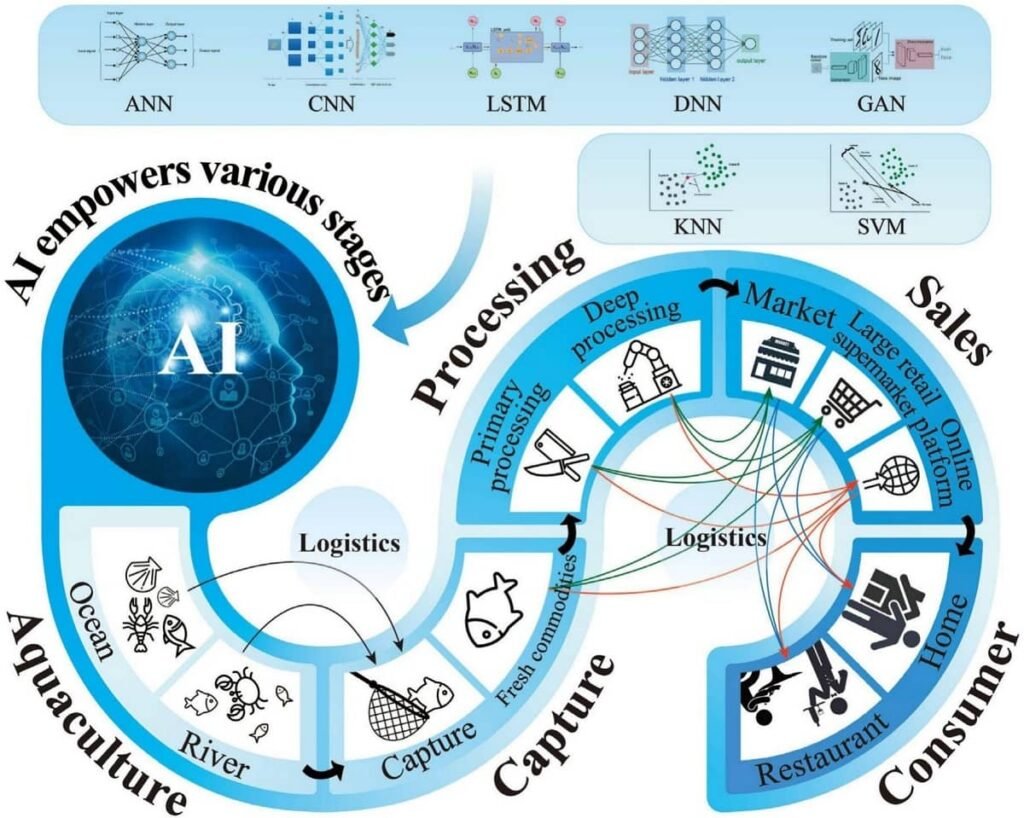
According to a scientific review published by specialists from the School of Management and the School of Food Science and Technology at Dalian Polytechnic University, in collaboration with the Liaoning Ocean and Fisheries Science Research Institute (China), AI integration is already a tangible reality across the aquaculture, harvesting, processing, logistics, and marketing phases.
Takeways
- Comprehensive Synergy: A pioneering framework is proposed, integrating precision aquaculture, smart logistics, and data-driven consumption.
- Critical Prediction: Advanced algorithms anticipate water quality and harmful algal blooms with over 90% accuracy.
- Precision Feeding: Computer vision systems achieve 98% accuracy in feed management, minimizing waste and environmental impact.
- Autonomous Logistics: The implementation of Digital Twins and neural networks reduces cold chain energy consumption by up to 47.64%.
- Guaranteed Authenticity: Deep learning detects species substitution fraud or improper freezing cycles with more than 90% reliability.
- Fraud Mitigation: The integration of spectroscopy and AI identifies substitutions and chemical adulterants with up to 100% accuracy.
- Technical Gaps: Despite progress, automated pre-processing (cleaning and gutting) and low-altitude aerial delivery remain in experimental phases.
Innovation in Cultivation and Capture
The integration of Artificial Intelligence (AI) in aquaculture aims to transcend dependence on ‘subjective experience’ by replacing it with high-precision, data-driven models.
Water Monitoring and Disease Diagnosis
Traditional manual monitoring methods are costly and lack the necessary immediacy; instead, AI—utilizing Artificial Neural Networks (ANN) and Long Short-Term Memory (LSTM) models—enables the prediction of environmental risks, such as harmful algal blooms (HABs), with exceptional accuracy. Furthermore, while conventional disease diagnosis is slow and expert-dependent, Computer Vision and Convolutional Neural Networks (CNNs) are shifting the paradigm by identifying critical pathologies, such as columnaris, through behavioral pattern analysis and skin lesion detection, reaching precision levels of 99.04%.
Underwater Harvesting and Catch Classification
Manual harvesting via diving is a high-risk activity with elevated operating costs; to mitigate this, robots equipped with deep residual networks have been developed to recognize targets—such as sea cucumbers or crustaceans—in complex underwater environments with over 90% accuracy. Following capture, automated classification algorithms process multiple species in milliseconds, drastically optimizing post-harvest logistics.
Precise Processing and Quality Control
Historically, aquatic product processing has relied on human sensory judgments, which are inherently variable and subjective; however, the transition toward intelligent systems allows for quality standardization with unprecedented rigor.
Contaminant Detection and Freshness Assessment
The synergy between AI and advanced techniques, such as spectroscopy, enables the identification of antibiotic residues and heavy metals with up to 100% accuracy. To evaluate freshness, the implementation of AI-integrated ‘electronic noses’ interprets colorimetric transitions and volatile gases, an approach that significantly surpasses the limitations of traditional visual inspection methods.
Cutting Operations and Value-Added Processing
The use of Deep Learning alongside laser profiling allows automated systems to determine the exact positioning for head and tail removal with over 90% precision, significantly minimizing raw material waste. In the realm of value-added products, such as fried fish, AI optimizes cooking parameters to preserve nutritional value and perfect the product’s final texture.
Mantente siempre informado
Stay Informed
Únete a nuestras comunidades para recibir al instante las noticias, informes y análisis más importantes del sector acuícola.
Join our communities to get instant access to the most important news, reports, and analysis from the aquaculture industry.
Smart Logistics in the Cold Chain
The cold chain constitutes the critical pillar of food safety in the aquaculture industry. In this field, Artificial Intelligence intervenes strategically through demand forecasting, a tool that optimizes inventory turnover and drastically reduces financial losses derived from overstocking.
Transport and Storage Efficiency
During transportation, AI systems mitigate thermal volatility by employing predictive models that alert to temperature excursions with 98.6% efficacy. Likewise, intelligent warehouse management, based on Deep Reinforcement Learning, has demonstrated its capacity to optimize energy efficiency, reducing electricity consumption by up to 47.64%.
Digital Marketing and Data-Driven Consumption
Modern aquatic product marketing employs Artificial Intelligence to combat food fraud, a global challenge that compromises market integrity; through advanced models, the sector is moving toward total transparency in commercialization.
Origin Verification and Authenticity
The integration of AI with Near-Infrared (NIR) spectroscopy allows for high-fidelity differentiation between wild-caught and farmed products, while precisely tracking their geographical origin. This technology is fundamental for ensuring traceability and protecting protected designations of origin.
Sales Prediction and Personalization
Neural network models merge complex consumer behavior data to adjust sales strategies in real-time, optimizing supply and reducing waste. Furthermore, although still developing, Generative AI and Large Language Models (LLMs) are beginning to offer personalized dietary recommendations and recipes based on each species’ specific nutritional profile.
Conclusion and Future Perspectives
The integration of AI into the aquaculture supply chain represents an unprecedented interdisciplinary convergence among food science, computer science, and strategic management. The transition from labor-intensive practices toward data-driven intelligent ecosystems is not merely a competitive advantage; it is an imperative necessity to ensure global food security. The industry’s horizon lies in Continual Learning (CL), where AI systems dynamically evolve in response to environmental changes and the emergence of new pathogens, ensuring a sustainable and transparent supply chain.
Table 1: Maturity of AI Technologies by Stage
| Stage | Primary Application | Featured AI Model | Maturity Level |
| Aquaculture | Water quality | LSTM, ANN, SVR-RGA | Advanced optimization |
| Capture | Species classification | YOLOv5, Faster R-CNN | Near industrialization |
| Processing | Antibiotic detection | 1D-CNN, AIHazardsFinder | Standardized |
| Logistics | Temperature control | ANN, LSTM, DNN | Notable results |
| Sales | Fraud detection | CNN, DNN, SVM | Multiple success cases |
AI is catalyzing a paradigm shift toward intelligent, transparent, and efficient ecosystems. However, large-scale industrial deployment still faces critical challenges: the need for standardized databases, cost reduction in marine-grade hardware, and the mitigation of the ‘black box’ effect to ensure that algorithms are interpretable by regulatory bodies.
Contact
Yang Liu
School of Food Science and Technology, Dalian Polytechnic University
Dalian 116034, China.
Email: 20071120200726@xy.dlpu.edu.cn
Deyang Li
School of Food Science and Technology, Dalian Polytechnic University
Dalian 116034, China.
Email: dpuldy@163.com
Reference (open access)
Fan, X., Zou, J., Liu, Y., Li, D., Zhou, D., Chi, H., & Li, D. (2026). Transformative artificial intelligence integration in aquatic supply chains: Synergizing precision aquaculture with intelligent logistics and data-driven consumption. Food Chemistry: X, 35, 103833. https://doi.org/10.1016/j.fochx.2026.103833

Editor at the digital magazine AquaHoy. He holds a degree in Aquaculture Biology from the National University of Santa (UNS) and a Master’s degree in Science and Innovation Management from the Polytechnic University of Valencia, with postgraduate diplomas in Business Innovation and Innovation Management. He possesses extensive experience in the aquaculture and fisheries sector, having led the Fisheries Innovation Unit of the National Program for Innovation in Fisheries and Aquaculture (PNIPA). He has served as a senior consultant in technology watch, an innovation project formulator and advisor, and a lecturer at UNS. He is a member of the Peruvian College of Biologists and was recognized by the World Aquaculture Society (WAS) in 2016 for his contribution to aquaculture.