Aquaculture is no longer a secondary industry; today, the production and consumption of farmed species have surpassed those of wild fisheries. In the face of a growing global population and deteriorating oceans, the sector serves as a crucial instrument for achieving the UN Sustainable Development Goals (SDGs).
However, research led by Aleah Wong and published in Fish and Fisheries (2026) issues a stern warning: the sector’s current biological trajectory is diverging from these objectives. Regarding this, Dr. William Cheung, professor, director of the Institute for the Oceans and Fisheries (IOF), and lead author of the study, notes: “Aquaculture holds immense potential to support global food systems and environmental targets, yet our findings demonstrate that prevailing production trends are leading us in the wrong direction.” According to the scholar, there is a burgeoning misalignment between current production and what would best support outcomes for climate, biodiversity, and food security.
Key Takeaways
- Sustainability Regress: Since 1980, production has shifted toward a select few species with lower potential to achieve food security, climate, and biodiversity (FCB) goals.
- Untapped Biological Potential: Bivalves and seaweed contribute disproportionately to environmental objectives, yet they remain underrepresented in current global production.
- Conflicting Objectives: As the sector intensifies, chosen species exhibit increasing trade-offs; benefits to one objective often come at the expense of another, as seen with biodiversity and food supply.
- Roadmap for Change: Diversification and the sustainable intensification of species with high biological scores are essential to reversing these unfavorable trends.
Measuring Success Beyond Tonnage
For this analysis, the University of British Columbia research team employed a fuzzy logic model based on 21 biological and ecological traits of the primary farmed species. They evaluated three fundamental indices on a scale of 1 to 100:
- Food Potential (): Linked to micronutrient density and production potential to enhance affordability.
- Climate Potential (): Assessing climate change sensitivity and species-associated emissions.
- Biodiversity Potential (): Measuring risks such as invasiveness, pathogen dispersal, and the provision of ecosystem services.
These indices were weighted according to annual production (1950–2023) to monitor the sector’s evolution.
The Rise of Finfish and the Decline of the Ecosystem
The Post-Blue Revolution Decline
FCB potential indices peaked in 1978, a period when aquaculture relied heavily on bivalves and seaweed, which yielded significant environmental benefits. However, from 1980 onward, production shifted toward crustaceans and the intensified production of finfish. Consequently, the market share of bivalves plummeted from approximately 50% in 1950 to a mere 14% by 2022. Regarding this, Aleah Wong, lead author and PhD candidate at the IOF, explains: “Salmon aquaculture is currently the fastest-growing food sector globally; yet, it is severely impacted by warming waters and deoxygenation, and it is a species characterized by lower FCB potential.”
The Geography of Sustainability

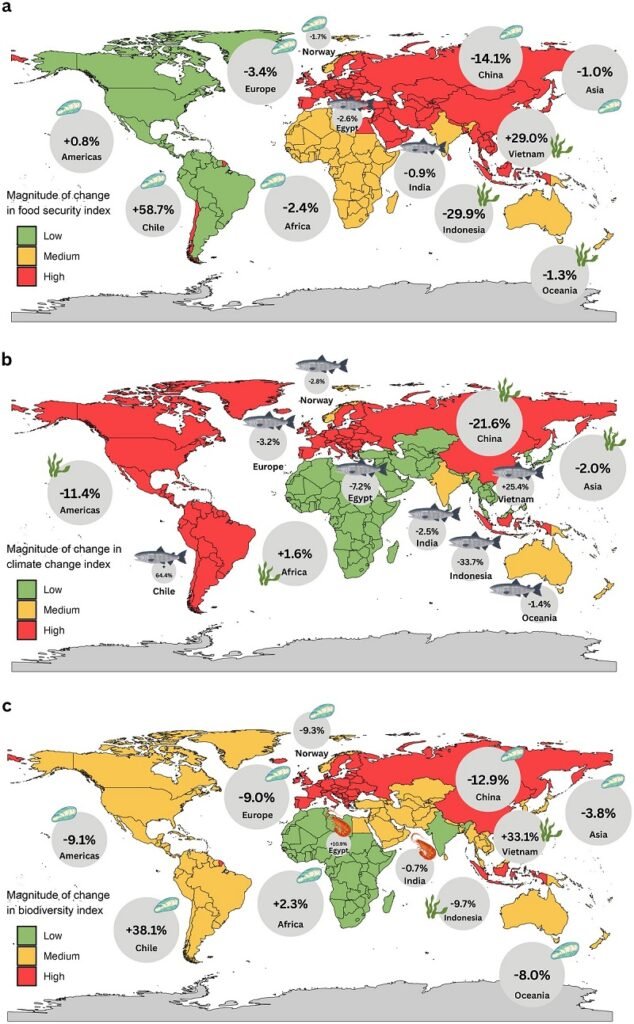
Trends exhibit spatial variation. Regions such as China and Indonesia have experienced marked declines in their biological indices due to the transition toward lower-scoring species. Conversely, countries like Chile and Vietnam have shown improvements, though these represent a substantial portion of their theoretical maximum potential, suggesting an imminent need to diversify species to sustain progress.
The Critical Importance of Bivalves and Seaweed
The study emphasizes that not all species are equal in terms of sustainability. “Certain species, such as bivalves and seaweed, can generate significant environmental benefits, whereas others entail greater trade-offs,” Wong states. “Currently, many of the most beneficial species are underrepresented in global production.”
Bivalves, for instance, contribute disproportionately to biodiversity and climate goals due to their filtration capacity and low input requirements. Nevertheless, barriers such as low market demand and the absence of regulatory frameworks limit their expansion, particularly in North America.
The Socioeconomic Factor
Dr. Cheung cautions that biology is not the sole determinant: “Food security is shaped by factors such as production efficiency and the nutrient density of species, but also by complex dynamics among producers, consumers, markets, and regulatory bodies. These factors indirectly influence food security through impacts on food availability, access, trade, income, and equity.”
Mantente siempre informado
Stay Informed
Únete a nuestras comunidades para recibir al instante las noticias, informes y análisis más importantes del sector acuícola.
Join our communities to get instant access to the most important news, reports, and analysis from the aquaculture industry.
Although biotechnology and feed improvements have bolstered the sector’s biological potential by a margin of 1.3% to 3.6%, these advancements are concentrated in a few species (such as salmon or tilapia) and in high-income regions. Such technological shifts have proven insufficient to reverse the overall negative trend driven by changes in the composition of produced species.
Toward a Coordinated Transformation
To align aquaculture with the SDGs, researchers suggest that the path forward is not merely producing more, but producing better. “Many regions already cultivate species with high sustainability potential. By scaling up these species and diversifying production, aquaculture can better contribute to global sustainability targets,” Cheung maintains.
However, Wong concludes that this shift will not occur in isolation: “The transition toward more sustainable aquaculture will require coordinated international action. It necessitates policy improvements, investment in innovation, and shifts in consumer dietary preferences.”
Contact
Aleah Wong
Institute for the Oceans and Fisheries, The University of British Columbia
Vancouver, British Columbia, Canada
Email: a.wong@oceans.ubc.ca
Reference (open access)
Wong, A., A. Y.Frommel, U. R.Sumaila, and W. W. L.Cheung. 2026. “Shifting Trends in Aquaculture’s Biological Potential to Address Food, Climate and Biodiversity Challenges.” Fish and Fisheries1–14. https://doi.org/10.1111/faf.70081.

Editor at the digital magazine AquaHoy. He holds a degree in Aquaculture Biology from the National University of Santa (UNS) and a Master’s degree in Science and Innovation Management from the Polytechnic University of Valencia, with postgraduate diplomas in Business Innovation and Innovation Management. He possesses extensive experience in the aquaculture and fisheries sector, having led the Fisheries Innovation Unit of the National Program for Innovation in Fisheries and Aquaculture (PNIPA). He has served as a senior consultant in technology watch, an innovation project formulator and advisor, and a lecturer at UNS. He is a member of the Peruvian College of Biologists and was recognized by the World Aquaculture Society (WAS) in 2016 for his contribution to aquaculture.