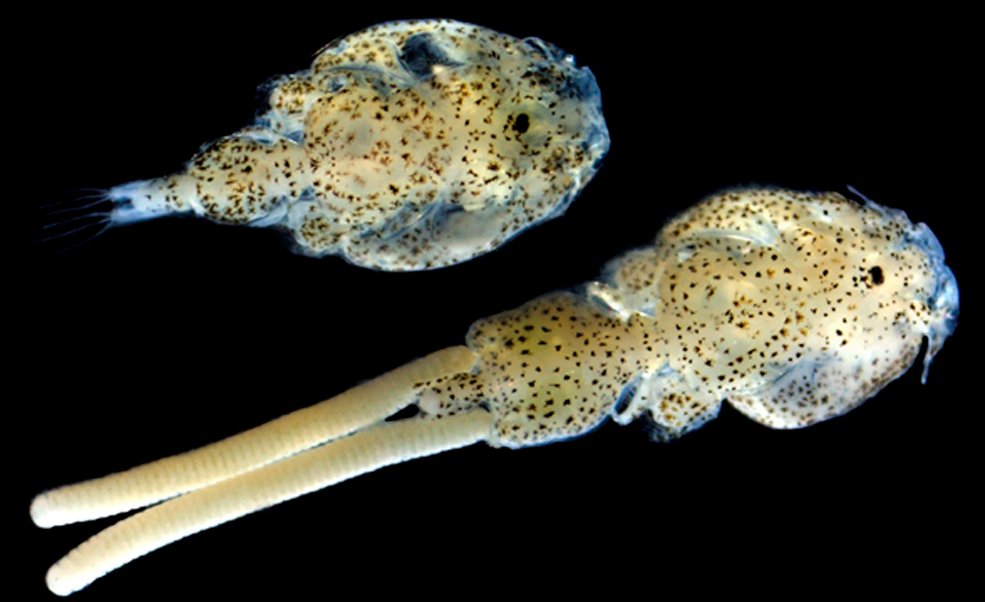
Dr. Cristian Gallardo Escárate, professor at the Department of Oceanography at the University of Concepción and director of the Applied Research Center funded by ANID, INCAR², has been awarded a FONDECYT Regular grant to investigate how sea lice determine their sex—a key finding for salmon aquaculture.
“This project will allow us to understand fundamental processes in invertebrate biology and, at the same time, contribute innovative solutions for a strategic industry such as salmon farming,” emphasized Dr. Gallardo Escárate.
The project, which also involves Dr. Steven Roberts from the University of Washington, United States, and Dr. Guillaume Rivière from the Université de Caen-Normandie, France, aims to decipher the molecular mechanisms that determine whether Caligus rogercresseyi will be male or female. This knowledge will enable the design of new control strategies against one of the main threats to the industry. Additionally, researchers Dr. Valentina Valenzuela and Dr. Diego Valenzuela will participate from INCAR² in developing the molecular and bioinformatic tools needed for this challenging research project.
The EPISex Project
The initiative, titled Epitranscriptomics of Sexual Determination in Sea Lice (EPISex), focuses on studying how certain chemical modifications in RNA—the molecules that carry genetic information—influence sexual differentiation in these organisms.
The team’s initial results show that males present higher levels of RNA methylation compared to females, directly affecting key genes involved in sex determination. These findings suggest that “epigenetic marks” may act as switches that silence or activate specific genes, thereby defining male or female development.
Beyond its scientific relevance, this research opens the door to new biotechnological control tools, such as manipulating sex ratios or silencing genes, which could reduce parasite reproduction and directly benefit aquaculture.
“Through INCAR², we will experimentally explore gene editing. As an applied research center, we are interested in staying at the forefront and participating in the discussion surrounding the application of these technologies in aquaculture,” added Dr. Gallardo Escárate.
The EPISex project sets out four major goals:
- Confirm the sex chromosome system in sea lice.
- Map RNA modifications throughout their development.
- Evaluate what happens when these modifications are chemically blocked.
- Analyze how non-coding RNAs contribute to the regulation of sex-related genes.
These objectives will be developed over the next three years.
Mantente siempre informado
Stay Informed
Únete a nuestras comunidades para recibir al instante las noticias, informes y análisis más importantes del sector acuícola.
Join our communities to get instant access to the most important news, reports, and analysis from the aquaculture industry.

Editor at the digital magazine AquaHoy. He holds a degree in Aquaculture Biology from the National University of Santa (UNS) and a Master’s degree in Science and Innovation Management from the Polytechnic University of Valencia, with postgraduate diplomas in Business Innovation and Innovation Management. He possesses extensive experience in the aquaculture and fisheries sector, having led the Fisheries Innovation Unit of the National Program for Innovation in Fisheries and Aquaculture (PNIPA). He has served as a senior consultant in technology watch, an innovation project formulator and advisor, and a lecturer at UNS. He is a member of the Peruvian College of Biologists and was recognized by the World Aquaculture Society (WAS) in 2016 for his contribution to aquaculture.