Historically, fish breeders faced both a philosophical and technical dilemma. Similar to the ancient Taoist debate on whether humans can truly know “the joy of fish,” modern science has struggled to objectively measure what occurs beneath the scales without resorting to invasive methods or sacrificing the animal. In traditional aquaculture, determining a fillet’s fat percentage or a specimen’s resilience often required culling the selection candidate’s siblings—a process both laborious and expensive.
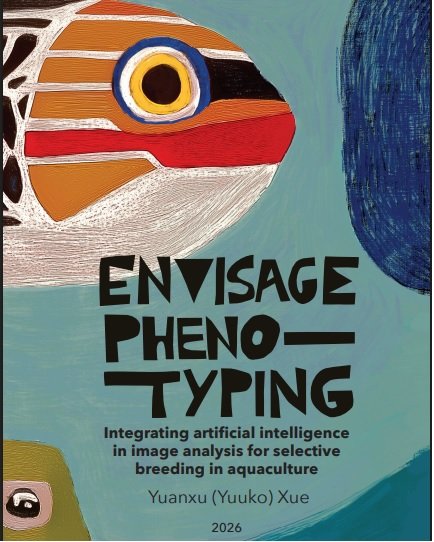
Today, thanks to Yuanxu (Yuuko) Xue’s doctoral research at Wageningen University & Research (WUR), we are witnessing a paradigm shift: “Envisage Phenotyping.” This thesis proposes that Artificial Intelligence (AI) is not merely a computational tool, but a new set of eyes capable of “perceiving” fish genetics and health through a standard camera lens.
- 1 Key Insights
- 2 The Analytical Framework: From Pixels to Slaughter Traits
- 3 Explainable AI (xAI): The Mystery of the Swimming Trout
- 4 The Holy Grail of Aquaculture: Farewell to PIT Tags?
- 5 Objectively Defining the “Perfect Shape”
- 6 Global Impact and the Future of the Industry
- 7 Entradas relacionadas:
Key Insights
- Phenotyping Revolution: Integrating Convolutional Neural Networks (CNNs) enables the non-invasive measurement of complex traits—such as fat content and yield—with superior precision compared to conventional methods.
- Predictive Aquaculture: A novel analytical framework enhanced fat percentage prediction accuracy in gilthead sea bream from 0.4 to 0.7, utilizing solely visual imagery and body weight.
- Explainable AI (xAI): Utilizing tools like GradCAM, researchers determined that larger cranial structures and broader epaxial muscles are genetically correlated with reduced swimming performance in trout.
- Identification Constraints: Despite Deep Learning advancements, image-based individual identification in salmon remains too nascent to replace PIT tags in field conditions due to phenotypic instability.
The Analytical Framework: From Pixels to Slaughter Traits
The essence of this transformation lies in the capacity to convert unstructured data (images) into breeding decisions. The study introduced a structural framework utilizing Convolutional Neural Networks (CNNs) to predict slaughter traits in the gilthead sea bream (Sparus aurata).
The Digital “Connoisseur” Analogy
Imagine a 19th-century sheep connoisseur, as described by Darwin, evaluating wool quality at a glance. Xue’s AI functions as a digital “connoisseur” that is not limited to measuring length and width; unlike previous models that relied on manual annotations (biological landmarks), this AI analyzes the fish’s entire image without preconceived assumptions.
- Results in Gilthead Sea Bream: The multi-input model—combining images and body weight—elevated fat percentage prediction accuracy from a mediocre 0.4 to a robust 0.7.
- Identification of Critical Regions: Utilizing the Score-CAM technique, it was discovered that the operculum edge and the pectoral fin serve as key indicators, negatively correlated with fillet fat content.
Explainable AI (xAI): The Mystery of the Swimming Trout
One of the most fascinating chapters of the thesis addresses critical swimming speed ($U_{crit}$) in rainbow trout (Oncorhynchus mykiss). Swimming performance is a vital indicator of health and survival; however, measuring it requires exhaustion trials in swim tunnels that are extremely labor-intensive.

Xue utilized 3D imagery and activation maps (GradCAM) to “open the black box” of AI. The system “learned” to predict swimming capacity by focusing on specific regions that were subsequently validated by physiologists.
The Counterintuitive Finding
Contrary to expectations, fish with larger and wider epaxial muscles (the upper dorsal region) exhibited poorer swimming performance. Genetically, the increase in muscle mass appears to generate drag that outweighs the benefits of additional strength. This discovery is pivotal for breeding programs: selecting fish solely for fillet size could unintentionally compromise their cardiovascular health and survival capacity.
Individual tracking is essential for monitoring growth over time. Currently, this necessitates the physical insertion of a microchip (PIT tag) into the fish—a stress-inducing process that can lead to mortality. Could AI recognize a salmon by its “freckles” or spots, akin to a human facial recognition system? Research on Atlantic salmon (Salmo salar) served as a lesson in scientific humility: when attempting to re-identify 1,500 fish five months apart, accuracy plummeted drastically.
Real-World Computer Vision Obstacles:
Mantente siempre informado
Stay Informed
Únete a nuestras comunidades para recibir al instante las noticias, informes y análisis más importantes del sector acuícola.
Join our communities to get instant access to the most important news, reports, and analysis from the aquaculture industry.
- Phenotypic Instability: Fish change shape, color, and spot patterns as they mature (smoltification).
- Environmental Variation: Inconsistent lighting in commercial farms confounds algorithms trained in controlled laboratory settings.
- Data Leakage: Xue warns that previous studies claiming 98% recognition accuracy may be biased due to using images taken only minutes apart, which fails to reflect actual farm conditions.
Objectively Defining the “Perfect Shape”
Chapter 6 of the thesis addresses body shape—a traditionally subjective trait. Breeders typically score fish from 1 to 3 based on aesthetics, a method prone to human error and low genetic transmissibility. Through contour analysis and Fourier descriptors, Xue developed two quantitative traits: Distance to Best (DtB) and Distance to Worst (DtW).
- Higher Heritability: These traits showed a heritability of 0.33, significantly surpassing expert visual scores.
- Economic Value: This technology automates the selection of fish meeting market standards, eliminating the need for laborious manual inspections.
Global Impact and the Future of the Industry
The implementation of these technologies by industry leaders like Hendrix Genetics suggests we are at the threshold of “Precision Aquaculture.” By minimizing physical handling and automating data collection, farms become more economically efficient and ethical, prioritizing animal welfare. However, Xue emphasizes that AI should not replace the biologist, but rather integrate genomic data with automated vision to create a dynamic phenotypic profile for every animal.
Reference (open access)
Xue, Y. (2026). Envisage phenotyping: integrating artificial intelligence in image analysis for selective breeding in aquaculture. PhD thesis, Wageningen University, the Netherlands. 194 p.

Editor at the digital magazine AquaHoy. He holds a degree in Aquaculture Biology from the National University of Santa (UNS) and a Master’s degree in Science and Innovation Management from the Polytechnic University of Valencia, with postgraduate diplomas in Business Innovation and Innovation Management. He possesses extensive experience in the aquaculture and fisheries sector, having led the Fisheries Innovation Unit of the National Program for Innovation in Fisheries and Aquaculture (PNIPA). He has served as a senior consultant in technology watch, an innovation project formulator and advisor, and a lecturer at UNS. He is a member of the Peruvian College of Biologists and was recognized by the World Aquaculture Society (WAS) in 2016 for his contribution to aquaculture.