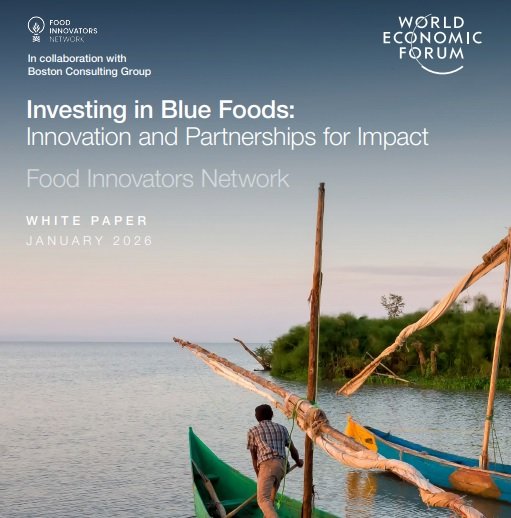
Within the contemporary landscape of global food security, blue foods—aquatic organisms harvested or cultivated in marine and freshwater environments—have transitioned from subsistence resources into the cornerstone of an unprecedented economic transformation. According to a recent report by the World Economic Forum, in collaboration with the Boston Consulting Group, these systems not only nourish billions but also sustain 800 million livelihoods worldwide.
For Africa, this opportunity is existential. While the global average daily protein supply stands at 91 grams per person, this figure drops to a mere 65 grams across the African continent. Blue foods provide a practical and scalable solution: they are 30% more cost-effective than other animal-based protein sources and produce 80% fewer greenhouse gas emissions than conventional terrestrial proteins.
Key Pillars of the Blue Revolution
- Massive Economic Impact: Doubling blue food production in Africa by 2050 could inject an additional $17 billion into the continent’s GDP.
- Closing the Nutritional Gap: This expansion would facilitate a 25% reduction in the protein supply deficit that currently separates Africa from the global average.
- Employment Engine: The sector’s strategic growth has the potential to generate approximately 3.3 million new sustainable livelihoods.
- Efficiency and Waste Mitigation: Simply reaching global efficiency benchmarks—by reducing transport and disease-related losses—would increase the annual supply by 5 million tonnes.
Analysis Methodology
This research draws upon data from the Food and Agriculture Organization (FAO), the World Bank, and strategic frameworks developed by the Boston Consulting Group (BCG). The ‘blue ambition’ model simulates the socio-economic impact of doubling current production—from 13.1 million to 26.2 million tonnes—by 2050, meticulously assessing variables such as GDP, employment, and nutritional outcomes.
Challenges: The Cost of Inefficiency
- Infrastructure and Post-Harvest Loss: Despite its potential, the sector faces critical bottlenecks; approximately one-third of total output is squandered before reaching the consumer due to deficient infrastructure.
- Input Cost Disparity: Fish feed accounts for 70% to 80% of total production costs in Africa, compared to a 60% global average, a gap primarily driven by heavy import dependency.
- Technological Divide: The Feed Conversion Ratio (FCR) for tilapia in Africa stands at 2.5, significantly higher than the global benchmark of 1.5, meaning African producers require substantially more input to achieve the same yield.
- Biosecurity Risks: Viral outbreaks, such as the Infectious Spleen and Kidney Necrosis Virus (ISKNV) in Lake Volta, have caused mortality rates of up to 90%, exacerbated by the absence of localized diagnostic systems.
- Governance and IUU Fishing: It is estimated that 36% of tuna and shrimp catches in African waters (2016–2021) were potentially illegal—nearly double the global average of 20%.
Innovation: The Game-Changing Technologies
The World Economic Forum identifies three critical categories where innovation is unlocking the potential of aquatic systems:
- Product and Input Innovation: Circular alternatives are challenging the traditional reliance on fishmeal and soy.
- Calysta (China): Leverages methane fermentation to produce single-cell proteins that consume up to 98% less water than conventional proteins.
- Agrimercarb (Ghana): Converts local organic waste into high-quality feed via Black Soldier Fly Larvae (BSFL), reducing costs and empowering rural women through waste collection initiatives.
- Production Technology: Precision is the cornerstone of reducing mortality and enhancing yields.
- Dominion Solutions (South Africa): Developed AquaBrain Net, an AI-powered system providing real-time monitoring of water quality and fish behavior to detect early pathological signs.
- WorldFish (Egypt and Bangladesh): By standardizing hatchery protocols, they have successfully boosted fingerling survival rates by 30% to 50%.
- Supply Chain Optimization: Bridging the gap between producers and the market is vital for profitability.
- ColdHubs (Nigeria): Deploys solar-powered cold storage at landing sites under a pay-as-you-store model, reducing spoilage by over 50%.
- Maritech (Norway): Implements machine-vision grading systems that assess weight, color, and fat content with surgical precision, facilitating entry into premium export markets.
Risks and Safeguards: Growth with Purpose
The report cautions that unmanaged growth may prove counterproductive; thus, industrial expansion must be coupled with rigorous environmental and social safeguards to ensure long-term viability.
- Ecosystem Preservation: Africa hosts 20% of the world’s mangroves, which function as vital ‘living infrastructure’ for coastal fisheries and must be prioritized for restoration and protection.
- Social Inclusion: Given that women constitute 60% of the post-harvest workforce, innovation must be inclusive by design—developed in collaboration with them to ensure equitable access to capital and leadership roles.
- Local Food Security: The scaling of aquaculture must prevent the diversion of staple crops (such as maize or wheat) exclusively toward fish feed production, requiring robust oversight to bolster regional food stability.
The Road Ahead: Multi-stakeholder Collaboration
The success of nations such as China, which achieved a tilapia production of 1.8 million tonnes in 2019, and Indonesia, which saw a fifteen-fold increase in aquaculture output between 2000 and 2021, underscores that strategic alignment is pivotal. For Africa, the World Economic Forum proposes the ‘Food Innovation Hubs’ model—catalytic centers designed to bridge governments, private investors, and local communities to de-risk early-stage investment and scale proven interventions.
‘Diversification and innovation will enable Africa to emerge as a leader in unlocking the blue food opportunity, providing a blueprint for inclusive and resilient growth.’
Reference (open access)
World Economic Forum. (2026). Investing in Blue Foods: Innovation and Partnerships for Impact [White paper]. En colaboración con Boston Consulting Group. Ginebra, Suiza: World Economic Forum. 37 p.

Editor at the digital magazine AquaHoy. He holds a degree in Aquaculture Biology from the National University of Santa (UNS) and a Master’s degree in Science and Innovation Management from the Polytechnic University of Valencia, with postgraduate diplomas in Business Innovation and Innovation Management. He possesses extensive experience in the aquaculture and fisheries sector, having led the Fisheries Innovation Unit of the National Program for Innovation in Fisheries and Aquaculture (PNIPA). He has served as a senior consultant in technology watch, an innovation project formulator and advisor, and a lecturer at UNS. He is a member of the Peruvian College of Biologists and was recognized by the World Aquaculture Society (WAS) in 2016 for his contribution to aquaculture.