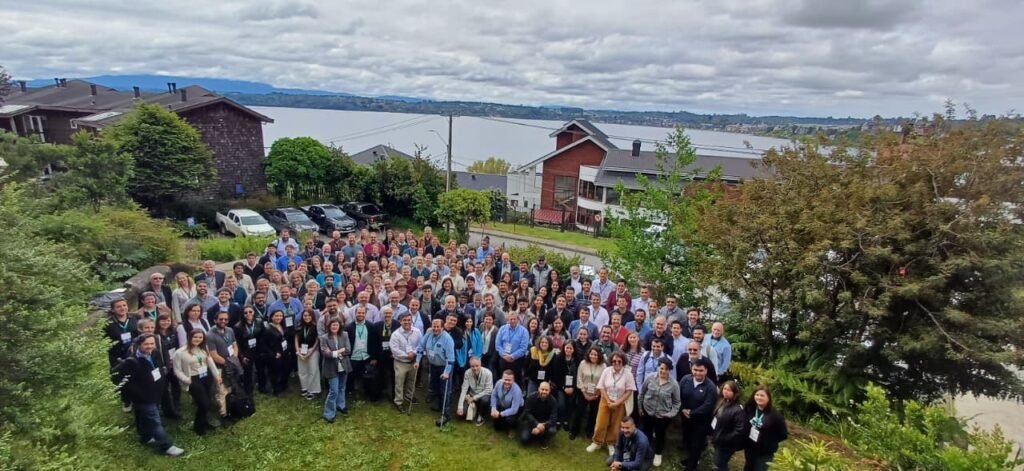
The city of Puerto Varas in southern Chile recently became the global epicenter of aquaculture health research by hosting the Sea Lice Conference 2025. Held from November 30 to December 4, the event brought together the scientific community, authorities, and private sector representatives to address one of the most persistent and costly challenges in global salmon farming: sea lice control (Caligus rogercresseyi and Lepeophtheirus salmonis).
With over 250 registered attendees and more than 80 presentations in both oral and poster formats, the conference served not only to present hard data but also to reaffirm Chile’s role as an undisputed benchmark in aquaculture research. Organized by the Institute of Aquaculture at the Austral University of Chile (UACh), the Interdisciplinary Center for Aquaculture Research (INCAR), and the Salmon Technological Institute (INTESAL), the event concluded with a highly positive outcome and a clear focus on the future: the next gathering will take place in 2028 in Bergen, Norway.
Below, we analyze the strategic pillars discussed by sector leaders and break down the most promising scientific findings presented during the sessions.
- 1 A Meeting Point for Aquaculture Sustainability
- 2 Animal Welfare: The Hidden Cost of Treatments
- 3 Genetics and Genomics: Editing Resistance
- 4 Pharmacology: Resistance Challenges and New Tools
- 5 Non-Pharmacological Strategies: Nutrition and Physical Barriers
- 6 Interaction with Wild Fauna and Conclusions
- 7 Entradas relacionadas:
A Meeting Point for Aquaculture Sustainability
Beyond the papers and charts, the true value of the Sea Lice Conference 2025 lay in the human and strategic interaction. The “triad” composed of the public sector, private enterprise, and academia was identified by attendees as the vital engine for generating real solutions.
Sandra Marín, from the Institute of Aquaculture and Environment at UACh, highlighted the caliber of the content: “We believe the quality of the work presented was high and very diverse, providing us with tremendous input for collaboration in the next version.” Marín emphasized the desire that, by the 2028 reunion, research will have advanced further toward applicability to directly contribute to industry sustainability.

From a governmental perspective, Mónica Rojas, Deputy Director of Aquaculture at Sernapesca, valued the instance as the most important global event on this subject, underscoring that it allows ecosystem actors to share key experiences for sustainable management.
Representing the private sector, Alejandro Heisinger, Health Manager at AquaChile Group, highlighted how this interaction allows for “grounding practices focused mainly on prevention, control, and understanding the parasite’s biology.”
Dr. Cristian Gallardo-Escárate, Director of the INCAR Center, emphasized national human capital: “This conference ratifies Chile’s leadership in research and development regarding Caligus. There is a lot of talent per square meter in Chile… so we must leverage and empower it.”
Delving into the scientific core, a transversal theme was the impact of control strategies on overall fish health. It is no longer enough to eliminate the parasite; it is imperative to do so without compromising the host’s welfare.
Mantente siempre informado
Stay Informed
Únete a nuestras comunidades para recibir al instante las noticias, informes y análisis más importantes del sector acuícola.
Join our communities to get instant access to the most important news, reports, and analysis from the aquaculture industry.
A relevant study presented by Aquabyte evaluated the effect of delousing treatments on Atlantic salmon skin integrity using underwater cameras in Norway. Researchers monitored indicators such as scale loss and wounds for six months. Results indicated that while all treatments negatively impact skin integrity, water temperature is a critical factor: treatments performed at lower temperatures (with a difference of approximately 10°C) showed a variation in skin damage, suggesting that thermal management is vital to mitigate fish suffering.
Complementing this view, MSD Animal Health presented data collected between 2015 and 2023 from over 100 Norwegian farms. Their studies showed that the use of sedation during mechanical and thermal treatments not only improves welfare indicators but also increases the lice removal rate, thereby optimizing production efficiency.
From an ecological perspective, the Norwegian Institute for Nature Research raised a question about co-infection in wild salmon: Do other parasites influence lice acquisition? Their preliminary findings suggest a positive correlation between endoparasite biomass and the number of lice acquired, adding a new layer of complexity to smolt health dynamics.
Genetics and Genomics: Editing Resistance
Modern biotechnology is enabling a shift from observation to the editing of the immune response. Dr. Mark Fast, an academic at the University of Prince Edward Island (Canada)—who also highlighted the importance of a united scientific community—led a study alongside other researchers on the genetic basis of resistance.
The team used CRISPR-Cas9 technology to edit genes in Coho salmon, a species known for its natural resistance to sea lice. By “knocking out” (deactivating) specific regions of immune genes (GE2 and GE4), they observed that these fish presented significantly higher infestations than controls, confirming the functional role of these genes in defense against the parasite. This finding is fundamental for attempting to transfer or emulate that resistance in Atlantic salmon.
Locally, researchers from the INCAR Center presented promising advances with the recombinant vaccine IPath®. This development, based on a chimeric ferritin/transferrin protein, has not only demonstrated over 70% protection against C. rogercresseyi but also revealed an unexpected additional benefit: improved tolerance to hypoxia. Vaccinated fish showed higher hemoglobin levels and less tissue damage under low-oxygen conditions, suggesting that new biotechnological tools can offer multipurpose solutions for environmental and sanitary stress.
Pharmacology: Resistance Challenges and New Tools
Despite the rise of alternative methods, pharmaceuticals remain a necessary control tool, although their efficacy is under pressure.
A retrospective study (2022-2025) conducted by Mowi Chile and Universidad San Sebastián analyzed the sensitivity of C. rogercresseyi to emamectin benzoate in the Los Lagos and Aysén regions. The data confirmed a worrying trend: EC50 values (the concentration needed to affect 50% of the parasites) have steadily increased, reaching historical highs in 2024, indicating significant sensitivity loss and the need to optimize rotation strategies.
To combat this, MSD Animal Health presented a new bioassay protocol in Norway to test emamectin sensitivity in larval stages (copepodids), something traditionally done only in mobile stages. This tool will allow producers to predict treatment success before application, preventing ineffective medication use.
Furthermore, Sudvet Corp introduced a new oral formulation with a novel active ingredient for the salmon industry. In controlled trials, this product demonstrated efficacy against all developmental stages of C. rogercresseyi and L. salmonis, positioning itself as a viable alternative to rotate with current molecules and extend their lifespan.
Non-Pharmacological Strategies: Nutrition and Physical Barriers
Prevention through functional diets and physical barriers was another strong pillar of the conference, aligning with the pursuit of more sustainable production.
- Functional Nutrition: A collaborative study between Aker BioMarine and the University of Bergen evaluated the use of krill meal in smolt diets. Results showed that an 8% inclusion of krill meal not only thickened the skin epithelium (improving the physical barrier) but also significantly reduced lice load after a challenge, validating the role of nutrition in mucosal immunity.
- Electric Fences: The “Harbor Fence” technology, presented by Harbor AS, uses electromagnetic pulses to damage lice larvae attempting to enter cages. Lab trials indicated a 60-80% reduction in lice settlement, offering a non-invasive preventive measure.
- Skirts: Field data presented by Mowi Chile demonstrated that the use of protective skirts reduced larval density inside cages by 40% to 60% compared to the outside. This resulted in delaying the need for the first pharmacological treatment, confirming the efficacy of skirts as part of integrated pest management.
Interaction with Wild Fauna and Conclusions
The conference also addressed the complex relationship between farms and wild fish populations. A Canadian study by Mainstream Biological Consulting analyzed lice trends in wild salmon following the removal of farms in the Discovery Islands and the Broughton Archipelago. Their conclusions suggest that, in those specific regions, lice abundance (L. salmonis and C. clemensi) in wild juveniles did not vary significantly after the cessation of aquaculture, a finding that adds nuance to the debate on environmental impact.
Conversely, research in Norway by the Institute of Marine Research documented through in situ experiments that the mortality risk for wild Atlantic salmon can increase drastically in areas of high lice density, also affecting sea trout and Arctic char.
The Sea Lice Conference 2025 closed its doors in Puerto Varas, leaving one certainty: the solution to the Caligus problem is not singular, but integrative. It requires genetics, smart pharmacology, barrier technology, and above all, the continuous collaboration driven by leaders like Cristian Gallardo-Escárate and Mark Fast. The industry takes away a clear roadmap from Chile, with the promise to reassess progress in Bergen in 2028.
Reference (open access)
Sea Lice Conference 2025. (2025). Book of Abstracts. Puerto Varas, Chile: Universidad Austral de Chile, INCAR & INTESAL.

Editor at the digital magazine AquaHoy. He holds a degree in Aquaculture Biology from the National University of Santa (UNS) and a Master’s degree in Science and Innovation Management from the Polytechnic University of Valencia, with postgraduate diplomas in Business Innovation and Innovation Management. He possesses extensive experience in the aquaculture and fisheries sector, having led the Fisheries Innovation Unit of the National Program for Innovation in Fisheries and Aquaculture (PNIPA). He has served as a senior consultant in technology watch, an innovation project formulator and advisor, and a lecturer at UNS. He is a member of the Peruvian College of Biologists and was recognized by the World Aquaculture Society (WAS) in 2016 for his contribution to aquaculture.