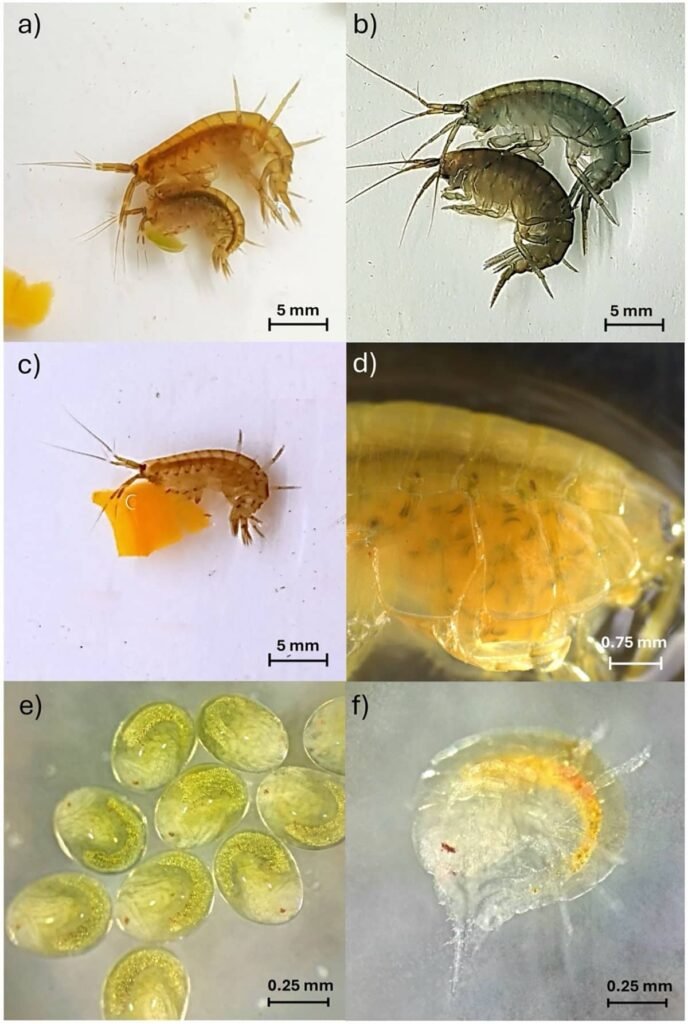
The growth of the aquaculture industry hinges on two finite and ecologically strained resources: fishmeal and fish oil. This is where an unexpected, diminutive, and segmented protagonist emerges: marine gammarids.
An international research consortium, led by experts from the University of Aveiro (CESAM) and ScienceCrunchers, has published a paradigm-shifting perspective in the journal Frontiers in Marine Science, positioning these amphipod crustaceans as the missing link in the sustainable aquaculture feed puzzle.
Key Highlights
- Omega-3 Bio-factories: Unlike terrestrial insects, marine gammarids can biosynthesize essential fatty acids (EPA and DHA), mitigating reliance on fish oil.
- Circular Economy Champions: These crustaceans can upcycle organic waste and invasive macroalgae, converting side-streams into premium nutritional ingredients.
- Superior Nutritional Profile: They provide crude protein levels (up to 50%) comparable to fishmeal, alongside natural carotenoids that enhance the pigmentation and health of farmed species.
- Low-Trophic Sustainability: By targeting organisms at the base of the food web, the environmental footprint of feed production is significantly curtailed.
The Challenge: Modern Aquaculture’s Nutritional Gap
Historically, aquaculture has relied on harvesting wild fish to feed farmed stocks. Although efficiency has improved, the industry still requires massive sources of long-chain polyunsaturated fatty acids (LC-PUFAs) omega-3, specifically EPA and DHA, which are vital for both fish health and the nutritional value of the final product reaching the consumer.
Current alternative ingredients, such as terrestrial insects (black soldier fly or mealworm), are excellent protein sources but lack the necessary levels of marine omega-3s. Gammarids, conversely, offer the best of both worlds.
What are gammarids, and why are they different?
Gammarids are small crustaceans belonging to the order Amphipoda. They are found in nearly all marine and estuarine ecosystems worldwide. According to the study led by Ricardo Calado and Marta Carvalho, these organisms possess a critical evolutionary advantage: the metabolic capacity to biosynthesize essential fatty acids.
The Metabolism of “Designer Fats”
Unlike many other animals, marine gammarids possess a suite of enzymes called elongases and desaturases. These biochemical tools allow them to take shorter, simpler fatty acids (present in low-quality algae or detritus) and transform them into valuable EPA and DHA.
This trait turns them into authentic microscopic “bio-refineries.” Instead of merely accumulating what they eat, they upgrade the nutritional value of the substrate, allowing low-cost food sources to be converted into “nutritional gold” for salmon, sea bream, or prawns.
Transforming Waste into High-Quality Biomass
The research emphasizes that gammarid production does not compete with human food. The model proposed by the Portuguese institutions and their European collaborators is based on the Blue Circular Economy.
Gammarids can be reared using:
Stay Always Informed
Join our communities to instantly receive the most important news, reports, and analysis from the aquaculture industry.
- Invasive or waste macroalgae: Biomass that often rots on beaches, causing environmental issues.
- Aquaculture sludge: Organic waste from the fish farms themselves.
- Food industry by-products: Vegetable remains that currently end up in landfills.
By feeding gammarids these materials, producers not only generate fish feed but also clean the environment and reduce the carbon footprint of the global food system.
Beyond Protein
The detailed nutritional analysis in the paper shows that gammarids not only match the protein content of fishmeal (40-55% crude protein) but also provide additional benefits:
- Natural Carotenoids: Such as astaxanthin, essential for the crustacean immune system and for the characteristic pink color of salmonid flesh.
- Minerals and Vitamins: A micronutrient density superior to plant-based ingredients (soy or wheat).
- High Palatability: Tests indicate that fish find gammarids extremely attractive, which reduces feed waste in aquaculture farms.
Challenges and the Path Toward 2030
Despite the immense potential, the transition toward gammarids as a standard ingredient is not without challenges. The article identifies three critical areas requiring investment and development:
- Cultivation Scalability: Currently, most studies have been conducted on a small scale. Mass production systems (possibly in Integrated Multi-Trophic Aquaculture or IMTA) are needed to compete in price with soy or fishmeal.
- Regulatory Framework: As occurred with terrestrial insects, gammarids must navigate complex EU food safety laws (Novel Foods) to be approved as large-scale feed ingredients.
- Nutritional Optimization: Researchers suggest that by “designing diets” for the gammarids themselves, “à la carte” ingredients could be created with specific amino acid or fatty acid profiles depending on the fish species to be fed.
Conclusion
The research published in Frontiers in Marine Science makes it clear that we cannot continue feeding the fish of the future with the methods of the past. Marine gammarids represent a unique opportunity to align economic efficiency with ecological regeneration.
By investing in these amphipods, the aquaculture industry not only secures its omega-3 supply but also becomes a driver of the circular economy, transforming the concept of “waste” into a “resource.” As the authors conclude, gammarids are not just an alternative; they are an essential part of the future portfolio of ingredients that will guarantee the health of our oceans and our own nutrition.
Reference (open access)
Calado, R., Carvalho, M., Marques, L., Rodrigues, D. P., Sousa, J. P., Rey, F., Domingues, M. R., Fernandes, J. F., Silva, R. X., Madeira, D., Malzahn, A. M., Monroig, Ó., & Leal, M. C. (2025). Why marine gammarids belong to the future portfolio of aquafeed ingredients. Frontiers in Marine Science, 12, 1697384. https://doi.org/10.3389/fmars.2025.1697384

Editor at the digital magazine AquaHoy. He holds a degree in Aquaculture Biology from the National University of Santa (UNS) and a Master’s degree in Science and Innovation Management from the Polytechnic University of Valencia, with postgraduate diplomas in Business Innovation and Innovation Management. He possesses extensive experience in the aquaculture and fisheries sector, having led the Fisheries Innovation Unit of the National Program for Innovation in Fisheries and Aquaculture (PNIPA). He has served as a senior consultant in technology watch, an innovation project formulator and advisor, and a lecturer at UNS. He is a member of the Peruvian College of Biologists and was recognized by the World Aquaculture Society (WAS) in 2016 for his contribution to aquaculture.