Vibrio parahaemolyticus is a persistent issue in the shellfish industry. This bacterium, naturally found in marine environments worldwide, is a leading cause of gastroenteritis from raw oyster consumption. As sea temperatures rise, conditions become more favorable for its growth, increasing public health risks and creating a constant challenge for oyster producers.
To address this, post-harvest processing (PHP) methods like freezing or high-pressure treatment are used. However, these processes kill the oysters, altering their organoleptic properties and diminishing their value to consumers who prefer a live, fresh product. Depuration offers a solution, allowing live oysters to purge bacteria in a controlled, sterile seawater environment. A recent study in PLOS One by Oregon State University researchers investigates how to optimize and safely validate this process for commercial use.
Key findings
- The study achieved a reduction of over 3-log in Vibrio parahaemolyticus levels in Crassostrea gigas and C. sikamea oyster species within five days.
- Non-pathogenic strains of V. parahaemolyticus were proven to be a suitable surrogate for pathogenic strains. Because they are removed at a comparable or slower rate, they provide a safe and conservative method for validating commercial systems.
- Depuration effectiveness varied significantly by species. While C. gigas and C. sikamea showed effective bacterial removal, the C. virginica species was more resilient and failed to meet the 3-log reduction target in any trial.
- Recirculating depuration systems are a viable post-harvest strategy for mitigating V. parahaemolyticus risks in live oysters, though parameters must be optimized for each species.
The challenge: How to validate a system without hazardous bacteria?
For a depuration method to be commercially viable, it must consistently reduce V. parahaemolyticus to safe levels, such as the >3.0-log reduction standard set by the U.S. National Shellfish Sanitation Program (NSSP). However, intentionally introducing large quantities of a pathogenic bacterium into an industrial-scale system for validation poses an unacceptable biological risk. The primary goal of this research was therefore to assess whether a “cocktail” of non-pathogenic V. parahaemolyticus strains could serve as a safe surrogate for pathogenic strains in validation studies.
Methodology
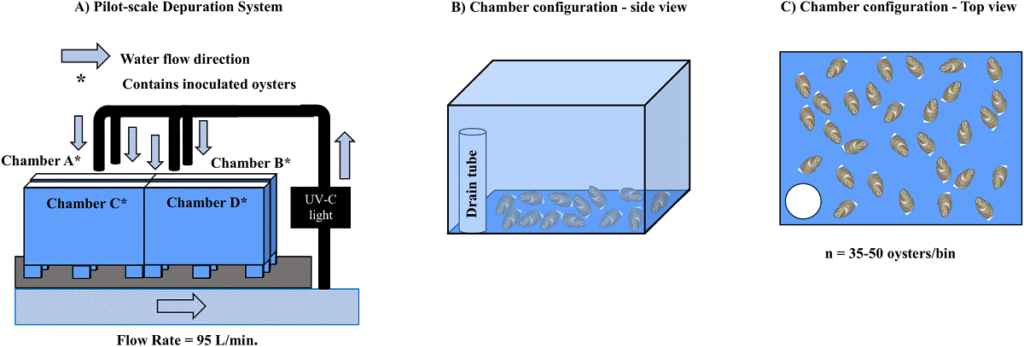
Researchers designed controlled experiments using a pilot-scale recirculating depuration system.
Oysters and bacteria under investigation
The study involved three commercially significant oyster species: Crassostrea gigas (Pacific oyster), C. sikamea (Kumamoto oyster), and C. virginica (Eastern oyster). These oysters were inoculated by exposure to seawater containing one of two bacterial mixtures:
- A cocktail of five pathogenic V. parahaemolyticus strains of clinical origin.
- A cocktail of five non-pathogenic V. parahaemolyticus strains isolated from Pacific oysters.
This step ensured the oysters had a high, measurable initial bacterial load (over 5 log CFU/g) to quantify a significant reduction.
The depuration system and test conditions
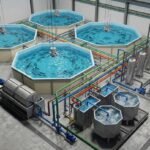
After inoculation, the oysters were placed in a 450-liter recirculating depuration system equipped with filters, a protein skimmer, and a UV sterilizer. The trials varied two key parameters:
- Temperature: Three cool temperatures were tested (5°C, 11°C, and 13°C), as V. parahaemolyticus does not proliferate below 15°C.
- Duration: Trials lasted five to seven days, with daily sampling to measure bacterial concentrations.
Temperature and species: The determining factors
The results highlighted the optimal conditions for depuration and confirmed the viability of the non-pathogenic surrogate.
The ideal temperature: Neither too cold nor too warm
- At 5°C: Bacterial removal was rapid in the first 48 hours but then stalled, potentially because the oysters entered a state of dormancy, reducing their filtering activity. The 3-log reduction target was not met under these conditions.
- At 11°C and 13°C: Results were far more promising. At 11°C, a >3-log reduction was achieved for pathogenic strains in C. gigas and C. sikamea within five days. At 13°C, all three species reached this target for the pathogenic cocktail, showing that a slightly elevated yet cool temperature promotes oyster activity without encouraging bacterial growth.
The non-pathogenic surrogate: A success for safe validation
The most significant finding for the industry was the confirmation of the surrogate. Across all tests and species, the non-pathogenic strain cocktail was reduced at a rate comparable to or slower than the pathogenic cocktail. This is crucial because it establishes the non-pathogenic strain as a conservative and safe indicator.
Mantente siempre informado
Stay Informed
Únete a nuestras comunidades para recibir al instante las noticias, informes y análisis más importantes del sector acuícola.
Join our communities to get instant access to the most important news, reports, and analysis from the aquaculture industry.
Not all oysters respond equally
The study also revealed that there is no one-size-fits-all solution. Depuration was considerably slower and less effective in C. virginica. This underscores the need to develop species-specific depuration protocols that account for physiological differences.
Practical implications for the oyster industry
This research offers valuable takeaways for oyster producers:
- Safe validation is possible: Producers now have a scientific basis for using non-pathogenic V. parahaemolyticus strains to validate their systems.
- Optimization is key: The success of depuration depends on fine-tuning parameters like temperature, with the 11-13°C range serving as an effective starting point.
- Protocols must be species-specific: A producer working with C. virginica will require different and potentially longer depuration conditions than one farming C. gigas.
In summary, this work is a fundamental step toward safer and more reliable oyster production.
Contact
Spencer L. Lunda
Department of Biomedical Sciences, Carlson College of Veterinary Medicine, Oregon State University
Corvallis, Oregon, United States of America
Lundas@oregonstate.edu
Reference (open access)
Lunda SL, Kilgore S, Hesser JM, Waite-Cusic JG, Schubiger CB (2025) Pilot-scale depuration demonstrates the suitability of non-pathogenic Vibrio parahaemolyticus as a surrogate for commercial-scale validation studies. PLoS One 20(10): e0334240. https://doi.org/10.1371/journal.pone.0334240

Editor at the digital magazine AquaHoy. He holds a degree in Aquaculture Biology from the National University of Santa (UNS) and a Master’s degree in Science and Innovation Management from the Polytechnic University of Valencia, with postgraduate diplomas in Business Innovation and Innovation Management. He possesses extensive experience in the aquaculture and fisheries sector, having led the Fisheries Innovation Unit of the National Program for Innovation in Fisheries and Aquaculture (PNIPA). He has served as a senior consultant in technology watch, an innovation project formulator and advisor, and a lecturer at UNS. He is a member of the Peruvian College of Biologists and was recognized by the World Aquaculture Society (WAS) in 2016 for his contribution to aquaculture.