Against the backdrop of Indonesia’s objective to reach an annual production target of 2 million tons of vannamei whiteleg shrimp, technical efficiency is no longer merely an advantage; it is a vital necessity for the industry’s survival.
Historically, earthen ponds have been the preferred option due to their low construction costs. However, a comprehensive study led by researchers at IPB University reveals a shifting paradigm: the pond floor, far from being a simple substrate, can become the primary cause of economic losses due to the accumulation of toxic metabolites and pathogens.
Key Highlights
- Explosive Productivity: The use of HDPE-lined ponds increases shrimp productivity and survival rates by 133% compared to conventional earthen ponds.
- Feed Efficiency: HDPE systems achieve a 24% lower Feed Conversion Ratio (FCR), meaning higher biomass production with significantly less feed.
- The Invisible Enemy: Low survival rates in earthen ponds are primarily attributed to a high abundance of Cyanophyta—toxic algae that damage the shrimp’s hepatopancreas.
- Proven Profitability: Although the initial investment is 17.54% higher, utilizing HDPE increases total revenue for producers by 57.20%, ensuring long-term economic viability.
The Duel: HDPE vs. Earth
The research was conducted at PT. Indonusa Yudha Perwita (IYP) facilities in West Java directly compared two intensive culture systems over a 91-day cycle:
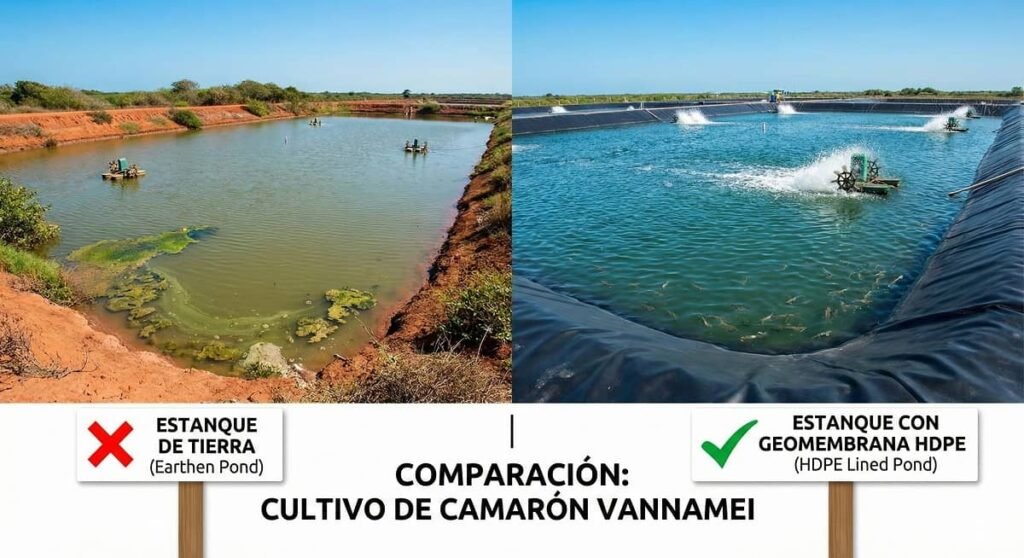
- Earthen Ponds: Traditional systems where water interacts directly with the soil.
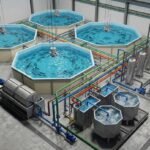
- HDPE-Lined Ponds: Tanks isolated with high-density polyethylene, designed to prevent soil-water contact and facilitate waste management.
Both systems maintained a stocking density of 95 shrimp per m2, evaluating critical parameters of water quality, microbiology, and economic performance.
HDPE as a Growth Catalyst
The data obtained reveal a stark contrast between the two systems. While earthen ponds struggled to maintain acceptable survival rates, HDPE-lined ponds demonstrated superior stability.
Productive Performance Comparison Table.
| Indicator | Earthen Pond | HDPE-Lined Pond | HDPE Impact |
| Productivity (ton/ha) | 3.92 | 9.18 | +133% |
| Survival Rate (%) | 27.32 | 59.34 | +117% |
| FCR (Feed Conversion Ratio) | 1.88 | 1.43 | -24% (More efficient) |
The study emphasizes that the FCR of 1.43 in HDPE-lined ponds falls within the optimal industrial range (<1.5), whereas the 1.88 value in earthen ponds indicates significant feed waste and metabolic stress in the animals.
Why Do Earthen Ponds Fail?
Scientific analysis identified two “silent killers” in earthen ponds that are absent in lined systems:
- The Invasion of Cyanophyta (Blue-Green Algae): Starting from day 56 of the culture cycle, earthen ponds experienced a massive proliferation of Cyanophyta. These algae produce microcystins—toxins that attack the shrimp’s hepatopancreas tissue, inhibit essential enzymes, and trigger cell death (apoptosis). In contrast, HDPE ponds maintained a healthy dominance of Chlorophyta throughout the cycle.
- Soil Depletion and Hydrogen Sulfide (H2S): In earthen ponds, organic matter accumulates within soil pores, creating anaerobic zones. This drops the Oxidation-Reduction Potential (ORP) to critical levels (as low as -191 mV), favoring the production of hydrogen sulfide (H2S), a highly toxic compound identified by the blackening of the sediment. HDPE, by sealing the soil, eliminates this toxic interaction at its source.
Lining Economics: Investing for Profit
The study by Zulfana Fikru Sifa et al. (2026) debunks the myth of HDPE being cost-prohibitive:
Stay Always Informed
Join our communities to instantly receive the most important news, reports, and analysis from the aquaculture industry.
- Production Cost: The HDPE system is 17.54% more expensive to operate (primarily due to the initial lining investment and higher feed consumption required for the increased biomass).
- Benefit-Cost Ratio (BCR): While earthen ponds proved economically unviable (BCR of 0.89), HDPE systems achieved a BCR of 1.72.
- Incremental Profit: For every additional unit of cost invested in HDPE versus earth, the producer yields 5.67 units of profit.
Conclusion and Global Impact
The transition toward intensive HDPE-lined systems is a biological and financial imperative. The ability to control the aquatic ecosystem—by reducing cyanophyta toxins and eliminating the impact of degraded soil—ensures stable production that earthen ponds can no longer guarantee in high-density systems.
Contact
Kukuh Nirmala
Department of Aquaculture, Faculty of Fisheries and Marine Science, IPB University
Bogor, West Java 16680, Indonesia
Email: kukuhni@apps.ipb.ac.id
Reference (open access)
Fikru Sifa, Z., Kukuh Nirmala, Yuni Puji Hastuti, Eddy Supriyono. 2026. Analyze of production performance of vaname shrimp Litopenaeus vannamei culture and water quality on earthen pond and HDPE-lined pond. Jurnal Akuakultur Indonesia. 25, 1 (Jan. 2026), 1–15. DOI:https://doi.org/10.19027/jai.25.1.1-15. https://journal.ipb.ac.id/jai/article/view/60855

Editor at the digital magazine AquaHoy. He holds a degree in Aquaculture Biology from the National University of Santa (UNS) and a Master’s degree in Science and Innovation Management from the Polytechnic University of Valencia, with postgraduate diplomas in Business Innovation and Innovation Management. He possesses extensive experience in the aquaculture and fisheries sector, having led the Fisheries Innovation Unit of the National Program for Innovation in Fisheries and Aquaculture (PNIPA). He has served as a senior consultant in technology watch, an innovation project formulator and advisor, and a lecturer at UNS. He is a member of the Peruvian College of Biologists and was recognized by the World Aquaculture Society (WAS) in 2016 for his contribution to aquaculture.