Europe is warming at an alarming rate, faster than any other continent, recording temperatures that already exceed the pre-industrial average by 2.3°C. This climatic reality poses an unprecedented challenge for aquaculture, a fundamental pillar of global food security.
A recent and comprehensive study, published in the prestigious scientific journal Reviews in Aquaculture, has cast a spotlight on a critical and frequently underestimated consequence of this phenomenon: the drastic alteration in the pathogenesis of infectious diseases in fish.
Global warming acts as a double-edged sword: it not only stresses fish, compromising their immune systems, but also modifies the behavior of viruses, bacteria, and parasites. The result is an increase in the lethality of certain pathogens and the geographic expansion of others into new areas.
Key Findings of the Study
Researchers have identified four critical points that define this new sanitary reality:
- Europe as “Ground Zero”: Warming rates in the Mediterranean and European lakes exceed global averages, directly impacting the physiology of farmed species.
- Bacterial Virulence: Thermal increases activate virulence genes in pathogens such as Vibrio and Lactococcus, significantly elevating mortality rates in cultures.
- Parasitic Surge: Heat accelerates the life cycles of devastating parasites, such as sea lice in salmon and Enteromyxum in sea bream.
- Complex Viral Response: While some cold-water viruses may recede, other more dangerous ones, such as Betanodavirus, thrive and expand in temperatures exceeding 25°C.
The Triangle Under Pressure: Environment, Host, and Pathogen
The study, led by researcher George Rigos of the Hellenic Centre for Marine Research (HCMR) in Greece—in collaboration with experts from the Autonomous University of Barcelona, the University of Split (Croatia), and Swansea University (UK)—underscores a fundamental biological fact: most fish are ectothermic organisms.
As “cold-blooded” animals, their metabolism and immunity depend entirely on water temperature. When this exceeds the species’ optimal range, thermal stress is triggered, leading to immunosuppression. Simultaneously, warmer water retains less oxygen, creating hypoxic environments that further weaken the fish, leaving them vulnerable to disease.
Climate change does not favor all viruses equally. For those adapted to the cold, such as the Viral Hemorrhagic Septicemia virus (VHSV) which attacks rainbow trout and turbot, warming could reduce incidence, as they prefer waters below 15°C.
However, for temperate water species, the outlook is concerning. The study highlights Viral Nervous Necrosis (VNN) as a major threat to sea bass and sea bream in the Mediterranean:
- Higher Mortality: VNN outbreaks in European sea bass are notably more severe when water exceeds 25°C.
- Geographic Expansion: Warming allows viral genotypes, previously restricted, to colonize new latitudes.
Bacteria: Virulence Boosted by Heat
Perhaps the most alarming finding is the bacterial reaction to heat. Unlike viruses, many bacteria not only replicate faster but also activate genetic “attack modes.” The team, including Mikolaj Adamek from the University of Veterinary Medicine Hannover, compiled evidence on key pathogens:
Stay Always Informed
Join our communities to instantly receive the most important news, reports, and analysis from the aquaculture industry.
- Vibriosis and Photobacteriosis: Bacteria such as Vibrio harveyi and V. anguillarum express greater virulence with heat. At 30°C, V. harveyi increases the production of lytic enzymes and siderophores (iron scavengers), tools essential for infection. In parallel, pasteurellosis (Photobacterium damselae) causes massive mortalities in sea bream when temperatures exceed 25°C.
- Emerging Lactococcosis: The bacterium Lactococcus garvieae causes mortality in sea bream starting at 18°C and in sea bass above 23°C, becoming a recurrent threat in the Mediterranean.
Parasites: Accelerated Life Cycles
The impact on parasites is direct and mechanical: heat accelerates their metabolism and reproduction. The report warns of two critical cases:
- Sea Louse (Lepeophtheirus salmonis): In Atlantic salmon, heat shortens the parasite’s generation time. Although they live shorter lives, they develop much faster, multiplying infection pressure. A rise of just 2°C could drastically elevate the parasitic load in the North Sea.
- Enteromyxosis (Enteromyxum leei): This intestinal parasite devastates sea bream. Although suppressed below 15°C, warmer winters allow the parasite to remain active or latent, ready to reinfect rapidly.
Mitigation Strategies: The Roadmap
Faced with this scenario, authors such as Sofia Consuegra (Swansea University) and Ivona Mladineo (Institute of Parasitology BCAS) propose urgent measures:
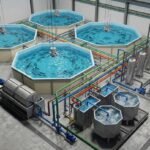
- Engineering and Location: Moving farms to areas with cold currents, using submersible cages to exploit deep thermoclines, or investing in Recirculating Aquaculture Systems (RAS) for total temperature control.
- Genetics and Epigenetics: Beyond classical genetic selection, the study emphasizes epigenetics. This could allow rapid adaptation through phenotypic plasticity, “programming” offspring to resist temperatures their parents experienced.
- Treatment Review: The efficacy of vaccines and chemicals (such as hydrogen peroxide) may drop with heat or become toxic due to the fish’s accelerated metabolism. Health protocols must be rewritten.
Conclusion
Global warming is no longer a future threat to European aquaculture; it is an operational reality redefining the biological relationship between fish and pathogens. The sector’s sustainability will depend on the capacity to anticipate these changes and implement adaptive technologies. Close collaboration between science and industry will be the only lifeline in these increasingly warming waters.
Contact
George Rigos
Hellenic Centre for Marine Research, Institute of Marine Biology, Biotechnology and Aquaculture
Anavyssos, Attiki, Greece
Email: grigos@hcmr.gr
Reference (open access)
Rigos, G., Padrós, F., Constenla, M., Jerončić, A., Kogiannou, D., Consuegra, S., Adamek, M., & Mladineo, I. (2026). Global Warming Affects the Pathogenesis of Important Fish Diseases in European Aquaculture. Reviews in Aquaculture, 18(1), e70112. https://doi.org/10.1111/raq.70112

Editor at the digital magazine AquaHoy. He holds a degree in Aquaculture Biology from the National University of Santa (UNS) and a Master’s degree in Science and Innovation Management from the Polytechnic University of Valencia, with postgraduate diplomas in Business Innovation and Innovation Management. He possesses extensive experience in the aquaculture and fisheries sector, having led the Fisheries Innovation Unit of the National Program for Innovation in Fisheries and Aquaculture (PNIPA). He has served as a senior consultant in technology watch, an innovation project formulator and advisor, and a lecturer at UNS. He is a member of the Peruvian College of Biologists and was recognized by the World Aquaculture Society (WAS) in 2016 for his contribution to aquaculture.