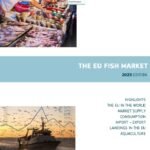
The European Market Observatory for Fisheries and Aquaculture Products (EUMOFA) has released its flagship report of the year: “The EU Fish Market 2025 Edition.” This comprehensive economic analysis is critical for producers, exporters, and researchers, unveiling a 2025 landscape where inflation continues to dictate the terms.
The report exposes a fundamental paradox: while European expenditure on seafood has reached record highs, consumption volume continues to decline. Below, we analyse key findings and their implications for the sector.
Key insights from the 2025 Fisheries Market
- Record Expenditure vs. Lower Volume: Household spending climbed to €62.8 billion (+4%), while fresh fish consumption is falling, hampered by a cumulative price increase of 25% since 2020.
- Trade Balance: The EU remains a net importer, although it managed to reduce its trade deficit by 2% thanks to a slight rebound in export value.
- Aquaculture Contraction: Following two years of growth, the value of EU aquaculture fell by 1% and volume by 4%, primarily affected by a decline in mussel production.
- Geopolitical Shift: China is losing significant ground in the Alaska pollock market to the United States, triggering a reconfiguration of supply routes.
- Market Leadership: Portugal retains the title of highest per capita consumer, while Spain reclaims its position as the EU’s top importer by value.
The consumption paradox: Higher spending, less protein
The most revealing statistic of 2024 is consumer behaviour. The 4% increase in spending does not reflect higher protein intake, but rather the persistent impact of inflation.
Apparent consumption has plummeted to 22.89 kg per person, the lowest level in a decade. Data from Europanel/Kantar/GfK confirm that fresh fish purchases have been falling since 2021. Although general inflation has moderated (near 2.4% in early 2025), aquatic food products are now 25% more expensive than in 2020.
Key Figure: Portugal leads the ranking with 53.61 kg per person, followed at a distance by Spain and France. Even in these traditional strongholds, high prices have eroded purchasing volume.
Self-Sufficiency and the role of logistics hubs
The European Union maintains its reliance on imports, although the self-sufficiency rate technically rose to 38.1% in 2023. This increase stems more from a reduction in imports than a boom in domestic production.
Intra-community trade is vital, representing 45% of the total value. Countries like the Netherlands and Sweden function as strategic logistics hubs, importing massive quantities of Norwegian salmon and cod for processing and subsequent re-export to the common market.
Commercial species dynamics: Winners and losers
Salmon and Shrimp: Undisputed Leaders
Salmon remains king. In 2024, imports grew by 5% in volume thanks to higher European aquaculture production. The stability in total value suggests a necessary price correction following the historic peaks of 2022-2023. Meanwhile, shrimp (prawns) grew 4% in imported volume, with Ecuador consolidating its global dominance in the vannamei variety, gaining ground alongside Argentina and India.
The Shift in Whitefish
Cod suffered a 20% quota cut in the Northeast Arctic, reducing external supply to the EU by 10% and keeping prices high (€6.90/kg). However, the most drastic change occurred with Alaska pollock. Imports from China plummeted by 51%, causing it to lose its hegemony. The United States (+19% share) and Russia quickly filled this void, signalling a restructuring of global processing chains.
State of EU Aquaculture
The aquaculture sector contracted in 2023, with production of 1.04 million tonnes (-4%) and a value of €4.76 billion (-1%).
Stay Always Informed
Join our communities to instantly receive the most important news, reports, and analysis from the aquaculture industry.
- Mussels: Fell 10% in production, impacting global figures.
- Trout: Consolidates as the species with the highest economic value (nearly 20% of the total), growing 16% compared to 2022.
- Seabass and Seabream: Greece maintains production leadership but suffered a 20% drop in value due to competitive pressure.
Conclusion: A market in stabilisation
The 2025 edition of the EUMOFA report outlines a sector seeking stabilisation after inflationary turbulence. Although prices are beginning to moderate, consumption recovery remains the major pending challenge. The European industry demonstrates technical resilience but faces urgent structural challenges in aquaculture production and extractive fishing that will demand continuous innovation.
Reference (open access)
European Market Observatory for Fisheries and Aquaculture Products. (2025). The EU fish market: 2025 edition. Publications Office of the European Union. https://doi.org/10.2771/1531521

Editor at the digital magazine AquaHoy. He holds a degree in Aquaculture Biology from the National University of Santa (UNS) and a Master’s degree in Science and Innovation Management from the Polytechnic University of Valencia, with postgraduate diplomas in Business Innovation and Innovation Management. He possesses extensive experience in the aquaculture and fisheries sector, having led the Fisheries Innovation Unit of the National Program for Innovation in Fisheries and Aquaculture (PNIPA). He has served as a senior consultant in technology watch, an innovation project formulator and advisor, and a lecturer at UNS. He is a member of the Peruvian College of Biologists and was recognized by the World Aquaculture Society (WAS) in 2016 for his contribution to aquaculture.