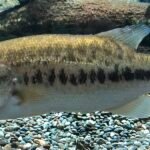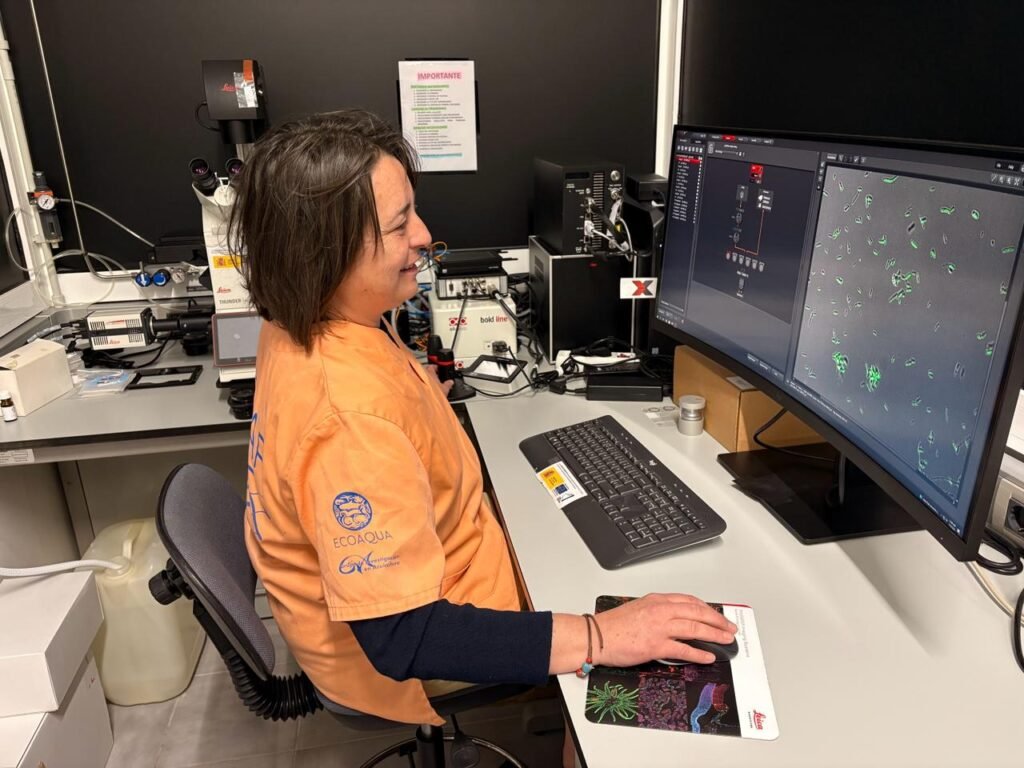
An international team comprising researchers from the Aquaculture Research Group (GIA) at the University Institute ECOAQUA of the University of Las Palmas de Gran Canaria (ULPGC) and the University of Bologna (Italy) has demonstrated that the probiotic Bacillus velezensis D-18 significantly improves the health and survival of European sea bass (Dicentrarchus labrax) against the emerging pathogen Vibrio harveyi, one of the most problematic bacteria for Mediterranean aquaculture.
The study, led by the Professor of Animal Health in Aquaculture, Dr. Félix Acosta Arbelo, titled ‘Effects of Bacillus Velezensis D-18 on Health Status of European Seabass (Dicentrarchus labrax) Experimentally Challenged with Vibrio harveyi’, was recently published in the prestigious scientific journal “Probiotics and Antimicrobial Proteins (Springer Nature)”, representing a key milestone in the search for sustainable alternatives to antibiotic use in aquaculture.
Demonstrated Protective Effect
During the trial, fish were fed for 30 days a diet supplemented with the probiotic Bacillus velezensis D-18, previously isolated and characterized by the GIA group. Subsequently, the animals were experimentally challenged with Vibrio harveyi.
The research findings were conclusive. On one hand, survival increased from 27% to 50% in fish receiving the probiotic. Furthermore, histological improvements were observed in the intestinal mucosa, including a larger villi area and an increase in the number of goblet cells.
Additionally, serum antibacterial activity significantly increased in supplemented fish following infection. Microbiome and environmental biofilm analyses also showed stability in microbial composition, indicating that the probiotic does not negatively alter the bacterial ecosystem of the fish or the tank.
A Real Alternative to Antibiotics
Dr. Félix Acosta Arbelo emphasized that “the results confirm the potential of Bacillus velezensis D-18 as an effective preventive tool against emerging pathogens in aquaculture, helping to reduce antibiotic dependency and promoting more sustainable production systems.“
The study reinforces the strategic line of the GIA group and the University of Bologna in developing biotechnological solutions for aquaculture health, aligned with the sustainability goals promoted by the UN Food and Agriculture Organization (FAO) and the ‘Blue Transformation’ initiative.
European Benchmark and International Collaboration
This multidisciplinary work combined expertise in microbiology, immunology, histology, and microbiome analysis. The collaboration strengthens the GIA-ECOAQUA Institute’s position as a European leader in applied aquaculture research.
This research was conducted under the auspices of the European project AQUAEXCEL 3.0, which promotes excellence in European aquaculture by integrating 40 top-tier research infrastructures. Alongside Dr. Acosta Arbelo, the study included researchers Luis Monzón Atienza, Antonio Gómez Mercader, and Pedro Luis Castro Alonso from ECOAQUA, as well as Giorgia Bignami, Daniela Leuzzi, Daniel Scicchitano, Marco Candela, Andrea Gustinelli, Mouna Jlidi, Perla Tedesco, and María Letizia Fioravanti from the University of Bologna.
Stay Always Informed
Join our communities to instantly receive the most important news, reports, and analysis from the aquaculture industry.
Contact
Felix Acosta
Grupo de Investigación en Acuicultura (GIA), Instituto Ecoaqua, Universidad de Las Palmas de Gran Canaria
Las Palmas de Gran Canaria, Spain
Email: felix.acosta@ulpgc.es
Reference
Bignami, G., Monzón-Atienza, L., Leuzzi, D. et al. “Effects of Bacillus Velezensis D-18 on Health Status of European Seabass (Dicentrarchus labrax) Experimentally Challenged with Vibrio harveyi”. Probiotics & Antimicro. Prot. (2025). https://doi.org/10.1007/s12602-025-10833-7

Editor at the digital magazine AquaHoy. He holds a degree in Aquaculture Biology from the National University of Santa (UNS) and a Master’s degree in Science and Innovation Management from the Polytechnic University of Valencia, with postgraduate diplomas in Business Innovation and Innovation Management. He possesses extensive experience in the aquaculture and fisheries sector, having led the Fisheries Innovation Unit of the National Program for Innovation in Fisheries and Aquaculture (PNIPA). He has served as a senior consultant in technology watch, an innovation project formulator and advisor, and a lecturer at UNS. He is a member of the Peruvian College of Biologists and was recognized by the World Aquaculture Society (WAS) in 2016 for his contribution to aquaculture.