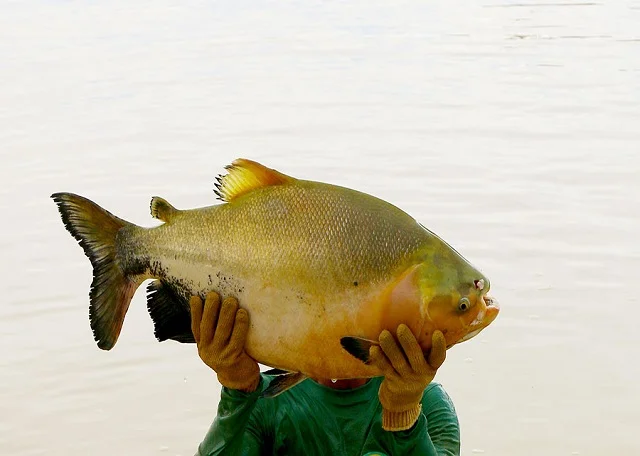
Feed Conditioning and Sex Reversal Boost Tambaqui Weight from 1 kg in 12 Months to 1.7 kg in Just 10 Months. A milestone for sustainable aquaculture production.
The tambaqui (Colossoma macropomum), also known as gamitana or cachama, is Brazil’s most cultivated native fish; however, current production remains modest compared to the country’s immense potential. To transform this landscape, institutions such as Embrapa are leading significant scientific efforts.
Research coordinated by Embrapa Fisheries and Aquaculture (TO) has successfully increased the weight gain of tambaqui in net-pen systems by more than double. Through advanced techniques involving hormonal supplementation and feed conditioning, scientists achieved specimens weighing 1.7 kg in ten months. This represents a weight gain rate 2.04 times higher than the traditional average, which hovers around 1 kg over twelve months.
These results were achieved in tanks with a density of 40 kilograms per cubic meter (kg/m³), with weight increment calculated based on the monthly average.
The Monotamba project and productive efficiency
Improving tambaqui production in net pens (cages) is a priority for agricultural research, given its potential for the socio-productive inclusion of family fish farmers. This breakthrough is the result of the “Use of Monosex Tambaqui Populations” project (Monotamba), led by researcher Flávia Tavares.
Cage production is not only environmentally responsible—promoting sustainable aquaculture with increasing productivity—but also facilitates access to local markets in riverside regions. This brings production closer to the final consumer, reducing logistics costs and improving product freshness.
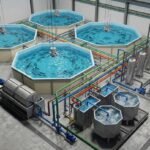
This study exclusively used females, who demonstrate greater weight gain in this species (unlike tilapia). They received the hormone estradiol during the nursery phase for six weeks. The experiments were divided between a Recirculating Aquaculture System (RAS) and net pens in Lake Palmas.
It is worth noting that previous initiatives, such as the BRS Aqua project, had already managed to reduce the fattening time to reach 1 kg from twelve to nine months through adjustments in grading and feeding charts.
In the Monotamba project, results with mixed populations (males and females) were also positive, reaching 1.4 kg in ten months. This group functioned as a control, serving as a comparative baseline for the all-female population treated with hormones.
Stay Always Informed
Join our communities to instantly receive the most important news, reports, and analysis from the aquaculture industry.
The key to success: Feed conditioning
During the nursery phase in the indoor system, the animals were fed exclusively with commercial pellets, generating vital conditioning. Upon transfer to the net pens in Lake Palmas, the fish were already habituated to this diet.
According to researcher Tavares: “Their feeding behaviour resembled that of tilapia, something previously unobserved.” In this context, the tambaqui reached 1 kg at around six and a half months, a highly competitive timeframe close to the tilapia cycle.
Tavares underscores that this expressive growth is largely due to feed training during the rearing phase. This highlights the close relationship between production stages: proper management in one phase positively impacts the next.
The expert highlights that indoor training “enabled the fish to learn to eat pellets earlier, making them much more avid for food than untrained ones, which made a significant difference.” This advance opens promising perspectives for the technological viability of the system.
Towards economic viability and next steps
This evolution is part of a joint effort between science and the productive sector to establish robust technological packages for tambaqui, similar to those that already exist for tilapia, Brazil’s most exported fish.
Although Monotamba’s results are excellent in zootechnical terms, the next step is to validate economic indicators. “We must calculate economic indicators to verify if the time the fish must remain in the indoor system represents a viable cost for the producer,” points out the researcher.
Given that feed can represent up to 80% of production costs, and considering the animals are conditioned to eat pellets, precise management of this input becomes a critical focal point.
In addition to weight, an increase in population density is anticipated. Tavares estimates it is feasible to reach 50 kg/m³, which would further reduce the productivity gap with tilapia.
The researcher concludes with optimism regarding the sector’s future: “We are advancing; it is part of a process. We will have improved species for cages and genomic editing to assist in weight gain. It has everything to succeed; the tambaqui possesses enormous potential, especially for the Northern Region of Brazil.”

Editor at the digital magazine AquaHoy. He holds a degree in Aquaculture Biology from the National University of Santa (UNS) and a Master’s degree in Science and Innovation Management from the Polytechnic University of Valencia, with postgraduate diplomas in Business Innovation and Innovation Management. He possesses extensive experience in the aquaculture and fisheries sector, having led the Fisheries Innovation Unit of the National Program for Innovation in Fisheries and Aquaculture (PNIPA). He has served as a senior consultant in technology watch, an innovation project formulator and advisor, and a lecturer at UNS. He is a member of the Peruvian College of Biologists and was recognized by the World Aquaculture Society (WAS) in 2016 for his contribution to aquaculture.