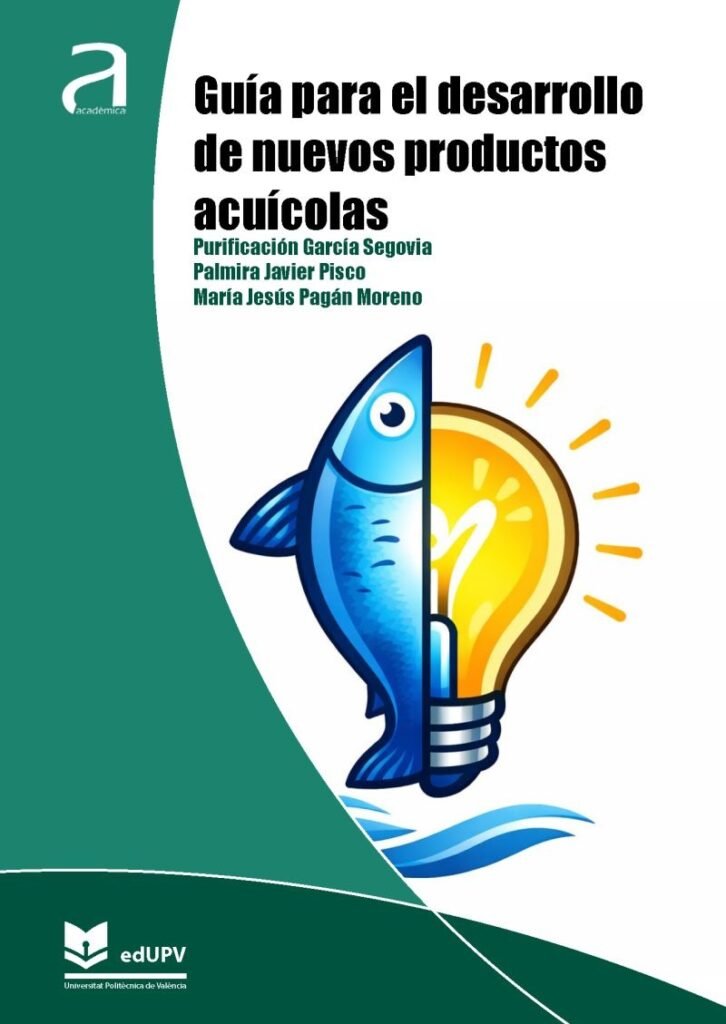
Aquaculture has established itself as one of the fastest-growing food production sectors worldwide, playing a pivotal role in global food security. However, commercial success in this industry hinges not only on production capacity but also on the development of strategies and technologies that deliver convenient, high-quality, and sustainably sourced products.
In this context, the “Guía para el desarrollo de nuevos productos acuícolas“ proposes a paradigm shift. Spearheaded by researchers Purificación García Segovia, María Jesús Pagán Moreno, and Palmira Javier Pisco from the i-FOOD group at the Universitat Politècnica de València (UPV), this work advocates for abandoning traditional, complex, and sequential planning processes in favor of Design Thinking (DT) as a driver for agile, user-centered innovation.
Key Points
- User-Centric Approach: Product success relies on a deep understanding of consumer demands, seeking solutions that are technologically feasible and economically viable.
- Agile Methodology: DT mitigates risks and accelerates time-to-market through rapid iteration and low-cost prototyping.
- Sustainability and Value: Innovation focuses on creating healthy, easy-to-prepare foods that optimize aquaculture resources.
- Scientific Validation: The integration of statistical tools, such as Principal Component Analysis (PCA) and Just-About-Right (JAR) sensory testing, ensures objective market acceptance.
Design Thinking Applied to the Food Industry
According to Tim Brown (2009), Design Thinking is a methodology for generating innovative ideas that balance three fundamental pillars: genuine user needs, technological feasibility, and a viable business strategy. Within the food industry, this implies that consumer value translates directly into a tangible market opportunity.
Unlike traditional methods, DT is structured into five iterative stages that ensure a constant connection with the user throughout the process:
- Empathize: Grasping the context and the physical and emotional requirements of the target audience.
- Define: Pinpointing the core problem or the specific design challenge.
- Ideate: Generating a broad spectrum of potential solutions.
- Prototype: Materializing ideas into preliminary versions (MVPs).
- Validate (Test): Testing prototypes with actual users to elicit feedback and refine the product.
Phase 1: Empathizing with the Modern Consumer
Empathy is the cornerstone of any human-centered design approach. In the aquaculture sector, this entails gaining a profound understanding of the drivers behind why consumers choose—or choose not to—consume seafood products.
Strategic Tools for Empathy
- Empathy Map: This tool visually organizes what the user thinks, feels, says, does, hears, and sees. It is essential for identifying “pain points” or frustrations, such as ambiguous labeling or a scarcity of ready-to-eat (RTE) options.
- Focus Groups: Facilitated sessions with 6 to 10 participants designed to explore deep-seated needs and motivations that standard surveys often fail to capture.
- Direct Observation and Immersion: Analyzing consumer behavior in situ (e.g., at the supermarket or while cooking at home) to capture authentic behavioral patterns.
Case Study Insight: A pivotal finding in the development of shrimp-based products for young adults revealed that this demographic seeks gratifying culinary experiences but prioritizes time efficiency and ethical, responsible consumption.
Phase 2: Problem Definition and Ideation
Once the data is gathered, the team must synthesize the findings to establish a clear, actionable framework.
The Point of View (POV) Statement
The POV is a template sentence that helps visualize the challenge:
[User] needs [Need] because [Key Insight].
Stay Always Informed
Join our communities to instantly receive the most important news, reports, and analysis from the aquaculture industry.
- Practical Example: A family with young children needs fish-based products with mild flavors and engaging presentations because they want to ensure nutritional intake without the children rejecting the meal.
Disruptive Ideation
In this stage, quantity takes precedence over initial quality. The guide suggests techniques such as:
- SCAMPER: Substitute, Combine, Adapt, Modify, Put to another use, Eliminate, or Reverse elements of existing products.
- Crazy 8s: Sketching 8 distinct ideas in just 8 minutes to stimulate visual creativity.
- User Co-creation: Directly involving the consumer in the concept generation process.
To evaluate which ideas should proceed to the prototyping phase, the guide recommends using a Prioritization Matrix, weighing Potential Impact against Required Effort:
| Idea | Impact | Effort | Decision |
| Fish-based snacks | High | Medium | Priority |
| International flavors | High | Low | Priority |
| Vegan burgers | High | High | Discard/Postpone |
Phase 3: Prototyping to Learn
Prototyping is not about manufacturing the final product; rather, it is about creating a representation that allows for rapid, cost-effective iteration. As the saying goes: “If a picture is worth a thousand words, a prototype is worth a thousand pictures.”
Types of Prototypes in Aquaculture
- Physical (Red): Developing tangible samples using alternative ingredients and simulating industrial processes such as maceration or thermal processing.
- Visual (Blue): Digital sketches, 3D food rendering, physical packaging mockups, and simulated labeling.
- Experience: Utilizing storyboards to map the user journey from the point of purchase to the final consumption stage.
Case Study: Shrimp-Based Snacks and Toppings
The ThinkInGood project implemented this methodology to engineer high-value-added products.
Market Insights
Through Principal Component Analysis (PCA), it was discovered that consumers categorize species distinctly:
- Gilt-head Sea Bream: Associated with fresh, skinless, and clean-cut products.
- Shrimp: Predominantly linked to savory snack formats and dry toppings.
Experimental Development
Several shrimp-based prototypes were evaluated for technical feasibility:
- Extruded Puffs (Extrusion): Feasibility confirmed (OK).
- Chips (Emulsion + Drying): Feasibility confirmed (OK).
- Wafers (Laminating): Feasibility unsuccessful (KO) due to high batter stickiness hindering the cutting process. This serves as a prime example of how DT identifies technical hurdles prior to significant capital investment.
JAR Sensory Evaluation
To validate the products, the Just-About-Right (JAR) analysis was employed. This technique determines if attributes such as salinity, texture, or aroma meet the “optimal” consumer threshold. For instance, testing a fish bar revealed high overall acceptance but indicated a need to recalibrate salinity levels and enhance packaging sustainability.
Conclusion and Sector Outlook
The application of Design Thinking allows the aquaculture sector to innovate with significantly mitigated risk. By integrating deep consumer insights with the rigor of food science, it is possible to generate products that are simultaneously appealing, healthy, and sustainable. This human-centered approach is the key to aquaculture fulfilling its promise as a cornerstone of future nutrition.
Reference (open access – Spanish)
García Segovia, Purificación; Javier Pisco, Palmira; Pagan Moreno, María Jesús (2025). Guía para el desarrollo de nuevos productos acuícolas. edUPV. 77 p. https://doi.org/10.4995/9788413963884edUPV

Editor at the digital magazine AquaHoy. He holds a degree in Aquaculture Biology from the National University of Santa (UNS) and a Master’s degree in Science and Innovation Management from the Polytechnic University of Valencia, with postgraduate diplomas in Business Innovation and Innovation Management. He possesses extensive experience in the aquaculture and fisheries sector, having led the Fisheries Innovation Unit of the National Program for Innovation in Fisheries and Aquaculture (PNIPA). He has served as a senior consultant in technology watch, an innovation project formulator and advisor, and a lecturer at UNS. He is a member of the Peruvian College of Biologists and was recognized by the World Aquaculture Society (WAS) in 2016 for his contribution to aquaculture.