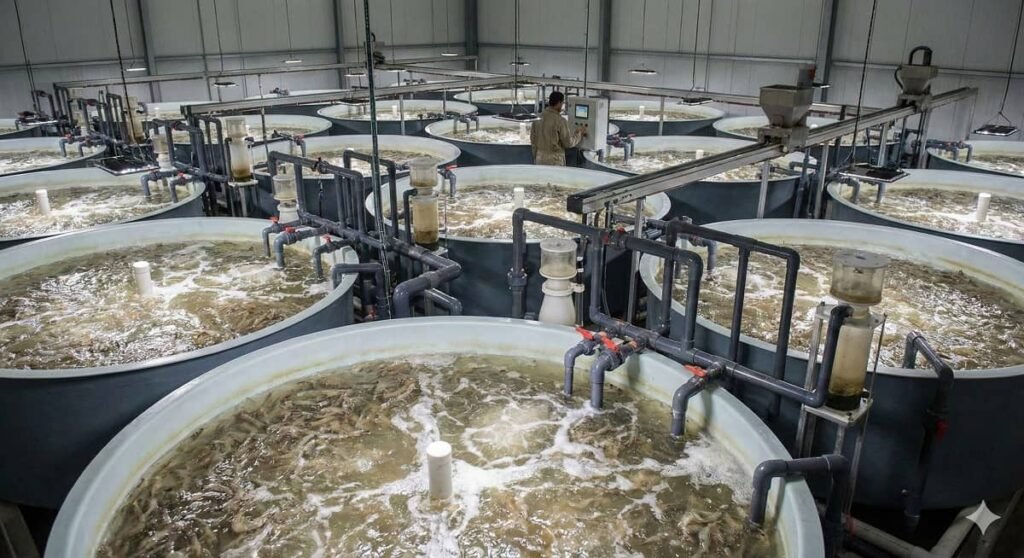
Global shrimp consumption is far more than a passing trend; it represents one of the most ubiquitous seafood categories on the planet. In 2022, production reached 11 million metric tons, 70% of which originated from aquaculture. However, the traditional industry faces persistent threats: devastating diseases such as White Spot Syndrome (WSS) and Early Mortality Syndrome (EMS), compounded by the impacts of climate change.
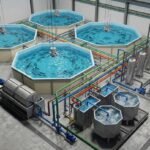
In response, a vanguard technology has emerged: super-intensive Recirculating Aquaculture Systems (RAS). These systems promise absolute environmental control, independence from natural surroundings, and a drastic reduction in water usage and discharge. But are they truly a secure investment? A new study published in the journal Aquaculture (2026) by Lijun Liu and Frank Asche of the University of Florida dissects the financial risks of these “shrimp factories.”
- 1 Key Takeaways
- 2 The Bioeconomic Model: Simulating Success and Failure
- 3 Price is King, but the System is the Judge
- 4 Why Is It Profitable Now? (Contrasting 2010)
- 5 The Global Context: China and Biosecurity
- 6 Discussion and Limitations: Not Everything is “Rosy”
- 7 Conclusion: The Investor’s Roadmap
- 8 Entradas relacionadas:
Key Takeaways
- Market Dominance: Shrimp price volatility is the primary risk factor, accounting for 86.3% of profit variance.
- The Critical Factor: System reliability—specifically the avoidance of catastrophic failures—is the main determinant for achieving a positive expected profit.
- Disruptive Productivity: Unlike studies from a decade ago, current RAS systems are profitable due to genetic advancements and accelerated growth rates.
- Entry Barrier: The initial capital expenditure (CAPEX) for a 1,000 MT farm ranges from 20 to 40 million USD, up to ten times higher than a traditional farm in Asia or Central America.
The Bioeconomic Model: Simulating Success and Failure
To evaluate the viability of these operations, researchers developed a stochastic model simulating the daily operations of a 1,000-ton annual capacity farm. Unlike previous models, this framework integrates three fundamental risks: production, market, and catastrophic system failures.
Simulated Farm Architecture
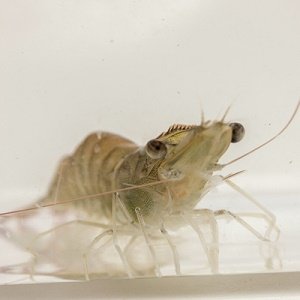
The study parameterizes a facility operating with white shrimp (Litopenaeus vannamei), the dominant species, which, alongside the tiger prawn, represents over 95% of global production. The technical assumptions are ambitious yet realistic for 2026 technology:
- Stocking Density: 13 million post-larvae per cycle.
- Growth Cycle: 80 days to reach a commercial weight of 25 grams.
- Feed Conversion Ratio (FCR): 1.4, a high-efficiency standard.
To capture uncertainty, the team utilized Monte Carlo simulations with 100,000 iterations, assigning probability distributions to key variables such as feed costs, survival rates, and sale prices.
Price is King, but the System is the Judge
The analysis reveals a fascinating dichotomy in risk management. While producers often obsess over biology (growth rates and survival), the data suggest that the market is significantly more volatile.
The Tyranny of Price Volatility
Shrimp prices are the primary driver of profit variance, representing 86.3% of fluctuations. In a scenario without system failures, there is a 99.54% probability of turning a profit per cycle; however, the range is vast: from a loss of $0.76 million to a gain of $6.74 million USD per cycle. This underscores a critical need: RAS farmers must be as adept at trading as they are at biology, utilizing futures contracts or product diversification to mitigate this exposure.
The Specter of Catastrophic Failure
This is where RAS reveals its riskier side. Technological complexity (biofilters, electrochemical systems, gas control) increases the likelihood of systemic failures. If the system fails, the loss is total: 100% mortality plus recovery costs of up to $100,000 USD. When this risk is incorporated (estimated at an average 10% probability per cycle), expected profit drops by 33%. Only 57% of 10-year simulations managed to recover the initial $30 million USD investment.
Why Is It Profitable Now? (Contrasting 2010)
It is inevitable to compare these results with classic studies like Clark et al. (2010), which concluded that shrimp RAS was not financially viable without massive price premiums. The fundamental difference in 2026 lies in genetically-driven productivity. Modern shrimp grow much faster. While in 2010 operating costs exceeded revenues, the current model shows a production cost of $7.21/kg against a sale price of $14.31/kg (assuming a premium fresh product). The break-even point is situated at $11.54/kg over a 10-year horizon.
Stay Always Informed
Join our communities to instantly receive the most important news, reports, and analysis from the aquaculture industry.
Table 01. Cost Structure in Super-Intensive RAS.
| Concept | Percentage of Total Cost |
| Feed | 54% |
| Fixed Costs (Maintenance, Management) | 17% |
| Other Variables (Electricity, Chemicals) | 17% |
| Seed (Post-larvae) | 11% |
The Global Context: China and Biosecurity
The study acknowledges that production geography is shifting. While China, Vietnam, and India lead in volume, countries like the US, Germany, and the UK are adopting RAS due to environmental and regulatory constraints. Recirculation technology acts as a shield against diseases that have caused massive shifts in global producer rankings since 1980. As closed systems, exposure to external pathogens is minimal, offering production stability that traditional ponds in Asia cannot guarantee.
Discussion and Limitations: Not Everything is “Rosy”
Despite the optimism, the authors warn of several limitations:
- Scarce Empirical Data: As an emerging technology, many parameters are based on expert consensus rather than decades of large-scale commercial operation.
- Regional Variation: The model does not adjust for specific electricity or labor costs, which can vary drastically between Florida and Germany.
- Market Cycles: Analyzing prices from a “bad” year (like 2023) might fail to recover the investment within 10 years, even if the Net Present Value (NPV) remains positive.
Conclusion: The Investor’s Roadmap
The financial viability of super-intensive shrimp RAS in 2026 depends on a dual strategy: robust price management and technological operational excellence. Having the best technology is insufficient; one must navigate the volatility of a globalized market. The transition toward land-based systems seems inevitable to meet the demand for fresh, sustainable, and antibiotic-free products in Western markets. However, the high initial capital (up to $40 million USD) remains the most significant filter for new players.
Contact
Lijun Liu
Department of Economics and Finance, University of Stavanger
Stavanger, Norway
Email: lijun.liu@uis.no
Reference
Liu, L., & Asche, F. (2026). Risk analysis for shrimp in a recirculating aquaculture system. Aquaculture, 614, 743467. https://doi.org/10.1016/j.aquaculture.2025.743467

Editor at the digital magazine AquaHoy. He holds a degree in Aquaculture Biology from the National University of Santa (UNS) and a Master’s degree in Science and Innovation Management from the Polytechnic University of Valencia, with postgraduate diplomas in Business Innovation and Innovation Management. He possesses extensive experience in the aquaculture and fisheries sector, having led the Fisheries Innovation Unit of the National Program for Innovation in Fisheries and Aquaculture (PNIPA). He has served as a senior consultant in technology watch, an innovation project formulator and advisor, and a lecturer at UNS. He is a member of the Peruvian College of Biologists and was recognized by the World Aquaculture Society (WAS) in 2016 for his contribution to aquaculture.