The global food system faces a gargantuan challenge: providing high-quality protein with the lowest possible environmental impact. In this context, bivalves have traditionally been crowned the “heroes” of a sustainable diet due to their water-filtering capabilities and zero reliance on external feed.
However, a recent study led by researchers from Pablo de Olavide University and the CSIC reveals a more complex reality: the environmental impact does not end at the aquaculture farm. By analyzing the entire supply chain in Spain—from cultivation in the Galician rías to the consumer’s home—scientists discovered that the mussel’s “ecological backpack” varies drastically depending on its commercial format: fresh, frozen, or canned.
Key Insights
- The Processing Paradox: Although fresh mussels are among the cleanest proteins, their carbon footprint increases by up to 136% when consumed in canned (pickled) form.
- Galicia, the Global Epicenter: This region accounts for 99% of Spanish production. However, only 25% of the fresh product is destined for the national market; the remainder fuels a complex network of exports and industry.
- Emissions Breakdown: The entire chain emits 287.8 annually, split almost equally between aquaculture production (45%) and industrial processing (43%).
- Commercial Disconnect: Spain is a production powerhouse but relies critically on imports from Chile to meet domestic demand for canned mussels.
Tracing the “Farm-to-Door” Footprint
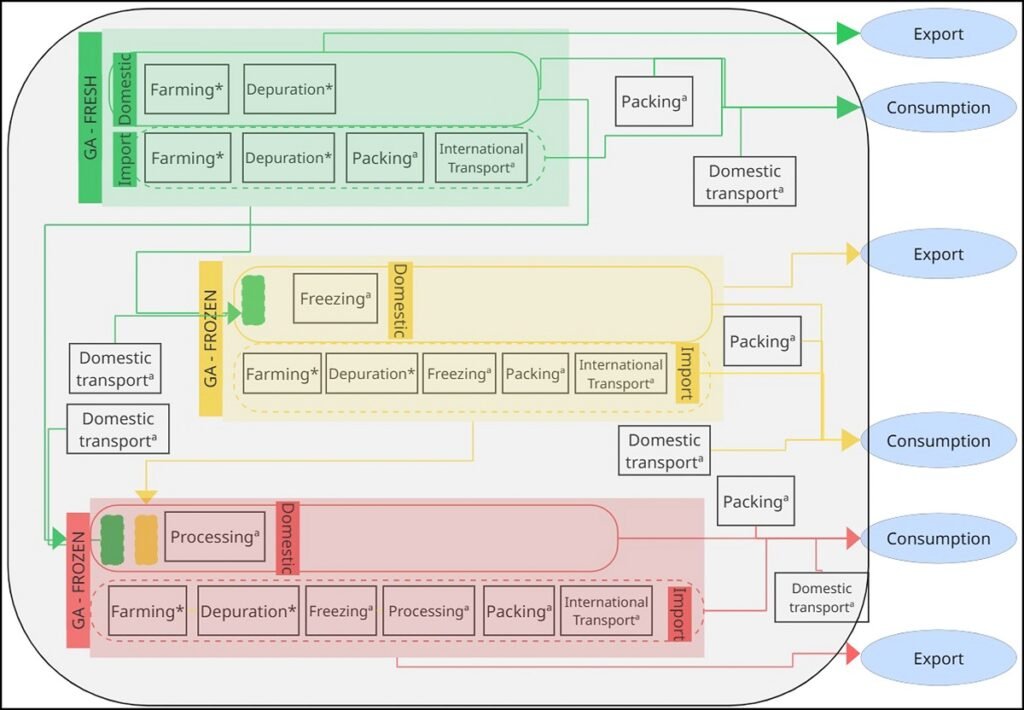
To obtain these figures, the team employed a combined approach of Material Flow Analysis (MFA) and Life Cycle Assessment (LCA), using 2017 as a reference year for its statistical robustness. The study established a systemic boundary that included:
- Production: Farm cultivation, depuration (purification), and primary packaging.
- Industrial Processing: Cleaning, cooking, freezing, and the complex canning process.
- Multimodal Logistics: International, national, and intra-provincial transport.
- Trade: Import and export flows that define actual availability in the Spanish market.
The Numbers Defining the Spanish Sector
Spain is the European Union’s leading producer of mussels (Mytilus galloprovincialis). With a gross availability of 276,000 tons, the sector is an economic giant; however, its structure reveals a surprising logistical dependency.
The Journey of the Galician Mussel
Galicia not only leads national production but also manages 98% of industrial processing. This geographical concentration necessitates massive recirculation: 84% of fresh mussels consumed in the rest of Spain travel hundreds of kilometers from the northwest, generating a transport footprint that is often underestimated.
| Consumption Format | Carbon Footprint (kgCO2eq/kg of meat) |
| Pickled (Escabeche) | 8.5 |
| In Brine | 6.7 |
| Fresh | 4.1 |
| Frozen | 3.6 |
“To put these emission figures into context, it is worth recalling the footprint of other common foods,” notes Joan Moranta, a researcher at the Balearic Oceanographic Center (IEO-CSIC). “Beef ranks far above mussels, with values in the tens of per kg. Pork approaches intermediate ranges, around 7 per kg, and some fish, such as hake, can be near 4.4 per kg. Mussels stand out as a marine protein with moderate emissions, though they are highly sensitive to the level of industrialization and commercial flows,” the scientist points out.
Why Does the Can Impact the Climate So Much?
The most disruptive finding is the emissions gap. While frozen mussels have the lowest impact (3.6 ), pickled mussels soar to 8.5 . Three factors drive this difference:
- Energy Intensity: Canning requires cooking, sterilization, and heat sealing—processes that demand significant heat and electricity.
- Packaging Materials: The manufacturing of metal cans and the use of oils for pickling add an emissions burden non-existent in the fresh format.
- Product Origin: 45% of canned mussels consumed in Spain come from Chile, integrating transoceanic transport into the environmental equation.
The Export Paradox
The study highlights a strategic “disconnect”: Spain exports a large portion of its low-impact products (frozen and fresh) while importing canned products from third countries. According to the authors, this trend prioritizes economic returns over the resilience of the local food system, increasing vulnerability to changes in trade policies.
Recommendations for a Sustainable Future
The researchers propose four optimization pathways for the sector:
Stay Always Informed
Join our communities to instantly receive the most important news, reports, and analysis from the aquaculture industry.
- Promote Local Consumption: Encouraging the consumption of fresh Galician mussels would drastically reduce emissions.
- Industrial Reconversion: Promoting the frozen format, which optimizes transport (by traveling without shells) and requires less energy than canning.
- Packaging Innovation: A 23% reduction in packaging impact could lower the overall footprint by 4%.
- Consumer Education: Implementing carbon footprint labeling to enable informed choices.
“Mussels are a low-impact marine protein, but the current production and consumption model—based on industrial transformation and complex commercial chains—considerably increases their climate footprint,” concludes Pablo Saralegui, lead author of the study.
Conclusion
Mussels remain an excellent protein alternative compared to beef (32.5 ) or other ruminants (28 ). However, this study serves as a reminder that sustainability spans the entire chain. For the Spanish mussel to be truly “green,” we must optimize every stage, from the farm to the final logistics.
“Optimizing transport, using more sustainable packaging materials, or employing technologies that minimize resource use and reduce emissions during mussel production and processing are specific practices that lead to improved sustainability,” concluded Montserrat Ramón, a researcher at the Institute of Marine Sciences (ICM-CSIC).
This publication, supported by the Daniel and Nina Carasso Foundation, is the result of a multidisciplinary collaboration between researchers from the think tank Alimentta, the Pablo de Olavide University, the University of Santiago de Compostela, the Mediterranean Institute for Advanced Studies (IMEDEA, CSIC-UIB), the Institute of Marine Sciences (ICM-CSIC), and the Balearic Oceanographic Center (COB-IEO, CSIC).
Contact
Pablo Saralegui-Díez
Alimentta Association, Granada, Spain
Universidad Pablo de Olavide, Departamento de Geografía Historia y Filosofía
Sevilla, Andalucía, Spain
Email: psardie@upo.es
Reference (open access)
Saralegui-Díez, P., Villasante, S., Ospina-Álvarez, A., Ramón, M., & Moranta, J. (2026). The carbon footprint of the mussel food chain in Spain. Resources, Conservation and Recycling, 227, 108742. https://doi.org/10.1016/j.resconrec.2025.108742

Editor at the digital magazine AquaHoy. He holds a degree in Aquaculture Biology from the National University of Santa (UNS) and a Master’s degree in Science and Innovation Management from the Polytechnic University of Valencia, with postgraduate diplomas in Business Innovation and Innovation Management. He possesses extensive experience in the aquaculture and fisheries sector, having led the Fisheries Innovation Unit of the National Program for Innovation in Fisheries and Aquaculture (PNIPA). He has served as a senior consultant in technology watch, an innovation project formulator and advisor, and a lecturer at UNS. He is a member of the Peruvian College of Biologists and was recognized by the World Aquaculture Society (WAS) in 2016 for his contribution to aquaculture.