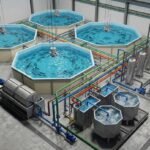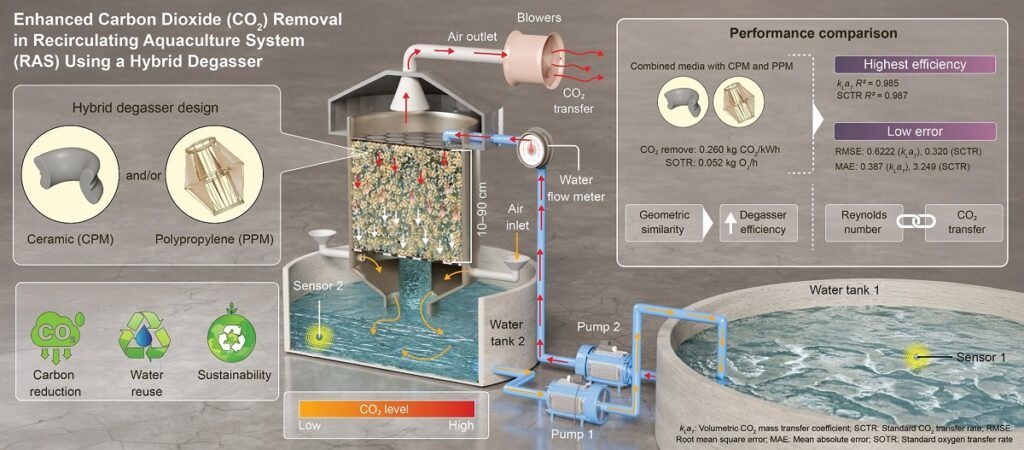
In the race to ensure global food security, Recirculating Aquaculture Systems (RAS) have established themselves as the most sustainable solution for the aquaculture industry. However, these closed ecosystems face an “invisible enemy”: the critical accumulation of dissolved carbon dioxide () and the subsequent depletion of oxygen levels.
As biomass density increases, levels surge, compromising species health and hampering productivity. Historically, gas management methods have been inconsistent or energy-inefficient; in response, the research led by Subha M. Roy and her team at Chonnam National University introduces a hybrid degasser designed to transform the sector’s operational standards.
- 1 Key takeaways for industrial producers
- 2 The Challenge of Gas Transfer in Closed Systems
- 3 Scientific Rigor at the Smart Aquaculture Research Center
- 4 Results and Performance Metrics
- 5 Precision Engineering and Sustainability
- 6 Global Impact: Toward Aquaculture 4.0
- 7 Future Outlook
- 8 Entradas relacionadas:
Key takeaways for industrial producers
- Material Synergy: The integration of polypropylene (PPM) and ceramic (CPM) media surpasses the efficiency of any single material.
- Superior Performance: The system eliminates up to 90% of residual in just 50 minutes.
- Dual Functionality: The design not only mitigates harmful gases but simultaneously accelerates water oxygenation.
- Energy Optimization: Through dimensional analysis, electrical consumption has been reduced without sacrificing technical performance.
The Challenge of Gas Transfer in Closed Systems
Traditionally, RAS degassers utilize a single type of contact media. However, these often suffer from biofouling (biofilm accumulation) or degradation in saltwater environments. Excessive is not only toxic to fish but also acidifies the medium, destabilizing the chemical equilibrium essential for survival.
Defining the Hybrid Degasser
Roy’s proposal integrates two types of “packing” within the degassing column:
- Polypropylene Media (PPM): Provides lightweight properties and a vast surface area.
- Ceramic Media (CPM): Noted for extreme durability, resistance to marine corrosion, and chemical stability.
By combining PPM + CPM, complex hydrodynamic flows are generated, maximizing the effective contact area and allowing to be released and oxygen to be absorbed with unprecedented speed.
Scientific Rigor at the Smart Aquaculture Research Center

The study was conducted at Chonnam National University in Yeosu, South Korea. To ensure data precision, a marine RAS without live species was employed, achieving absolute control over chemical variables.
Experimental Setup Details:
- Architecture: A PVC column with a structural height of 1593 mm.
- Fluid Dynamics: Water descends by gravity through the packing media while being intercepted by an airflow.
- Advanced Dispersion: 15 mm perforated plates transform the flow into a fine spray, optimizing interaction with the blower air. To validate results, the team correlated direct measurements with pH variations, ensuring high-level statistical reliability.
Results and Performance Metrics
The evaluation of various packing heights and air-to-water ratios () yielded revealing data:
- Critical Height: A 90 cm bed optimizes residence time for gas exchange.
- Ratio: A ratio of 16 proved to be the most efficient equilibrium point for both degassing and oxygenation.
- Mass Transfer: The system achieved a coefficient () of , far surpassing conventional configurations.
Precision Engineering and Sustainability
The study’s greatest contribution is the development of mathematical models based on the Reynolds Number (). This facilitates the scalability of laboratory designs to commercial farms with total predictability. Furthermore, the use of ceramics reduces maintenance costs—a critical factor for profitability in marine aquaculture.
Mantente siempre informado
Stay Informed
Únete a nuestras comunidades para recibir al instante las noticias, informes y análisis más importantes del sector acuícola.
Join our communities to get instant access to the most important news, reports, and analysis from the aquaculture industry.
Global Impact: Toward Aquaculture 4.0
The sector faces growing pressure to reduce its environmental footprint. This hybrid degasser is not only faster, but its efficiency allows for operation with lower-power equipment.
Producer Benefits:
- Operational Efficiency: Lower energy expenditure per cubic meter of treated water.
- System Longevity: Ceramics mitigate the chemical degradation common in plastics.
- Animal Welfare: Gas stability ensures a low-stress environment, enhancing growth rates.
Future Outlook
While results are promising, the authors emphasize that commercial implementation requires techno-economic and life-cycle analyses to quantify long-term impact. Currently, predictive equations are validated within a Reynolds range between 8576 and 45,914.
The work of Roy, Choi, and Kim represents a milestone toward sustainability. By breaking the single-packing material paradigm and applying rigorous mathematical models, they have created a vital tool for efficient aquaculture, capable of feeding the world while minimizing energy resource consumption.
Contact
Taeho Kim
Department of Marine Production Management, Chonnam National University
Yeosu, 59626, Republic of Korea.
Email: kimth@jnu.ac.kr
Reference (open access)
Roy, S. M., Choi, H., & Kim, T. (2026). A hybrid degasser for improved CO2 removal and oxygenation in recirculating aquaculture systems: Toward sustainable water quality control. Journal of Water Process Engineering, 86, 109953. https://doi.org/10.1016/j.jwpe.2026.109953

Editor at the digital magazine AquaHoy. He holds a degree in Aquaculture Biology from the National University of Santa (UNS) and a Master’s degree in Science and Innovation Management from the Polytechnic University of Valencia, with postgraduate diplomas in Business Innovation and Innovation Management. He possesses extensive experience in the aquaculture and fisheries sector, having led the Fisheries Innovation Unit of the National Program for Innovation in Fisheries and Aquaculture (PNIPA). He has served as a senior consultant in technology watch, an innovation project formulator and advisor, and a lecturer at UNS. He is a member of the Peruvian College of Biologists and was recognized by the World Aquaculture Society (WAS) in 2016 for his contribution to aquaculture.