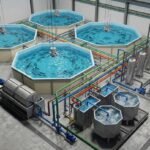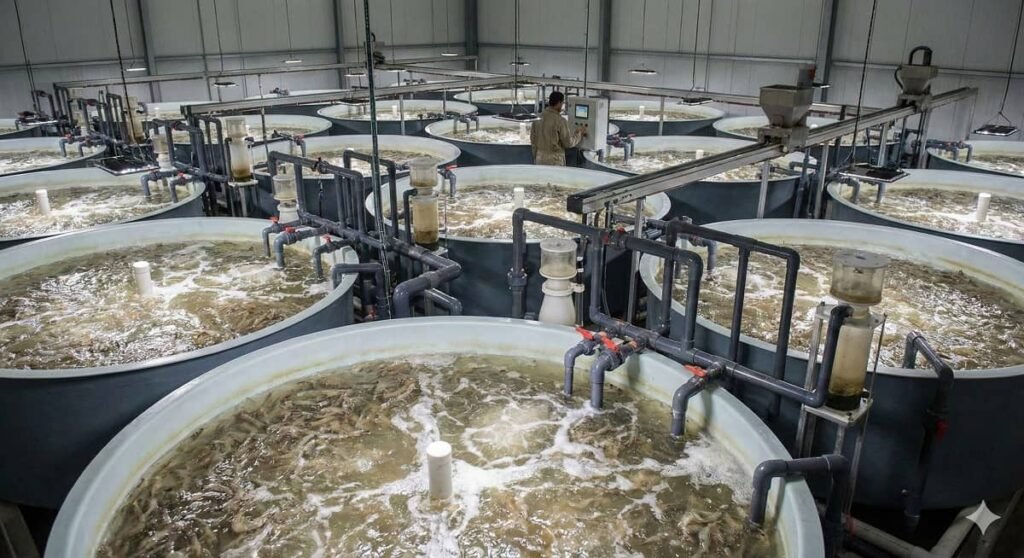
Recirculating Aquaculture Systems (RAS) currently represent a disruptive technology, essential for their ability to optimise water and nutrient use, enabling intensive production even in water-scarce environments. However, the primary operational challenge of RAS lies in its high energy dependency.
Critical components—such as pumping, filtration, thermal control, and oxygenation—operate continuously, significantly increasing operational costs and the sector’s carbon footprint. To date, scientific evidence regarding these consumption patterns has remained fragmented. In response, a new meta-analysis led by the University of Melbourne seeks to standardise current knowledge and identify the factors that define the actual efficiency of these high-tech infrastructures.
This research was conducted by specialists from the School of Agriculture, Food and Ecosystem Sciences (Faculty of Science) at the University of Melbourne (Australia), in collaboration with the Department of Agricultural and Biological Engineering at North Carolina State University (USA).
- 1 Key Takeaways for Producers
- 2 Tracking 14 Years of Energy Data
- 3 Critical Determinants of Electrical Consumption in RAS Systems
- 4 The Resource Correlation Myth
- 5 Species Analysis: The Success of the African Catfish
- 6 Why Isn’t Energy Consumption Decreasing?
- 7 Toward a Data Reporting Standard
- 8 General Study Conclusion
- 9 Entradas relacionadas:
Key Takeaways for Producers
- Resource Disconnection: Surprisingly, there is no direct correlation between energy expenditure, water usage, and feed in current RAS systems.
- Density as a Driver: Systems with higher maximum stocking densities are significantly more energy-efficient than those with low densities.
- The Salinity Factor: Freshwater species production is notably more efficient (7.49 kWh/kg) compared to operating saltwater systems (14.53 kWh/kg).
- Scientific Gap: A critical discrepancy exists between research and commercial data; commercial systems report much lower consumption (6.85 kWh/kg) than experimental setups (18.60 kWh/kg).
Tracking 14 Years of Energy Data
The research team conducted a systematic review following PRISMA guidelines, ensuring process transparency and replicability. The study analysed literature published between 2010 and 2024, filtering an initial repository of over 9,200 records to consolidate 25 specific datasets on Electrical Energy Use per Biomass (EUB).
To ensure an equitable comparison across diverse species and geographic regions, the primary metric was standardised to kWh per kilogram of fish produced. Furthermore, the analysis integrated critical production variables—such as species, stocking density, and water salinity—alongside methodological factors, distinguishing between data derived from theoretical modelling and results obtained through direct experimentation.
Critical Determinants of Electrical Consumption in RAS Systems

Energy expenditure in a recirculation system is not uniform; its magnitude is intrinsically linked to design variables, the cultured species, and geographic location. Following a review of technical literature, the primary energy demand vectors in these facilities have been identified:
- Treatment and Disinfection: This section integrates mechanical filtration and ultraviolet (UV) disinfection, accounting for up to 16% of total usage.
- Water Pumping: This constitutes the most significant operational factor, representing up to 45% of the system’s total consumption.
- Thermoregulation and Temperature Control: In specific scenarios, this process can absorb more than 50% of the site’s energy demand, being critical in extreme climates.
- Aeration and Oxygenation: These life-support systems fluctuate between 9% and 37% of the cumulative electrical expenditure.
The Resource Correlation Myth
One of the study’s most disruptive findings is the absence of a significant statistical correlation between Energy Use per Biomass (EUB), Water Use per Biomass (WUB), and the Feed Conversion Ratio (FCR).
The Impact of Density and Scale
The research demonstrated that these systems do not operate under a linear logic of “more fish equals proportionally more energy.” In fact, RAS facilities operating near their maximum design capacity are more efficient. This occurs because equipment such as pumps and air blowers consumes energy at a constant rate, regardless of whether the tank is at half or full capacity; therefore, energy efficiency improves by amortising these fixed costs across a larger final biomass.
Freshwater vs. Saltwater
Efficiency varies drastically based on salinity:
Mantente siempre informado
Stay Informed
Únete a nuestras comunidades para recibir al instante las noticias, informes y análisis más importantes del sector acuícola.
Join our communities to get instant access to the most important news, reports, and analysis from the aquaculture industry.
- Freshwater systems: Average of 7.49 kWh/kg.
- Saltwater systems: Average of 14.53 kWh/kg.
This discrepancy is attributed to the stricter physiological requirements of marine species, which necessitate additional water treatment components—such as protein skimmers and ozone disinfection systems—that increase electrical demand.
The Data Enigma: Models vs. Reality
The study revealed a concerning methodological gap. Data derived from modelling studies reported an EUB of 8.03 kWh/kg, while experimental studies showed an actual consumption of 22.27 kWh/kg. This suggests that many theoretical models may be underestimating real energy consumption by failing to account for all peripheral electronic devices or by relying on overly optimistic assumptions.
Species Analysis: The Success of the African Catfish
When comparing farmed species, the African Catfish (Clarias gariepinus) emerged as the leader in efficiency, with consumption rates as low as 0.77 kWh/kg in certain systems.
| Species / Efficiency Factors | Average EUB (kWh/kg) | Efficiency Drivers |
| Catfish | High density (>250 kg/m³), air-breathing, low $O_2$ demand. | |
| Salmonids (Salmon/Trout) | Require high dissolved oxygen levels and strict temperature control. | |
| Tilapia | Tolerance to moderate nitrate levels, but requires supplemental oxygen. | |
| Others (Seabass/Cod) | Marine species with complex filtration systems and lower density. |
Why Isn’t Energy Consumption Decreasing?
Despite technological improvements between 2010 and 2024, the study found no statistically significant downward trend in energy use. The authors suggest that “noise” in the data and a lack of standardisation obscure these advancements. Furthermore, while the Global Warming Potential (GWP) of this energy expenditure is low in countries like Norway or Sweden due to their renewable energy matrices, the same electrical consumption in countries like China or Germany translates into a much larger carbon footprint.
Toward a Data Reporting Standard
The primary limitation identified is the scarcity of transparent data. Of the 25 datasets analysed, only 36% reported maximum stocking density—a critical variable for understanding efficiency. For the industry to progress, researchers recommend a minimum reporting standard that includes not only fish growth but also a detailed inventory of all energy consumers within the system. Only through harmonised metrics can public policies and engineering strategies be designed to effectively decarbonise aquatic protein production.
General Study Conclusion
Although the RAS sector is actively seeking to mitigate energy costs, scientific literature does not yet fully reflect these efforts due to data heterogeneity. Energy efficiency is highest in high-density, freshwater commercial systems; however, greater transparency and standardisation in technical reporting are required to establish robust benchmarks that will guide future aquaculture engineering and policy decisions.
Contact
Sara M. Pinho
School of Agriculture, Food and Ecosystem Sciences, Faculty of Science, The University of Melbourne
VIC 3010, Australia
Email: sara.pinho@unimelb.edu.au
Reference (open access)
Klatt, L., Pinho, S. M., Mekala, G., Losordo, T. M., & Turchini, G. M. (2026). In search of electricity use patterns for resource-efficient fish farming in recirculating aquaculture systems – A systematic review. Aquaculture, 619, 743887. https://doi.org/10.1016/j.aquaculture.2026.743887

Editor at the digital magazine AquaHoy. He holds a degree in Aquaculture Biology from the National University of Santa (UNS) and a Master’s degree in Science and Innovation Management from the Polytechnic University of Valencia, with postgraduate diplomas in Business Innovation and Innovation Management. He possesses extensive experience in the aquaculture and fisheries sector, having led the Fisheries Innovation Unit of the National Program for Innovation in Fisheries and Aquaculture (PNIPA). He has served as a senior consultant in technology watch, an innovation project formulator and advisor, and a lecturer at UNS. He is a member of the Peruvian College of Biologists and was recognized by the World Aquaculture Society (WAS) in 2016 for his contribution to aquaculture.