Aquaculture represents the fastest-growing food production sector, currently responsible for supplying over half of the fish consumed globally. Nonetheless, this success bears an “original sin”: the intensification of farming systems has triggered a surge in disease outbreaks. For decades, the standard response was the mass administration of antibiotics, often without veterinary oversight, which has created a biological “time bomb”: antimicrobial resistance (AMR).
Scientists from the Aquatic Organism Health Laboratory (AQUOS) at the Federal University of Santa Catarina in Brazil have published an exhaustive review in Reviews in Aquaculture (2026), positioning monoterpenes—volatile compounds derived from plants such as thyme and oregano—as the new frontrunners in aquaculture health.
Key Points
- Sustainable Alternative: Monoterpenes (such as thymol and carvacrol) drastically reduce fish mortality without causing the environmental contamination associated with synthetic antibiotics.
- Therapeutic Efficacy: Studies demonstrate that doses of microencapsulated monoterpenes can match the effectiveness of oxytetracycline in treating severe bacterial infections.
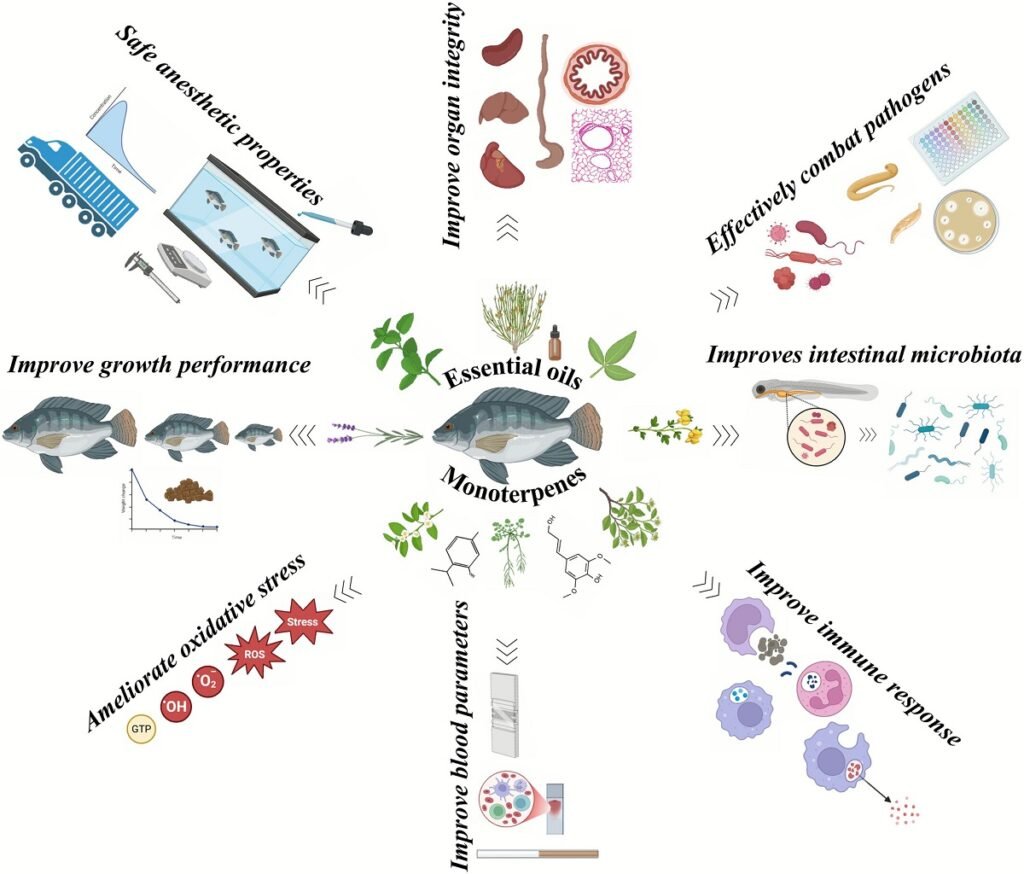
- Immune Boost: These compounds do not merely eradicate pathogens; they also activate the fish’s immune system, enhancing stress response and growth.
- Expanding Market: The phytogenic feed additive market for aquaculture is projected to reach US$5.3 billion by 2030.
The Disaster Triangle
The emergence of diseases is no coincidence. It stems from the disruption of the equilibrium within the “triangle: environment, pathogen, and host.”
- Host: Fish stressed by high stocking densities.
- Pathogen: Bacteria such as Aeromonas hydrophila and Edwardsiella tarda that already carry multiple resistance genes.
- Environment: Water contaminated with antibiotic residues (such as sulfadiazine or amoxicillin) that alter aquatic biodiversity.
What are monoterpenes, and why are they so special?
Monoterpenes are secondary plant metabolites consisting of 10 carbon atoms. In nature, plants synthesize them to defend against insects and hostile climates. In fish, these compounds function in a multifunctional capacity.
Mechanisms of Action: The Molecular “Battering Ram”
Unlike traditional antibiotics that typically target a single bacterial process, monoterpenes act through “surgical” yet broad-spectrum attacks:
- Membrane Rupture: Due to their lipophilic nature, they insert themselves into bacterial membranes, increasing permeability and causing the leakage of vital cellular contents (ions, proteins, genetic material).
- Energy Inhibition: They block key enzymes in the bacterial respiratory chain, such as cytochrome c oxidase, depriving the pathogen of the “fuel” required for growth.
- Anti-Quorum Sensing: They interfere with bacterial communication, preventing pathogens from coordinating to form resistant biofilms.
From Theory to Practice

The scientific review compiles striking data on key species such as Nile Tilapia (Oreochromis niloticus), Tambaqui (Colossoma macropomum), and Black Sea Salmon (Salmo labrax).
| Species | Highlighted Additive | Primary Result |
| Nile Tilapia | Oregano Oil (Carvacrol) | Enhances growth and antioxidant response. |
| Common Carp | Limonene | Reduces bacterial infections and strengthens the immune system. |
| Tambaqui | Thymol/Carvacrol Mixture | Increases pathogen resistance and improves performance. |
| Zebrafish | Lavender Oil | Regulates anti-inflammatory genes (IL-10). |
The Case of Edwardsiellosis
One of the most recent milestones reported is the use of microencapsulated thymol and carvacrol to treat tilapias already infected with E. tarda. Results showed an efficacy comparable to oxytetracycline, achieving survival rates exceeding 95%. This shifts the paradigm: monoterpenes are no longer just preventive, but curative.
The Immune Boost: More Than Just “Killing Bugs”
The effect of these compounds extends beyond direct bacterial elimination; they act as potent immunomodulators.
- Phagocytosis: They increase the capacity of macrophages to “consume” and destroy invaders.
- Immunological Memory: They stimulate antibody production, preparing the fish for future challenges.
- Inflammation Control: They modulate pathways such as NF-κB, preventing excessive inflammation that could damage the fish’s own tissues.
Challenges for Mass Adoption: Not All “Rosy”
Despite their potential, the transition from antibiotics to monoterpenes faces significant hurdles:
Mantente siempre informado
Stay Informed
Únete a nuestras comunidades para recibir al instante las noticias, informes y análisis más importantes del sector acuícola.
Join our communities to get instant access to the most important news, reports, and analysis from the aquaculture industry.
The Economic Gap
While extraction costs are decreasing, clear information regarding financial viability for small-scale producers is still lacking. Antibiotics are often perceived as a cheaper and faster short-term solution.
Chemical Instability
Monoterpenes are highly volatile and degrade easily when exposed to light, heat, or oxygen. This is where microencapsulation technology is vital to ensure the compound reaches the fish’s digestive tract intact.
Lack of Standardization
The composition of an essential oil can vary based on climate or harvesting methods. The industry must ensure consistent levels of active ingredients to guarantee uniform results.
Toward a Sustainable Aquaculture
The incorporation of these natural substances aligns directly with the UN Sustainable Development Goals (SDGs), specifically SDG 12 (Responsible Consumption and Production) and SDG 15 (Life on Land). It is estimated that by 2050, between 65% and 75% of commercial aquafeeds will contain phytobiotics to replace synthetic growth promoters. Asia continues to lead production, but regions like Latin America (led by Chile and Brazil) are investing heavily in these controlled-delivery technologies.
Contact
Marco Shizuo Owatari
Aquatic Organism Health Laboratory—AQUOS, Federal University of Santa Catarina
Florianópolis, SC, Brazil
Email: owatarimarco@hotmail.com
Reference (open access)
Vilhena Batista, D. V., Souza, B. S., Santana Farias, C. F., Lopes, E. M., Brasil, E. M., Martins, M. L., Pedreira Mouriño, J. L., & Owatari, M. S. (2026). Monoterpenes: Functional Additives for Reducing Antibiotics in Aquaculture. Reviews in Aquaculture, 18(1), e70124. https://doi.org/10.1111/raq.70124

Editor at the digital magazine AquaHoy. He holds a degree in Aquaculture Biology from the National University of Santa (UNS) and a Master’s degree in Science and Innovation Management from the Polytechnic University of Valencia, with postgraduate diplomas in Business Innovation and Innovation Management. He possesses extensive experience in the aquaculture and fisheries sector, having led the Fisheries Innovation Unit of the National Program for Innovation in Fisheries and Aquaculture (PNIPA). He has served as a senior consultant in technology watch, an innovation project formulator and advisor, and a lecturer at UNS. He is a member of the Peruvian College of Biologists and was recognized by the World Aquaculture Society (WAS) in 2016 for his contribution to aquaculture.