Ensuring that the fish reaching our plates is safe requires more than just routine inspections. The European Union’s legislative framework is built upon the “Farm to Fork” strategy, which entails designing risk-based official controls. In Norway, where Atlantic salmon (Salmo salar) production is a high-tech industry, monitoring chemical contaminants is essential not only for public health but also for animal welfare.
The challenge is complex: how to decide which substances to analyze among thousands of potential chemical compounds, particularly when emerging contaminants with scarce data arise? This is where the work program developed by experts from the Institute of Marine Research (IMR, Norway) and the Istituto Zooprofilattico Sperimentale della Lombardia e dell’Emilia Romagna (IZSLER, Italy) comes into play.
Key Points
- Intelligent Prioritization: A semi-quantitative scoring system (from 2 to 14 points) has been developed to classify which contaminants must be monitored most urgently in salmon and their feed.
- Focus on Norwegian Salmon: The study focuses on Norway’s aquaculture sector, which in 2022 produced 1.65 million tons of aquatic animals, with Atlantic salmon being the primary species.
- Hunting Emerging Contaminants: The method allows for the evaluation of substances that do not yet have defined legal limits, such as Dechloranes, by identifying critical knowledge gaps.
- Cutting-Edge Technology: The use of High-Resolution Mass Spectrometry (HRMS) has been integrated to detect a potentially unlimited number of unknown compounds in fish fillets.
The New Scoring System: How is Risk Measured?
The core of this research is a ranking methodology that converts qualitative and quantitative information into a transparent numerical score. This system enables risk managers to decide which substances should be included in national monitoring plans.
The 4 Pillars of Assessment
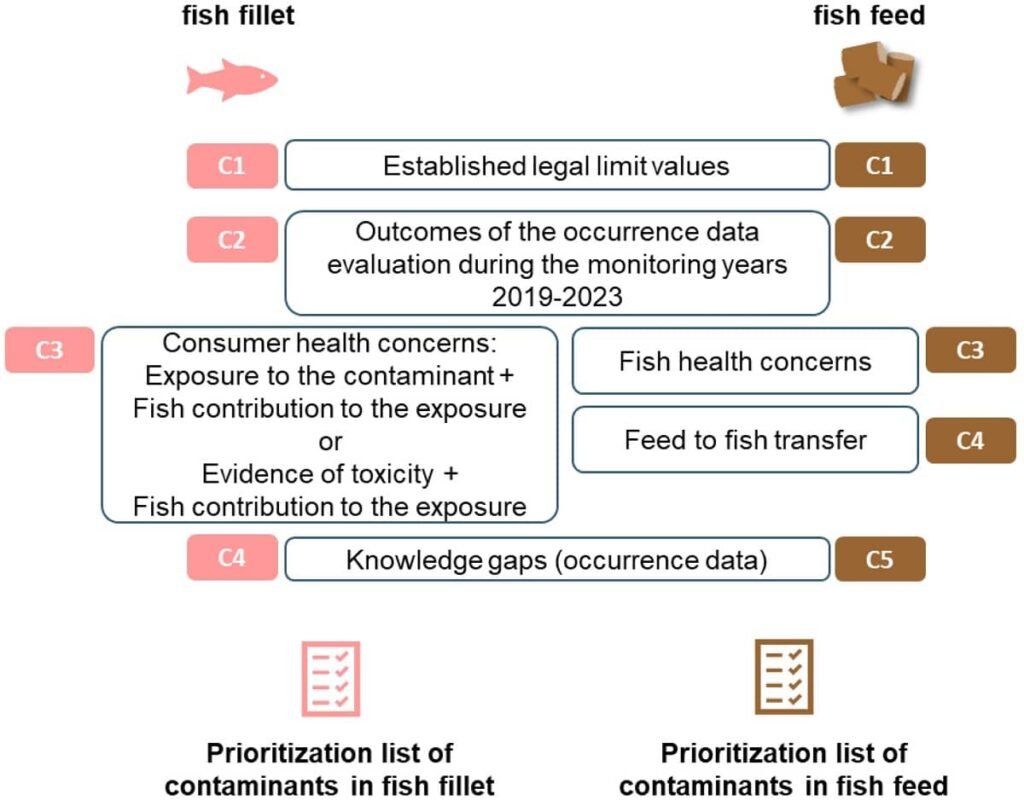
To calculate a contaminant’s priority, scientists assign points based on four fundamental criteria:
- Health Concerns (Maximum 6 points): This is the most heavily weighted criterion. It evaluates human dietary exposure (specifically how much fish consumption contributes to the total intake of a toxin) and potential adverse effects on the health of the fish itself.
- Occurrence Data (Maximum 3 points): Monitoring data from the last 5 years (2019-2023) are analyzed. If a contaminant shows increasing trends or levels near safety limits, its score rises.
- Knowledge Gaps (Maximum 3 points): If there is insufficient data regarding the presence of a substance in the feed or the fillet, the system penalizes it with a high score to compel further investigation.
- Legal Status (Maximum 2 points): It considers whether the contaminant already has maximum residue levels established by European legislation.
Ultimately, each substance receives a score between 2 and 14 points. The higher the score, the higher the priority for the Norwegian government to allocate resources for its surveillance.
Case Study: Dechloranes Under Scrutiny
To validate this method, researchers applied it to Dechloranes (DRCs), a group of chlorinated flame retardants used in plastics and electronic components. Dechlorane Plus (DP), for instance, was recently included in the Stockholm Convention on Persistent Organic Pollutants.
Assessment Results
For both the salmon fillet and the complete feed, Dechloranes obtained a score of 8 out of 14.
- In the fillet: The score was driven by the lack of legal limits and gaps in occurrence data, combined with concerns over chronic toxicity and the high probability of fish being a major source of human exposure.
- In the feed: An 8 was obtained due to evidence that these chemicals transfer from the feed to the fish tissue and can cause oxidative stress and neurodevelopmental effects in species like zebrafish.
This result demonstrates that, although there is currently no strict regulation for dechloranes in fish, science suggests we must keep a close watch on them.
Beyond the Known: “Suspect” Technology
One of the most fascinating aspects of the work performed at the IMR was the exploration of suspect screening. Traditionally, laboratories look for a closed list of substances (targeted methods). But what about what we don’t know is there? Using High-Resolution Mass Spectrometry (HRMS) coupled with Ultra-High-Performance Liquid Chromatography (UHPLC), scientists can analyze salmon samples and compare them against immense databases. This allows for the identification of:
Stay Always Informed
Join our communities to instantly receive the most important news, reports, and analysis from the aquaculture industry.
- Emerging environmental contaminants such as new PFAS.
- Pharmaceutically active compounds.
- Substances that previously went unnoticed due to a lack of reference materials.
This “non-targeted” technique acts as a long-range radar that detects threats before they become food safety crises.
Global Impact and Conclusion
This EFSA program is not merely an academic endeavor; it provides a robust, evidence-based scientific foundation for authorities, such as the Norwegian Food Safety Authority (NFSA), to design truly efficient Multi-Annual National Control Plans (MANCPs).
The implementation of this methodology ensures that Atlantic salmon—a flagship product across Europe and the globe—consistently meets the most stringent safety standards. By identifying knowledge gaps and prioritizing substances according to their actual health impact, science preemptively mitigates risks, safeguarding both consumers and the long-term sustainability of the aquaculture industry. This study was funded by the European Food Safety Authority (EFSA) through the EU-FORA fellowship program.
Contact
Elena Butovskaya
Istituto Zooprofilattico Sperimentale della Lombardia e dell’Emilia Romagna
Italia
Email: eu-fora@efsa.europa.eu
Reference (open access)
Butovskaya, E., Sele, V., Lundebye, K., Hannisdal, R., Ali, A., Menotta, S., & Bernhard, A. Risk prioritisation of (emerging) contaminants in aquaculture production. EFSA Journal, 23, e231108. https://doi.org/10.2903/j.efsa.2025.e231108

Editor at the digital magazine AquaHoy. He holds a degree in Aquaculture Biology from the National University of Santa (UNS) and a Master’s degree in Science and Innovation Management from the Polytechnic University of Valencia, with postgraduate diplomas in Business Innovation and Innovation Management. He possesses extensive experience in the aquaculture and fisheries sector, having led the Fisheries Innovation Unit of the National Program for Innovation in Fisheries and Aquaculture (PNIPA). He has served as a senior consultant in technology watch, an innovation project formulator and advisor, and a lecturer at UNS. He is a member of the Peruvian College of Biologists and was recognized by the World Aquaculture Society (WAS) in 2016 for his contribution to aquaculture.