The global aquaculture industry has reached a remarkable production output of over 91 million tonnes annually, consolidating itself as a fundamental pillar of global food security. However, the sector faces the challenge of optimizing growth sustainably in the face of increasing protein demand. Growth performance is the most critical economic trait, as it directly determines production costs and the profitability of operations.
While traditional breeding has been effective, the integration of molecular biology and genomics now offers unprecedented opportunities to enhance genetic traits. A new systematic review of 180 scientific articles (published between 1992 and 2025)—conducted by scientists from the Research and Development Station for Aquaculture and Aquatic Ecology, Alexandru Ioan Cuza University, and the Faculty of Food and Animal Sciences, University of Life Sciences “Ion Ionescu de la Brad”—reveals that the future success of aquaculture depends on our ability to understand and manipulate the molecular networks controlling fish development.
Key Points
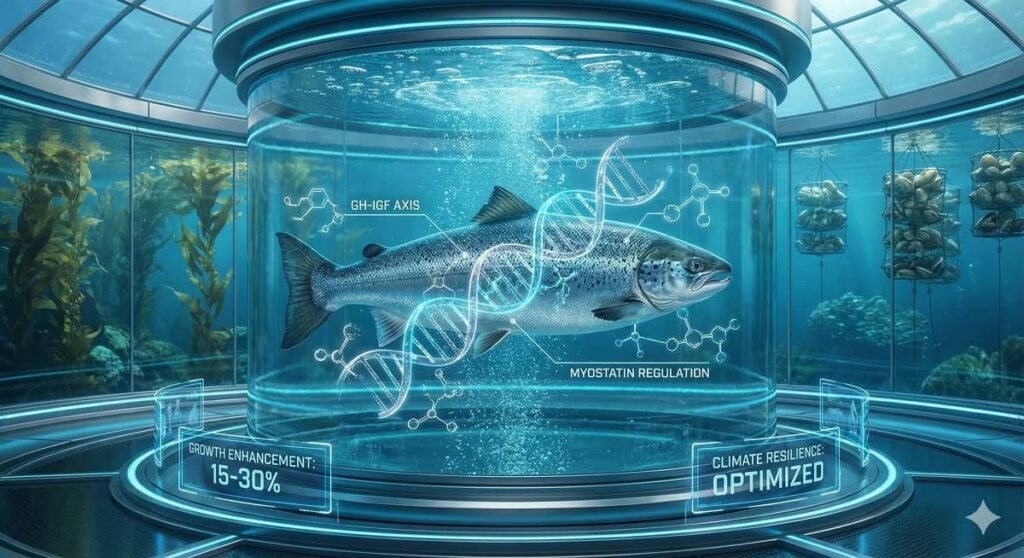
- Integrated Networks: Growth regulation does not rely on a single gene, but rather on multi-level networks including the GH-IGF axis, myostatin signaling, and epigenetic mechanisms.
- CRISPR Potential: The use of CRISPR-Cas9 for myostatin knockout allows for increases of 15% to 30% in muscle growth.
- Genomic Complexity: Many commercial species, such as common carp and salmonids, possess complex polyploid genomes due to ancient Whole Genome Duplication (WGD) events, offering unique selection opportunities as well as technical challenges.
- Climate Resilience: Epigenetic markers and genomic selection are essential tools for developing varieties capable of maintaining productivity in the face of rising temperatures and hypoxia.
The Three Pillars of Molecular Regulation
Fish growth is an intricate process that integrates environmental, nutritional, and developmental signals through three main systems.
The GH-IGF Axis: The Endocrine Motor
The system, composed of growth hormone (GH) and insulin-like growth factor (IGF) acts as the central control for body size. Growth hormone controls metabolic processes, while IGF-I mediates anabolic effects at the tissue level, promoting protein synthesis. Studies in common carp have shown that polymorphisms in these genes significantly affect performance during critical developmental stages. Furthermore, this axis is highly sensitive to external factors: temperature is the dominant modulator in poikilothermic fish, directly influencing the expression of these genes.
Myostatin: The Muscle Growth Brake
Within the transforming growth factor-β (TGF-β) superfamily, myostatin (MSTN) stands out as the primary negative regulator of muscle growth. Its function is to limit the proliferation and differentiation of muscle cells. Advanced research through gene editing has demonstrated that by “disabling” this natural brake using CRISPR-Cas9, substantial improvements in muscle mass and feed conversion efficiency are achieved without adverse physiological effects.
Epigenetics: The Bridge Between Environment and Genes

Epigenetic mechanisms, such as DNA methylation and microRNAs, allow fish to adapt dynamically to their environment without changing their genetic sequence. These processes function as rapid response systems to thermal or nutritional stress. A promising finding is the capacity for these epigenetic changes to be inherited transgenerationally, opening the door to breeding strategies that prepare future generations for specific environmental conditions.
The Complexity of Polyploid Genomes
Economically significant species like the common carp (Cyprinus carpio) and salmon possess genomes that duplicated millions of years ago. This means they have an expanded repertoire of genes, allowing for more sophisticated regulatory control. However, this advantage is accompanied by high technical complexity for breeding programs. Managing multiple gene copies (homeologs) requires specialized statistical methods and higher marker density for genomic selection to be effective. Despite the challenges, this genetic redundancy acts as a buffer against deleterious mutations and offers adaptive flexibility.
Vanguard Technologies for Sustainable Production
The review emphasizes that the sustainable intensification of aquaculture requires “precision genetics” supported by various tools:
- Genomic Selection: Allows for the estimation of genetic merit using genome-wide markers, accelerating improvement in difficult-to-measure traits like feed efficiency or disease resistance.
- Gene Editing (CRISPR-Cas9): A transformative technology for making precise modifications to improve muscle quality or environmental adaptation.
- Multi-omic Integration: The combined use of genomics, transcriptomics, proteomics, and metabolomics enables the precise identification of factors affecting muscle quality under different management systems.
Integrated Multi-Trophic Aquaculture (IMTA)
Genetics must also adapt to more sustainable farming systems, such as IMTA, which utilizes species from different trophic levels to maximize nutrient use and minimize environmental impact. In these systems, it is crucial to select strains that are not only productive but also maintain beneficial ecological interactions with other farmed species, such as mollusks and algae.
Mantente siempre informado
Stay Informed
Únete a nuestras comunidades para recibir al instante las noticias, informes y análisis más importantes del sector acuícola.
Join our communities to get instant access to the most important news, reports, and analysis from the aquaculture industry.
Challenges for Global Implementation
Despite scientific advances, the practical application of these technologies faces significant barriers. The implementation of CRISPR, for example, is limited by divergent regulatory frameworks worldwide, high economic investment requirements, and variable consumer acceptance. To bridge the gap between research and practice, it is essential to strengthen technology transfer to producers, especially in developing regions, and to establish international collaboration networks.
Conclusion
The molecular revolution in aquaculture genetics offers unprecedented tools to ensure global food security in the context of climate change. Achieving resilient and sustainable aquaculture systems will depend on our ability to integrate scientific innovation with economic viability and environmental stewardship.
Reference (open access)
Șerban, D. A., Barbacariu, C.-A., Ivancia, M., & Creangă, Ș. (2025). Molecular Regulation of Growth in Aquaculture: From Genes to Sustainable Production. Life, 15(12), 1831. https://doi.org/10.3390/life15121831

Editor at the digital magazine AquaHoy. He holds a degree in Aquaculture Biology from the National University of Santa (UNS) and a Master’s degree in Science and Innovation Management from the Polytechnic University of Valencia, with postgraduate diplomas in Business Innovation and Innovation Management. He possesses extensive experience in the aquaculture and fisheries sector, having led the Fisheries Innovation Unit of the National Program for Innovation in Fisheries and Aquaculture (PNIPA). He has served as a senior consultant in technology watch, an innovation project formulator and advisor, and a lecturer at UNS. He is a member of the Peruvian College of Biologists and was recognized by the World Aquaculture Society (WAS) in 2016 for his contribution to aquaculture.