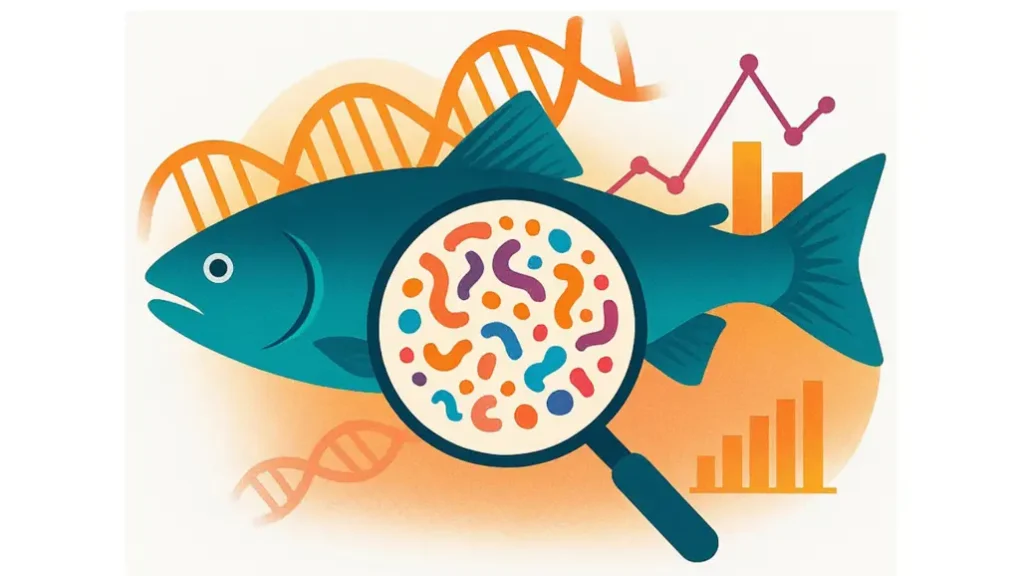
For the expansion of aquaculture to be sustainable, the industry must reduce its dependence on conventional protein sources, such as fishmeal and soy, by seeking alternatives that not only provide nutrition but also promote the health and well-being of the fish. In this context, the gut microbiota emerges as a fundamental biological interface between the diet, the host’s physiology, and the environment. These are not simple passengers; these communities of microorganisms profoundly influence nutrient utilization, immune function, and the overall performance of such valuable species as Atlantic salmon (Salmo salar) and rainbow trout (Oncorhynchus mykiss).
Researcher Shuowen Cao, from the Department of Animal Nutrition and Management at the Swedish University of Agricultural Sciences (SLU), has delved into this complex relationship in her 2025 doctoral thesis. Cao’s work provides a roadmap for how environmental, technical, and dietary factors—specifically the use of filamentous fungi and probiotic yeasts—can shape the intestinal ecosystem to produce healthier and more resilient fish.
- 1 Key conclusions
- 2 The Challenge of Comparing Studies: Technical Bias
- 3 Biological and Environmental Factors: What Matters More?
- 4 Filamentous Fungi: Sustainable Proteins from Industrial By-products
- 5 Probiotic Yeasts: Strengthening the Intestinal “Shield”
- 6 The Path Toward Responsible Aquaculture
- 7 Entradas relacionadas:
Key conclusions
- Dominant Technical Influence: The study and laboratory methods (DNA extraction kits and 16S gene regions) explain more than 60% of the observed variation in the composition of the microbiota.
- Environmental and Weight Effect: Factors such as diet and the initial weight of the fish have a significant impact on the diversity of microorganisms.
- Fungi as an Alternative: Filamentous fungi such as Aspergillus oryzae and Rhizopus oryzae have great potential as sustainable protein sources, although their digestibility must be optimized.
- Next-Generation Probiotics: The yeast Rhodosporidium babjevae stands out as a promising probiotic by improving the presence of beneficial bacteria and regulating key genes of the intestinal barrier.
The Challenge of Comparing Studies: Technical Bias
One of the most revealing findings of the meta-analysis conducted by Cao, which integrated data from 19 published studies on freshwater salmonids, is the enormous influence of methodology. Technical factors such as the choice of DNA extraction kit or the specific region of the 16S rRNA gene being analyzed can drastically alter the results. For example, the analysis showed that the study itself explained most of the observed diversity. This underscores an urgent need in the scientific community: the standardization of sampling and sequencing protocols to allow real comparisons between different research projects and countries.
Biological and Environmental Factors: What Matters More?
Beyond technicalities, factors such as fish species and initial weight influence the diversity of the microbiota. Atlantic salmon, for instance, tends to present a higher phylogenetic diversity in its gut compared to rainbow trout. Regarding the environment, the rearing system is a determining factor. Fish raised in Recirculating Aquaculture Systems (RAS) showed significantly higher microorganism diversity than those in open-flow systems or in the wild. This could be due to the higher bacterial load and water retention time in RAS systems. Other factors, such as water temperature, flow rate, and light cycle, also play specific roles, although to a lesser extent than diet.
Filamentous Fungi: Sustainable Proteins from Industrial By-products
In the search for alternatives to fishmeal, Cao evaluated four species of filamentous fungi: Aspergillus oryzae, Neurospora intermedia, Rhizopus delemar, and Rhizopus oryzae. What is fascinating about these microorganisms is that they can be grown on industrial by-products, such as waste from bioethanol production, transforming waste into biomass rich in proteins (30-60%), vitamins, and bioactive compounds. Experiments conducted at the SLU aquatic facility in Uppsala revealed that including 30% of these fungi in the diet of rainbow trout significantly alters the microbiota. Although the digestibility of these diets was slightly lower than that of the control feed, the results suggest that fungi can favor the growth of beneficial bacteria such as Lactobacillus and Weissella. Species like A. oryzae, traditionally used in Asian fermentations such as miso and soy sauce, are emerging as ingredients with not only nutritional potential but also as promoters of gut health if their digestibility can be improved.
Probiotic Yeasts: Strengthening the Intestinal “Shield”

The study also explored the use of yeasts as probiotic supplements. After an initial screening of ten species using brine shrimp (Artemia franciscana) larvae as a model, two were selected for fish trials: Kluyveromyces marxianus and Rhodosporidium babjevae. Supplementation with Rhodosporidium babjevae yielded the most encouraging results. This yeast not only increased the abundance of beneficial bacteria like Lactococcus in the gut but also regulated the expression of genes essential for the integrity of the intestinal barrier, such as occludin (ocln) and transforming growth factor-beta (tgf-β). These genes are responsible for maintaining the “tightness” of the intestinal epithelium and regulating inflammatory responses. This finding suggests that R. babjevae acts as a mild immunostimulant, priming the fish’s defense system without causing chronic inflammation, which could translate into greater resistance to infectious diseases under intensive farming conditions.
The Path Toward Responsible Aquaculture
The work of Shuowen Cao, which involved collaboration with researchers from institutions such as the University of Borås and the University of Guelph in Canada, concludes that understanding and managing microbial communities is essential for the development of functional feeds. Humanizing science involves recognizing that every advance in the laboratory is a step toward a more circular and efficient production system. The transition toward responsible aquaculture depends on our ability to integrate this knowledge into commercial formulations that respect the fish’s internal ecology. For aquaculture producers, the message is clear: health depends not only on what the fish eat but on how what they eat shapes their microscopic allies. The future of aquaculture feed seems to be written in the cells of fungi and yeasts.
Reference (open access)
Cao, S. (2025). Shaping the salmonid gut microbiota: Meta-analytical insights and dietary approaches to enhance fish health and performance (Acta Universitatis Agriculturae Sueciae No. 2025:91) [Tesis doctoral, Swedish University of Agricultural Sciences]. https://doi.org/10.54612/a.6jl5jv1vb3

Editor at the digital magazine AquaHoy. He holds a degree in Aquaculture Biology from the National University of Santa (UNS) and a Master’s degree in Science and Innovation Management from the Polytechnic University of Valencia, with postgraduate diplomas in Business Innovation and Innovation Management. He possesses extensive experience in the aquaculture and fisheries sector, having led the Fisheries Innovation Unit of the National Program for Innovation in Fisheries and Aquaculture (PNIPA). He has served as a senior consultant in technology watch, an innovation project formulator and advisor, and a lecturer at UNS. He is a member of the Peruvian College of Biologists and was recognized by the World Aquaculture Society (WAS) in 2016 for his contribution to aquaculture.
Mantente siempre informado
Stay Informed
Únete a nuestras comunidades para recibir al instante las noticias, informes y análisis más importantes del sector acuícola.
Join our communities to get instant access to the most important news, reports, and analysis from the aquaculture industry.