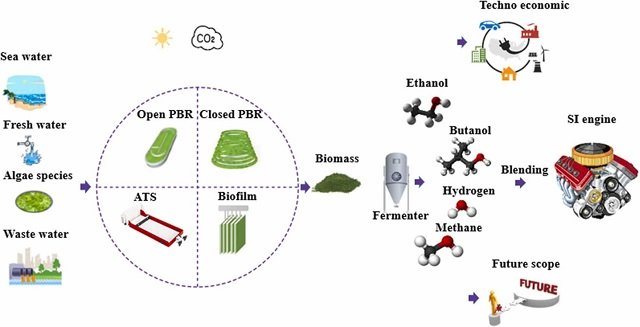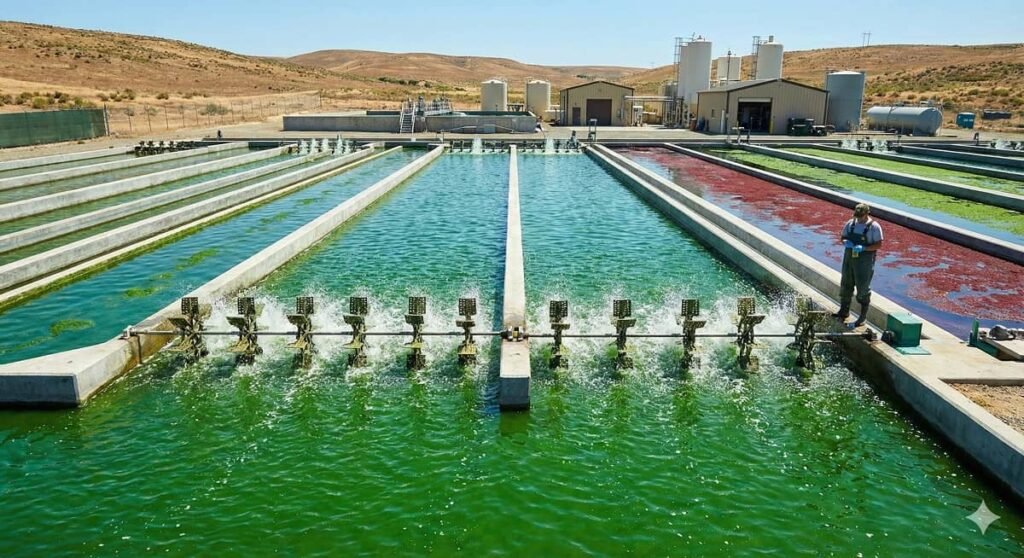
Microalgae cultivation in open ponds faces a persistent challenge: climatic volatility. Critical factors such as ambient temperature and solar radiation fluctuate constantly, directly impacting biomass growth rates. Traditionally, producers have relied on static schedules for strain rotation and pond management; however, these rigid strategies often underutilize the system’s productive potential.
A recent study led by researchers from the Pacific Northwest National Laboratory (PNNL) and the University of Washington, published in Biotechnology and Bioengineering, presents a groundbreaking solution: a monthly biomass forecasting system. This tool facilitates adaptive decision-making, determining which strain to cultivate and the optimal operating depth based on forecasted weather conditions.
Key study takeaways
- Yield Increase: Implementing forecast-based strategies raised average biomass yields by 15% compared to current standard technology.
- High Model Accuracy: The GEOS-5 climate model demonstrated remarkable efficacy, identifying the optimal cultivation strategy with 84% accuracy.
- Strain Selection vs. Depth: Models were more effective at predicting the ideal strain (92% success rate) than water depth, as strain biology responds to broader seasonal patterns.
- Critical Periods: Seasonal transition months, such as May and September, pose the greatest predictive challenge due to high atmospheric instability.
The Challenge of Environmental Variability
Microalgae represent a promising source for biofuels and bioproducts. However, outdoor cultivation is extremely sensitive. Extreme weather events, such as unforeseen cold snaps, can compromise production if preventive mitigation is lacking. Until now, the industry lacked robust systems to guide critical operational decisions based on weather projections. To bridge this gap, the authors developed an experimental system integrating PNNL’s Biomass Assessment Tool (BAT) with advanced monthly climate forecast data.
Methodology: Simulating the Future in Arizona
The study analyzed the behavior of two high-yield strains in Arizona during the 2020–2024 period:
- Picochlorum celeri: A strain optimized for warm seasons.
- Tetraselmis striata: A variety tolerant to cold climates.
Researchers evaluated performance across four pond depths (15, 20, 25, and 30 cm) using two predictive approaches:
- Operational Seasonal Forecasts (NMME): Dynamic models that anticipate actual future weather.
- Historical Climatology (NLDAS-2): Benchmarks based on historical averages.

The core objective was to determine if the system could anticipate the winning “strain + depth” combination to maximize the following month’s biomass.
A Leap in Productivity
Simulations confirmed that adaptive, forecast-based management significantly outperforms current fixed strategies (referred to as State of Technology or SOT). While the SOT strategy maintains a constant depth of 20 cm and rotates strains on pre-set dates, the new system suggests dynamic adjustments.
- Substantial Gains: The predictive approach achieved an average biomass increase of 15%.
- Efficiency Peaks: In key months like October and April, the system recommended cultivating T. striata at 15 cm (instead of P. celeri at 20 cm), generating production increases of 50.9% and 47.6%, respectively.
Decision-Making Precision
The GEOS-5 model (part of the NMME suite) stood out as the most precise, selecting the correct strategy in 84.3% of cases. The study revealed an important distinction: it is considerably easier to predict the appropriate strain than the exact water depth. While strain choice exceeded 90% accuracy due to clear seasonal patterns, optimal depth is highly sensitive to monthly variability, complicating its forecast.
Climatology vs. Dynamic Models
A finding of great practical value for producers is the robustness of historical data. While complex dynamic models (GEOS-5) offered greater technical accuracy, the approach based on historical climatology (NLDAS-2) proved to be an effective “safety net.” This approach reported an average production loss of only 2.2% in months where predictions failed, suggesting that in the absence of complex models, the intelligent use of historical data remains a powerful tool against uncertainty.
Mantente siempre informado
Stay Informed
Únete a nuestras comunidades para recibir al instante las noticias, informes y análisis más importantes del sector acuícola.
Join our communities to get instant access to the most important news, reports, and analysis from the aquaculture industry.
Implications for the Aquaculture Industry
Funded by the U.S. Department of Energy’s (DOE) Bioenergy Technologies Office, this study lays the foundation for a more resilient microalgae aquaculture. The ability to anticipate environmental conditions allows for a shift from a reactive to a proactive approach. Although current results are based on simulations under ideal conditions, the potential to boost biomass by 15% through operational adjustments represents a significant economic opportunity to scale sustainable algae production in a changing climate.
Contacto
Hongxiang Yan
Energy and Environment Directorate, Pacific Northwest National Laboratory
Richland, Washington, USA
Email: hongxiang.yan@pnnl.gov
Referencia (acceso abierto)
Yan, H., Gao, S., Wigmosta, M. S., Coleman, A. M., Sun, N., & Huesemann, M. H. Adaptive Algal Cultivation Enabled by a Monthly Biomass Forecasting System. Biotechnology and Bioengineering. https://doi.org/10.1002/bit.70120

Editor at the digital magazine AquaHoy. He holds a degree in Aquaculture Biology from the National University of Santa (UNS) and a Master’s degree in Science and Innovation Management from the Polytechnic University of Valencia, with postgraduate diplomas in Business Innovation and Innovation Management. He possesses extensive experience in the aquaculture and fisheries sector, having led the Fisheries Innovation Unit of the National Program for Innovation in Fisheries and Aquaculture (PNIPA). He has served as a senior consultant in technology watch, an innovation project formulator and advisor, and a lecturer at UNS. He is a member of the Peruvian College of Biologists and was recognized by the World Aquaculture Society (WAS) in 2016 for his contribution to aquaculture.