Assessing animal welfare in aquaculture has evolved from a mere administrative formality to a cornerstone of scientific quality and ethical production. However, defining welfare and how to measure it in fish presents unique challenges, given that different species and life stages possess distinct needs.
A recent scientific review published in Reviews in Aquaculture by an international group of scientists led by Nofima proposes an updated and practical approach: the use of the Welfare Indicator (WI) “toolboxes” specifically designed for the five most farmed fish species in Europe: Atlantic salmon, rainbow trout, European sea bass, gilthead sea bream, and common carp.
Below, we break down the most relevant findings of this study and explain how these tools can transform monitoring in research centers and production farms.
Key conclusions
- Multispecies Approach: Specific WI toolboxes have been developed for Atlantic salmon, rainbow trout, European sea bass, gilthead sea bream, and common carp, taking into account their unique biological needs and life stages.
- Types of Indicators: A robust assessment must combine environment-based indicators (inputs) with animal-based indicators (outcomes), at both the group and individual levels.
- Beyond Compliance: The proposed tools exceed the minimum requirements of European Directive 2010/63/EU, seeking to optimize scientific and ethical quality.
- Emerging Technology: Digitization—including the use of cameras, sensors, AI, and microbiome analysis—is fundamental for refining non-invasive welfare monitoring.
- Humane Endpoints: The use of precise indicators is crucial for determining when to intervene in an experiment to avoid unnecessary suffering (Humane Endpoints).
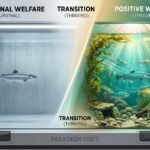
Understanding welfare: Beyond survival
The study defines animal welfare as “the quality of life as perceived by the animal itself.” This implies that the state of welfare is the sum of subjective experiences, both positive and negative, at a given moment.
To assess this, researchers utilize the Five Domains Model: nutrition, physical environment, health, behavioral interactions, and the resulting mental state. An effective assessment cannot rely on a single parameter; it requires a holistic approach.
The “Toolbox”: Input and outcome indicators

The core of the scientific proposal lies in classifying indicators into two broad categories that must be used conjointly:
Input-based indicators
These describe the resources and the environment to which the fish are exposed. They are the first line of defense to ensure adequate conditions.
- Water Quality: Parameters such as temperature, dissolved oxygen, and nitrogenous compounds are critical. The study warns that tolerance thresholds vary enormously depending on the species and prior acclimation.
- Lighting and Noise: Often underestimated factors, such as light intensity, photoperiod, and vibrations, have direct impacts on behavior and physiology.
- Physical Environment: Includes stocking density, water volume, and current speed; determining factors for allowing natural swimming behavior.
Outcome-based indicators
These measures how the fish responds to its environment, indicating whether its needs are being met.
At the group level:
Mantente siempre informado
Stay Informed
Únete a nuestras comunidades para recibir al instante las noticias, informes y análisis más importantes del sector acuícola.
Join our communities to get instant access to the most important news, reports, and analysis from the aquaculture industry.
- Behavior: Changes in swimming activity, appetite, or aggression serve as early warning signals.
- Mortality: Although a reactive (lagging) measure, tracking mortality and survival rates remains essential.
- Visual Indicators in Water: The presence of scales or blood in the water are unequivocal signs of physical trauma or inadequate handling.
At the individual level:
- Physical Damage: Assessment of injuries to fins, skin, eyes, and snout, as well as opercular or vertebral deformities.
- Physiological State: Measurement of cortisol, glucose, and lactate as biological stress markers.
- Internal Health: Macroscopic state of the gills, liver, and heart.
Species-specific considerations
The study underscores that there is no “one size fits all” for animal welfare. Needs vary significantly:
- Atlantic Salmon: Particularly sensitive to oxygen levels and temperature, especially during smoltification. Indicators such as gill status and vertebral deformities are highlighted.
- Rainbow Trout: Priority should be given to observing fin erosion and eye damage (cataracts), common pathologies in intensive systems.
- Sea Bass and Sea Bream: In these Mediterranean species, opercular deformities and lordosis (spinal curvature) are frequent problems that compromise respiration and swimming.
- Common Carp: As a benthic (bottom-dwelling) fish, substrate quality and water turbidity play a different role than in salmonids. Their tolerance to temperature and oxygen also differs.
The role of technology and digitization
One of the most promising areas discussed in the article is the use of advanced technologies to refine welfare assessment without disturbing the fish (non-invasive methods).
- Computer Vision and Artificial Intelligence (AI): Cameras and algorithms can monitor swimming, detect skin lesions, and assess appetite in real-time, eliminating the stress associated with manual handling.
- Sensors and Biosensors: From acoustic tags measuring acceleration to implantable heart rate sensors, technology turns individual fish into “sentinels” of group welfare.
- The Microbiome as an Indicator: The analysis of microbial communities (in water, skin, or gut) emerges as a new “hybrid” indicator offering simultaneous information on the environment and fish health (the holobiont concept).
Ethical application: Humane endpoints
Finally, the review addresses a crucial ethical topic in research: Humane Endpoints (HEPs). The use of precise indicators allows researchers to determine the exact moment to intervene or halt an experiment, avoiding severe suffering. This ensures compliance with the 3Rs principle (Replacement, Reduction, and Refinement) and current European regulations.
Conclusion
Standardizing indicators through these “toolboxes” represents a significant advancement for European aquaculture. By combining traditional observation with new technologies and deep biological knowledge of each species, producers and researchers can guarantee not only legal compliance but also more ethical and efficient production. The key lies in observing both the environment (inputs) and the animal (outcomes) to obtain a complete picture of their quality of life.
Contact
Chris Noble
Nofima
Tromsø, Norway
Email: chris.noble@nofima.no
Reference (open access)
Noble, C., Abbink, W., Alvestad, R., Ardó, L., Bégout, L., Bloecher, N., Burgerhout, E., Calduch-Giner, J., Chivite-Alcalde, M., Císař, P., Durland, E., Espmark, Å. M., Falconer, L., Føre, M., Georgopoulou, D. G., Heia, K., N. Helberg, G. A., Gomez, D. I., Johansen, H., . . . Østbye, K. K. (2026). Welfare Indicators for Aquaculture Research: Toolboxes for Five Farmed European Fish Species. Reviews in Aquaculture, 18(1), e70109. https://doi.org/10.1111/raq.70109

Editor at the digital magazine AquaHoy. He holds a degree in Aquaculture Biology from the National University of Santa (UNS) and a Master’s degree in Science and Innovation Management from the Polytechnic University of Valencia, with postgraduate diplomas in Business Innovation and Innovation Management. He possesses extensive experience in the aquaculture and fisheries sector, having led the Fisheries Innovation Unit of the National Program for Innovation in Fisheries and Aquaculture (PNIPA). He has served as a senior consultant in technology watch, an innovation project formulator and advisor, and a lecturer at UNS. He is a member of the Peruvian College of Biologists and was recognized by the World Aquaculture Society (WAS) in 2016 for his contribution to aquaculture.