Today, ‘blue foods’—encompassing fisheries and aquaculture—represent the fastest-growing food sector, providing nearly 20% of global animal protein. Within this ecosystem, shrimp stands out as a unique commodity catering to both local markets in developing nations and high-value export markets.
However, the shrimp sector is facing a ‘perfect storm’ of challenges; growth has decelerated due to resource scarcity, disease outbreaks, extreme weather events, and volatile economic factors. To meet a demand expected to double by 2050, the industry must transition from a ‘boom-and-bust’ model toward one of structural resilience.
An international team of researchers, led by Queen’s University Belfast, has published a comprehensive analysis in the journal npj Science of Food that serves as an urgent diagnostic. The verdict is clear: unless we transform our crustacean farming practices, the industry risks collapse before global demand doubles by the year 2050.
Key Takeaways for the Industry
- Species Dominance: Roughly 80% of shrimp aquaculture production is concentrated in just two species: the Pacific white shrimp (Litopenaeus vannamei) and the giant tiger prawn (Penaeus monodon).
- Resource Efficiency: Commercial feed accounts for up to 70% of greenhouse gas emissions and exceeds 50% of production costs in intensive farming systems.
- Climate Vulnerability: Climate change not only impacts infrastructure but also compromises shrimp immunity, allowing pathogens to thrive in warming waters.
- Resilience Strategies: Five pillars have been identified for the future: Detect, Isolate, Optimize, Diversify, and Support.
El mapa de la producción actual: sistemas y especies
La camaronicultura moderna se divide principalmente en cuatro sistemas, cada uno con un perfil de riesgo y retorno distinto:
- Extensivo: Utiliza grandes extensiones de tierra (zonas intermareales) con baja densidad de siembra y costos operativos mínimos, pero con alta vulnerabilidad ambiental.
- Semi-intensivo: Introducen alimentación artificial y bombeo de agua, buscando un equilibrio entre inversión y rendimiento.
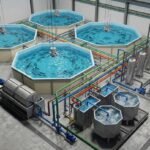
- Intensivo y Super-intensivo: Estos sistemas utilizan densidades de siembra superiores a 100 PL/. Aunque requieren alta inversión en aireación y tecnología, permiten un uso más eficiente de la tierra y un mayor control bioseguro.
El estudio destaca que el camarón blanco (L. vannamei) ha ganado terreno por su ciclo de cultivo más corto (60-90 días) y su mejor factor de conversión alimenticia (FCR), lo que reduce el riesgo económico en caso de fallos por enfermedades.
The Sector’s Four Horsemen: Supply, Disease, Climate, and Economics

The analysis identifies four critical challenges that are intricately intertwined:
- Supply and Food Security: The industry relies on critical inputs: post-larvae (PL), feed, energy, and water. There is currently a shortage of certified Specific Pathogen-Free (SPF) larvae, which can cost up to six times more than non-certified stock. Furthermore, disruptions in global supply chains—stemming from the COVID-19 pandemic or geopolitical conflicts—directly impact operational costs.
- The Constant Threat of Disease: Pathogens affecting shrimp, such as White Spot Syndrome Virus (WSSV) and Yellow Head Virus (YHV), have caused massive financial losses. Since shrimp rely on innate, non-adaptive immunity, prevention through biosecurity remains the only viable long-term strategy.
- Environmental and Climate Impact: Climate change alters water salinity and temperature, stressing organisms and facilitating epidemic outbreaks. Ironically, farm expansion has historically driven mangrove deforestation, eliminating natural coastal protection against storms.
- Economic Dynamics and Debt: Many small-scale producers operate under debt-based schemes with informal intermediaries, limiting their capacity to invest in sustainability technologies or international certifications, such as Best Aquaculture Practices (BAP).
Five Strategies for Global Resilience
To counteract these threats, researchers propose a matrix of solutions that must be implemented synergistically rather than as isolated efforts.
- I. Detect: AI in the Pond: The implementation of Early Warning Systems (EWS) is vital. Utilizing Artificial Intelligence (AI) and point-of-care diagnostics allows for the detection of changes in shrimp DNA or fluctuations in water microbiota before mortality symptoms appear, giving farmers the window to perform emergency harvests or adjust aeration.
- II. Insulate: Biosecurity and Renewable Energy: Creating a “protective bubble” around production is essential. This ranges from employing genetically resilient strains and probiotics to installing physical barriers against viral vectors like birds or rodents. Additionally, solar energy offers a path toward decoupling farms from unreliable power grids.
- III. Streamline: Resource Efficiency: The goal is to optimize the Feed Conversion Ratio (FCR)—producing more biomass with less feed. The study highlights Recirculating Aquaculture Systems (RAS) and Biofloc technology, which leverage microbial communities to recycle nitrogenous waste into supplemental feed within the pond.
- IV. Diversify: Beyond Monoculture: Relying on a single species poses a significant financial risk. The research suggests polyculture or co-cultivation with halophytic plants to diversify income and improve water quality. Furthermore, alternative proteins for feed, such as insect or algae meal, are being explored to reduce pressure on wild fish stocks.
- V. Support: Microfinance and Policy: Without financial backing, technological innovations remain out of reach for smallholders. Microfinance mechanisms and cooperatives are required to facilitate bulk purchasing and access to climate insurance. A notable example is Thailand’s 2023 debt moratorium, allowing farmers a three-year window to recover.
General Conclusion of the Study
The resilience of the shrimp aquaculture sector will not be achieved through isolated solutions, but rather through a strategic matrix involving stakeholders from the producer to the retailer. Transitioning toward more sustainable and transparent models—supported by technologies such as Artificial Intelligence (AI) and Blockchain—is fundamental to ensuring that shrimp remains a vital protein source for the global population.
The research was funded by Queen’s University Belfast’s internal ‘Agility Fund’, the Thammasat University Center of Excellence in Global Food Security, and the National Science, Research and Innovation Fund, Thailand Science Research and Innovation (TSRI).
Mantente siempre informado
Stay Informed
Únete a nuestras comunidades para recibir al instante las noticias, informes y análisis más importantes del sector acuícola.
Join our communities to get instant access to the most important news, reports, and analysis from the aquaculture industry.
Contact
C. T. Elliott
Institute for Global Food Security, School of Biological Sciences
Queen’s University of Belfast, Belfast, UK
Thammasat University Center of Excellence in Global Food Security, Thammasat University (Rangsit Campus), 12120, Pathum Thani, Thailand
Email: chris.elliott@qub.ac.uk
Reference (open access)
Campbell, E., Becker, J. A., Bracher, P., Budhiraja, B., Chaiyapechara, S., Chen, W. N., Colyer, L., Karoonuthaisiri, N., Keeffe, G., McKinley, J., Petchkongkaew, A., Rungrassamee, W., & Elliott, C. T. (2026). Challenges and strategies for globally resilient shrimp aquaculture. npj Science of Food. https://doi.org/10.1038/s41538-026-00787-7.

Editor at the digital magazine AquaHoy. He holds a degree in Aquaculture Biology from the National University of Santa (UNS) and a Master’s degree in Science and Innovation Management from the Polytechnic University of Valencia, with postgraduate diplomas in Business Innovation and Innovation Management. He possesses extensive experience in the aquaculture and fisheries sector, having led the Fisheries Innovation Unit of the National Program for Innovation in Fisheries and Aquaculture (PNIPA). He has served as a senior consultant in technology watch, an innovation project formulator and advisor, and a lecturer at UNS. He is a member of the Peruvian College of Biologists and was recognized by the World Aquaculture Society (WAS) in 2016 for his contribution to aquaculture.