By 2050, the global population is projected to exceed 9 billion people. This demographic growth presents a Herculean challenge: how can we feed humanity without depleting the planet’s natural resources, which are already under severe stress from water and climate issues? The answer may lie in a technological symbiosis that integrates fish, plants, and solar energy.
Researchers at the Universidad Rey Juan Carlos have designed and evaluated a photovoltaic-powered aquaponics system that promises to revolutionize food production efficiency.
- 1 Key Takeaways
- 2 Experimental Design: Tilapia and Lettuce
- 3 The Secret Ingredient: Photovoltaic Energy
- 4 Life Cycle Assessment (LCA): Measuring Real Impact
- 5 Aquaponics vs. Traditional Agriculture: A Clash of Titans
- 6 Nutrient Efficiency: Maximizing Every Gram
- 7 Limitations and the Future of the Technology
- 8 Entradas relacionadas:
Key Takeaways
- Footprint Reduction: The implementation of solar panels resulted in a 52% decrease in grid electricity consumption, reducing the overall environmental impact by an average of 40%.
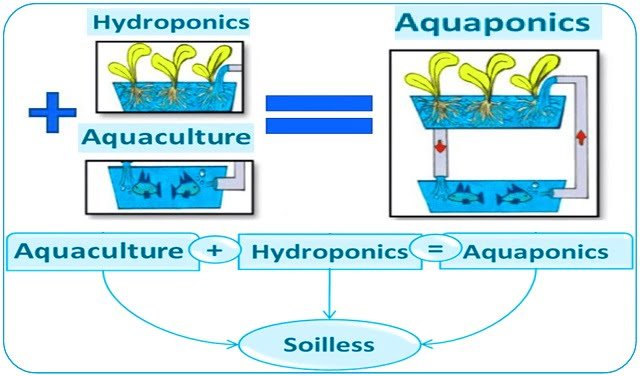
- True Circular Economy: Fish waste (ammonia) is converted into plant nutrients, eliminating the need for chemical fertilizers and wastewater treatment.
- Water Efficiency: Nutrient Film Technique (NFT) technology enables massive water savings compared to traditional aquaculture, which requires the periodic renewal of large volumes of water.
- Identified Hotspots: The Life Cycle Assessment (LCA) revealed that electricity and fish feed account for 90% of the system’s environmental burdens.
Experimental Design: Tilapia and Lettuce
The study focused on a pilot-scale system located in a 240 m² greenhouse at the Móstoles campus of the Universidad Rey Juan Carlos. The species were carefully selected:
- Nile Tilapia (Oreochromis niloticus): Chosen for its rapid growth, resilience, and ease of processing.
- Lettuce (Lactuca sativa): Selected for its short growing cycle and high demand in international markets.
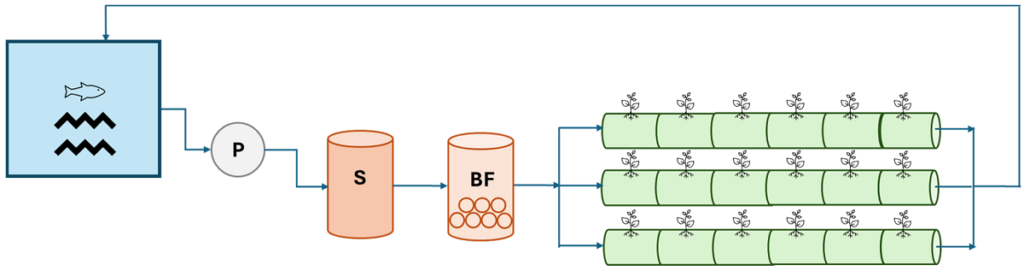
Water flows continuously in a thin layer (Nutrient Film Technique or NFT), allowing lettuce roots to absorb nutrients directly from the stream.
The Secret Ingredient: Photovoltaic Energy
While aquaponics is water-efficient, it is typically energy-intensive due to water pumps, aerators, and climate control systems. To mitigate this, researchers installed a 2.8 kW photovoltaic unit covering 8.61 m². This unit not only powers the system but also acts as a shield against energy volatility. During the study, solar energy covered 52.41% of the system’s total consumption (3062.80 kWh/year), leaving only the remainder to the conventional electrical grid.
Life Cycle Assessment (LCA): Measuring Real Impact

To avoid “greenwashing,” the team utilized the Life Cycle Assessment (LCA) methodology. The LCA analyzes everything from the manufacturing of polyester tanks to the production of fish feed.
Impact Results
The study quantified several key categories, comparing the system with and without solar energy:
| Impact Category | Without Solar (Grid Mix) | With Solar (AQ-PHV) | Achieved Reduction |
| Climate Change (kg CO₂-eq) | 795.71 | 480.31 | ~40% |
| Freshwater Eutrophication (kg P-eq) | 0.30 | 0.18 | ~40% |
| Energy Demand (MJ) | 24,110 | 13,888 | ~42% |
The conclusion is clear: electricity is the primary environmental “villain” in aquaponics. By transitioning to solar energy, a drastic improvement is achieved across nearly all sustainability metrics.
Aquaponics vs. Traditional Agriculture: A Clash of Titans
The study conducted a fascinating comparison between its model (AQ-PHV) and traditional production methods for tilapia and lettuce.
Mantente siempre informado
Stay Informed
Únete a nuestras comunidades para recibir al instante las noticias, informes y análisis más importantes del sector acuícola.
Join our communities to get instant access to the most important news, reports, and analysis from the aquaculture industry.
- Tilapia Production: Compared to conventional pond aquaculture, the aquaponics system designed in this study is superior in almost every aspect, achieving an average 60% reduction in environmental impacts. This is primarily because it does not require the massive water renewal that typically causes high eutrophication in nearby ecosystems.
- Lettuce Production: Results here are more nuanced. Traditional soil-based agriculture still has a lower impact regarding material consumption and direct energy, as it lacks complex infrastructure made of plastic and concrete. However, aquaponics offers an insurmountable advantage: it can be implemented on non-arable land near cities, shortening supply chains and eliminating nitrogen fertilizer pollution.
Nutrient Efficiency: Maximizing Every Gram
One of the design’s greatest achievements was the Nitrogen Use Efficiency (NUE) and Phosphorus Use Efficiency (PUE), reaching values of 36.45% and 48.87%, respectively. These levels are considered highly adequate and demonstrate that the system effectively recycles nutrients rather than discharging them into the environment.
Limitations and the Future of the Technology
Despite the optimism, researchers warn that the study’s scope is limited by its pilot-scale nature. Fish feed production remains a critical hotspot, as its manufacturing consumes significant amounts of water and energy.
The future of this technology depends on:
- Industrial Scaling: Observing how these savings perform in large-scale facilities.
- Alternative Feeds: Researching feeds based on insects or algae to reduce the “Fish Feed” category’s impact.
- Urban Integration: Utilizing rooftops to produce local food by leveraging a building’s own solar energy.
Reference (open access)
Espada Sanjurjo, J. J., Díaz de Mera-Sánchez, M. P., & Rodríguez Escudero, R. (2026). Design and Environmental Analysis of an Aquaponics System Coupled with Photovoltaic Unit for Food Production and Reuse of Nutrients from Wastewater: A Life Cycle Assessment Study. Applied Sciences, 16(2), 635. https://doi.org/10.3390/app16020635

Editor at the digital magazine AquaHoy. He holds a degree in Aquaculture Biology from the National University of Santa (UNS) and a Master’s degree in Science and Innovation Management from the Polytechnic University of Valencia, with postgraduate diplomas in Business Innovation and Innovation Management. He possesses extensive experience in the aquaculture and fisheries sector, having led the Fisheries Innovation Unit of the National Program for Innovation in Fisheries and Aquaculture (PNIPA). He has served as a senior consultant in technology watch, an innovation project formulator and advisor, and a lecturer at UNS. He is a member of the Peruvian College of Biologists and was recognized by the World Aquaculture Society (WAS) in 2016 for his contribution to aquaculture.