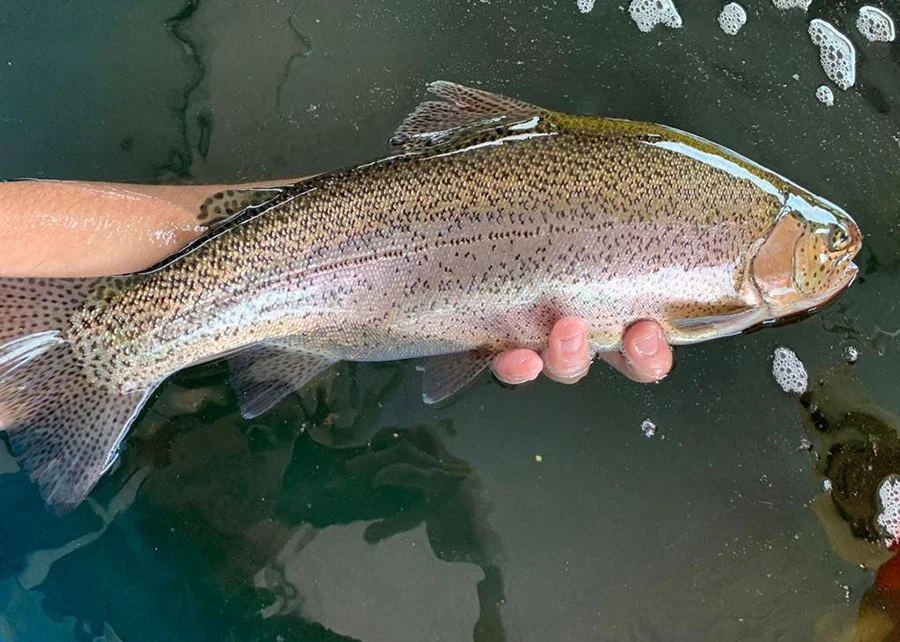
Historically, fish meal has been the standard ingredient for carnivorous fish; however, its high cost and finite availability have driven the search for sustainable alternatives.
Among plant-based alternatives, soybean meal (SBM) stands out for its availability and acceptable nutritional profile. Economically, it is highly attractive: while fish meal trades around $1.70 USD/kg, soybean meal costs approximately $0.35 USD/kg. Nevertheless, a significant biological barrier remains: salmonids, such as rainbow trout (Oncorhynchus mykiss), are sensitive to anti-nutritional factors in soy. High consumption of this ingredient triggers an intestinal pathology known as soybean meal-induced enteritis (SBMIE), which reduces growth and feed efficiency and compromises animal welfare.
To overcome this challenge, researchers from the Aquaculture Research Institute (University of Idaho) and the USDA-Agricultural Research Service have studied a trout line genetically selected over two decades to tolerate plant-based diets. A new study published in the Journal of the World Aquaculture Society employs proteomic tools to delve into the molecular mechanisms that allow these trout to resist inflammation, offering new perspectives for the aquafeed industry.
Key Findings of the Study
- Genetic Superiority: The selected strain (Sel) consistently outperformed the commercial strain (Com) in growth and feed conversion, without developing enteritis even on high-soy diets.
- Confirmed Pathology in Non-Selected Fish: The commercial strain fed soy developed severe enteritis, characterized by shortened intestinal villi and inflammatory infiltration.
- Blood Biomarkers: The Nlrp1 protein was identified in plasma as a key molecular indicator of systemic inflammation in fish affected by the soy diet.
- Stress and Damage Mechanisms: While commercial fish showed molecular signs of stress, DNA damage, and activated immune signaling in the gut, the selected line did not display these inflammatory signatures.
- Metabolic Adaptation: Resistance is not merely passive; it involves coordinated histological and molecular adaptations that prevent the energetic cost of inflammation.
The Soybean Meal Challenge and Genetic Response
Replacing fish meal with plant proteins is not just a matter of formulation, but of physiological interaction. Soybean meal-induced enteritis is characterized by the degradation of intestinal villi, thickening of the lamina propria, and a reduction in nutrient absorption capacity.
In this study, researchers compared two rainbow trout lines over 7 months: a standard commercial strain (Com) and a strain selected (Sel) by the USDA-ARS specifically to utilize fish meal-free, high-soy diets. Both lines received two diets: one based on fish meal (FM) and another plant-based diet with high soybean meal content (PM).

The production results were compelling. The selected strain showed superior weight gain regardless of the diet. Specifically, on the plant-based diet, the selected strain gained an average of 497.3 g, while the commercial strain only gained 387.9 g. Furthermore, only the commercial strain developed the classic signs of enteritis when consuming the plant-based diet, confirming that genetic selection has conferred actual physiological resistance.
Intestinal Histology: Visible Evidence of Damage
Histological analysis of the distal intestine—the area most affected by enteritis—revealed critical differences. In the commercial strain-fed soy, intestinal villi became shortened and widened, a phenomenon known as “clubbing.” Additionally, increased infiltration of inflammatory cells and changes in goblet cell distribution were observed.
Conversely, the selected strain maintained a healthy intestinal morphology, very similar to that of fish fed fish meal. This suggests that the improvement in growth is not due to higher feed intake (which was similar), but rather to avoiding the energetic cost and physical damage of inflammation, thus maintaining efficient nutrient absorption.
Proteomics: Deciphering Molecular Signals in Plasma
One of the most novel aspects of this research was the use of label-free shotgun proteomics to analyze blood plasma and intestinal tissue. The goal was to find non-lethal biomarkers that could indicate the fish’s health status.
Mantente siempre informado
Stay Informed
Únete a nuestras comunidades para recibir al instante las noticias, informes y análisis más importantes del sector acuícola.
Join our communities to get instant access to the most important news, reports, and analysis from the aquaculture industry.
The analysis identified 18 differentially expressed proteins in the plasma. Among them, the upregulation of the Nlrp1 inflammasome sensor in the commercial strain fed soy stands out. The Nlrp1 protein acts as a crucial sensor to initiate the innate immune response and activate pro-inflammatory cytokines. Its elevation in plasma provides molecular evidence that enteritis is not just a local intestinal issue, but provokes systemic inflammation in susceptible fish.
Other altered proteins included Trpm7, implicated in cellular stress, and the downregulation of complement factor B (Cfb), suggesting complex modulation of the immune system in response to the plant-based diet.
Differences in Metabolic and Stress Pathways
Beyond individual proteins, Gene Set Enrichment Analysis (GSEA) allowed researchers to see the “big picture” of activated biological pathways.
In the intestine of commercial fish fed soy, there was clear activation of pathways related to:
- Stress and DNA damage: DNA repair pathways and cellular senescence.
- Innate immune signaling: Specifically, Toll-like receptor (TLR) cascades, which are the first line of defense against aggression.
The fascinating finding is that these inflammatory and stress signatures were absent in the selected strain fed the same high-soy diet. This indicates that genetic resistance could be due to an inherent ability to modulate the immune response, avoiding excessive inflammation, or to a more robust intestinal barrier that prevents soy anti-nutritional factors from triggering these damaging responses.
Implications for Sustainable Aquaculture
This study underscores that sustainability in aquaculture depends not only on finding new ingredients but on adapting our cultured animals to them. The combination of genetics and nutrition is fundamental.
The findings demonstrate that:
- Genetic selection works: It is possible to breed trout that grow efficiently on sustainable plant-based diets without compromising their health.
- Non-lethal biomarkers exist: The identification of Nlrp1 in plasma suggests that in the future, we could monitor the development of enteritis via blood tests, without the need to sacrifice fish for histology.
- Mechanism of resistance: Tolerance to soy in these trout appears to be based on preventing the inflammatory cascade and cellular damage, allowing energy to be allocated to growth rather than tissue repair and immune response.
These advances, led by institutions such as the University of Idaho and the USDA, pave the way for reducing dependence on fish meal, making trout production more economical and environmentally responsible.
Contact
Jacob Bledsoe
Aquaculture Research Institute, University of Idaho
Hagerman, ID, USA
Email: bledsoe@uidaho.edu
Reference (open access)
Bledsoe, J., Redman, N., Simmons, D., Tudor, C., Welker, T., Romano, N., & Overturf, K. (2025). Proteomic mechanisms underlying soybean meal-induced enteritis resistance in selected rainbow trout. Journal of the World Aquaculture Society, 56(6), e70068. https://doi.org/10.1111/jwas.70068

Editor at the digital magazine AquaHoy. He holds a degree in Aquaculture Biology from the National University of Santa (UNS) and a Master’s degree in Science and Innovation Management from the Polytechnic University of Valencia, with postgraduate diplomas in Business Innovation and Innovation Management. He possesses extensive experience in the aquaculture and fisheries sector, having led the Fisheries Innovation Unit of the National Program for Innovation in Fisheries and Aquaculture (PNIPA). He has served as a senior consultant in technology watch, an innovation project formulator and advisor, and a lecturer at UNS. He is a member of the Peruvian College of Biologists and was recognized by the World Aquaculture Society (WAS) in 2016 for his contribution to aquaculture.