Strategically aligned with World Antimicrobial Awareness Week (WAAW), the prestigious international journal Antibiotics has published the scientific article “Insights and Lessons from Chilean Salmon Aquaculture on Antimicrobial Use.” This publication marks a watershed moment for the industry, formalizing a strategy designed by a group of experts that transcends national borders.
This document does not merely offer a local solution; it stands as a crucial reference for other producing nations seeking to establish clear priorities and define concrete actions for responsible pharmacological stewardship within their production systems.
Key conclusions
- Global Model: A transdisciplinary strategy is published, establishing a new international standard for responsible drug use in aquaculture.
- Unprecedented Collaboration: Spearheaded by the Monterey Bay Aquarium, the proposal articulates the vision of 27 experts from public bodies, academia, and the private sector.
- “One Health” Approach: Priority is placed on integrated environmental surveillance to prevent Antimicrobial Resistance (AMR).
- Therapeutic Innovation: Given the variable efficacy of vaccines against SRS, alternatives such as phytotherapy and early treatments are prioritized.
An unprecedented collaborative effort
The transdisciplinary research establishes a strategic roadmap serving as a global template. The document consolidates analyses and workshops conducted during the First Congress on “Sustainable Management of Bacterial Diseases in Aquaculture,” held in Puerto Varas in November 2024.
The strength of this proposal lies in its unique governance. Under the leadership of the Monterey Bay Aquarium, an unprecedented working group was successfully articulated, bringing together public organizations, academia, the private sector, and civil society.
This synergy convened key institutions, including:
- Intesal and Wavet Research
- University of Chile (via its reference center, CASA)
- Pontificia Universidad Católica de Chile and Universidad Andrés Bello
- INCAR Center and CIMARQ
- Pincoy Initiative
- The Roslin Institute at the University of Edinburgh

This broad backing validates a work model essential for resolving complex sanitary challenges such as Piscirickettsiosis, which accounts for the majority of antibiotic use during the marine fattening stage.
Comprehensive “One Health” approach and environmental gaps
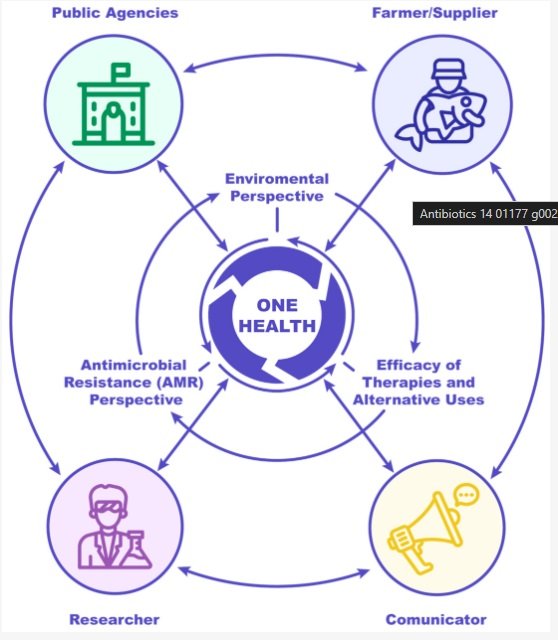
The roadmap proposes an approach based on the “One Health” concept. This paradigm recognizes the dual role of aquaculture as both a source and a recipient of antimicrobial resistance (AMR), demanding coordinated surveillance that integrates human, animal, and environmental health.
The paper warns of the urgency to bridge current environmental data gaps to quantify the exact impact on aquatic ecosystems. To this end, experts emphasize the need to:
- Utilize advanced molecular tools.
- Establish adaptive regulatory frameworks to prevent irreversible ecological damage.
Therapeutic alternatives and the human capital challenge
The work highlights the need to bolster therapeutic alternatives in light of the limited efficacy of current vaccines against Piscirickettsia salmonis. Promising domestic innovations are highlighted, such as:
Mantente siempre informado
Stay Informed
Únete a nuestras comunidades para recibir al instante las noticias, informes y análisis más importantes del sector acuícola.
Join our communities to get instant access to the most important news, reports, and analysis from the aquaculture industry.
- Phytotherapy (use of plant extracts).
- Intestinal microbiota modulation.
- Passive immunotherapy.
Furthermore, it underscores that early interventions are critical to reducing both mortality and total antimicrobial use.
Regarding human capital, experts project the need for a sustained educational effort—estimated to span a decade—to achieve a generational shift in the management of these drugs. This implies covering gaps in specialized veterinary training and improving public communication.
Future outlook
Given the impact of these results, the organizing institutions have confirmed plans for a second edition of the congress in 2026, aiming to evaluate the progress of this ambitious initiative. This roadmap seeks not only the sustainability of the Chilean industry but also to lay the foundations for recommendations universally applicable to global aquaculture.
Referencia (acceso abierto)
Farias, D. R., Ibarra, R., Tucca, F., Jaramillo-Torres, A., Cornejo, J., Ibieta, P., Mardones, F. O., & Avendaño-Herrera, R. (2025). Insights and Lessons from Chilean Salmon Aquaculture on Antimicrobial Use. Antibiotics, 14(12), 1177. https://doi.org/10.3390/antibiotics14121177

Editor at the digital magazine AquaHoy. He holds a degree in Aquaculture Biology from the National University of Santa (UNS) and a Master’s degree in Science and Innovation Management from the Polytechnic University of Valencia, with postgraduate diplomas in Business Innovation and Innovation Management. He possesses extensive experience in the aquaculture and fisheries sector, having led the Fisheries Innovation Unit of the National Program for Innovation in Fisheries and Aquaculture (PNIPA). He has served as a senior consultant in technology watch, an innovation project formulator and advisor, and a lecturer at UNS. He is a member of the Peruvian College of Biologists and was recognized by the World Aquaculture Society (WAS) in 2016 for his contribution to aquaculture.